
By Nic Maclellan in Koror, Palau
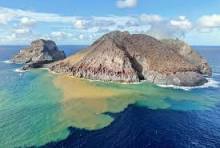
Vanuatu has lodged an application to the world’s highest court, the International Court of Justice, seeking recognition of its sovereignty over Umaenupne (Matthew) and Umaeneag (Hunter), two uninhabited volcanic islands located east of New Caledonia and southeast of Vanuatu.
The decision to launch an ICJ case comes after the Vanuatu government walked away from bilateral negotiations with France over the sovereignty claim and the disputed maritime boundary with the neighbouring French Pacific colony of New Caledonia.
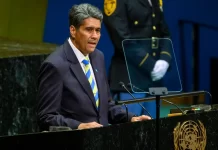
Speaking on the sidelines of this week’s Pacific Islands Forum in Palau, the head of the Vanuatu delegation Ralph Regenvanu said: “We’ve decided that we’ve discussed this issue long enough and we have now submitted an application to the court for the court to resolve this issue. Of course, it’s up to France to consent or not – tha’t’s the process.”
A statement from the ICJ confirmed that on 31 August “Vanuatu filed an application before the International Court of Justice relating to a dispute between itself and France concerning Vanuatu’s sovereignty over Umaenupne (Matthew) and Umaeneg/Leka (Hunter) Islands…and concerning the establishment of a single maritime boundary between the exclusive economic zones and continental shelf of Vanuatu and France (with respect to New Caledonia).”
The ICJ noted that “Vanuatu’s application has been transmitted to France. However, no action will be taken in the proceedings unless and until France consents to the Court’s jurisdiction in the case.”
France has not accepted the ICJ’s compulsory jurisdiction over disputes with other states, and the French government is yet to announce whether it will participate in the arbitration. Vanuatu awaits that decision, but Regenvanu noted: “The other route is to seek an advisory opinion. We’ve done that with the climate change case, so we know what we have to do, which is get a majority vote of the UN General Assembly to have the advisory opinion issued.”
France’s Minister Delegate for Francophonie Éléonore Caroit is leading the French delegation to this week’s Forum summit in Palau.
She acknowledged that Vanuatu had lodged the case, but said: “Unfortunately, I do not have much more to tell you except that it is a unilateral decision by Vanuatu, while we were engaged in a process that was going very well, but in which the position of France is unchanged.”
“Our position is we maintain our sovereignty on these territories of Matthew and Hunter,” she said. “So what are the concessions that you could possibly make? Because if you remain open to dialogue, it would be impossible. In fact, it is not about concessions.”
Customary pathways
The debate over Matthew and Hunter is driven by customary leaders and national councils of chiefs in both Vanuatu and New Caledonia.
Meeting in Noumea in April 2009, chiefs from Vanuatu’s Malvatumauri and New Caledonia’s Sénat coutumier (Kanak Customary Senate) signed a joint statement reaffirming – in customary law and Melanesian culture – Vanuatu’s right to Matthew and Hunter.
Their statement noted that “the demarcation of the maritime boundaries separating New Caledonia and the Republic of Vanuatu has never been submitted for approval to the customary authorities of the two countries, and so it follows that the misappropriation of territory – as understood within the indigenous Melanesian perspective, based on myths, oral traditions and the historical movement of populations – may have occurred at the time said boundaries were drawn.”
“With regard to the annexation of the Matthew and Hunter Islands to New Caledonia and its dependencies,” they declared, “it must be considered that this act has no historical or customary basis and that, according to Melanesian tradition, these islands therefore belong to the Republic of Vanuatu.”
In July 2009, Vanuatu’s then Prime Minister Edward Natapei and representatives of New Caledonia’s independence movement Front de Libération National Kanak et Socialiste (FLNKS) travelled to Tanna in Tafea province, joining customary leaders to witness the signing of the Keamu Accord. The agreement was described as “a solemn commitment between the Kanak people and the people of Vanuatu, that whatever the political and institutional future of New Caledonia, Matthew and Hunter Islands will always remain the property of the people of Vanuatu.”
This position has been reaffirmed ever since by the FLNKS. Last month, the provincial president of New Caledonia’s Loyalty Islands Mickaël Forrest told Islands Business: “These islands are part of the cultural heritage of Melanesian peoples. This is nothing new. The status of these two islands is a matter between Melanesian peoples. For Kanak, for the FLNKS, for the Sénat coutumier, Matthew and Hunter are part of the Republic of Vanuatu’s natural heritage, full stop.”
Speaking this week in Palau, Vanuatu’s Ralph Regenvanu acknowledged the importance of this pan-Melanesian connection, noting: “The cultural case – which is supported by the Kanak leadership and the customary chiefs of Kanaky who recognise that Matthew and Hunter belong to Vanuatu – is part of the evidence that will be brought before the arbitration.”
Delayed negotiations
For Vanuatu, the 2009 Keamu Accord boosted its efforts to press France to defer the 2007 bid to extend New Caledonia’s continental shelf and come to the negotiating table on the disputed maritime boundary.
Two rounds of initial talks were held in 2018 and 2019 but faltered until President Macron visited New Caledonia and Vanuatu in July 2023, where he pledged action on the issue. After newly elected Vanuatu Prime Minister Jotham Napat visited Paris in June 2025, the two nations agreed to hold an officials meeting in November, followed by negotiations in July this year.
However further progress was derailed when the November meeting – initially ignored by the French media – became controversial a month later. The conservative French newspaper Le Figaro speculated that the two islands could be ceded to Vanuatu and raised alarm over “the major geopolitical risks such a precedent could create.” Far-right politicians erupted at the perceived threat to French sovereignty, targeting French President Emmanuel Macron and angering the French government, which was doing everything possible to hold onto the islands.
Marine Le Pen is leader of the extreme-right party Rassemblement National and a candidate in next year’s French Presidential elections. Never one to miss an opportunity to denigrate Emmanuel Macron, Le Pen tweeted that national sovereignty “is neither negotiable nor something to be relinquished. The French people do not expect the Macronist government to carve up our overseas territories, which are real levers of power, influence and economic development, behind their backs.”
Her attack was echoed on social media by another far-right leader, Marion Maréchal, who argued that “the prospect of transferring our Pacific islets, Matthew and Hunter, to Vanuatu would represent a major strategic breach and blunder for France, threatening its heritage, security and credibility alike. It would be an affront to our national heritage, as these islets off the coast of New Caledonia are not mere specks of rock. They grant France a vast exclusive economic zone, rich in potential fisheries, energy and mineral resources.”
Surrendering the islands “would be a breach of our national security,” Maréchal thundered, “as any territorial cession sets a precedent. It would inevitably lead to further claims. The very credibility of the nation is at stake. By giving in, the President of the Republic would be committing a historic error in the eyes of France and the French people.”
In response, the French foreign ministry affirmed that “no cession of territory or renunciation of our sovereignty was discussed” during discussions with Vanuatu leaders. The Napat government was angered, since the unresolved issue of sovereignty over Matthew and Hunter is at the very heart of the maritime border dispute.
In Koror, French Minister Caroit acknowledged that the debate had been complicated by “bad faith” interventions in Paris.
“When you have a dispute, you first find a path of dialogue, contrary to what opportunistic politicians in France say,” she said. “In particular, I think of Marine Le Pen, who has made completely opportunistic and bad faith statements on this subject. The first thing is to establish a dialogue, in which you can think about forms of cooperation, because we have common issues, and all Pacific Islands face the same threats, the same issues.”
However, after talks in Paris in July, Vanuatu’s Deputy Prime Minister Johhny Koanapo announced the government would end bilateral discussions and rejected France’s proposal to conclude a maritime boundary agreement while the sovereignty issue remained unresolved: “Our journey to full independence will not be complete until Vanuatu’s rightful ownership of Matthew and Hunter Islands is fully recognised.”
In Koror, France’s Minister for Francophonie Caroit reaffirmed her government’s position on sovereignty but would not confirm whether Paris will participate in the ICJ process: “It has never been a question of renouncing sovereignty. France is attached to multilateralism, it is attached to international law. At this stage, really, I cannot tell you more, because it is a process that is at its very beginning.”