
By Pita Ligaiula in Koror, Palau
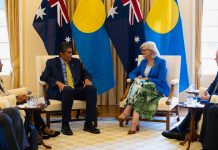
Palau President and Pacific Islands Forum Chair Surangel Whipps Jr has challenged Forum leaders to turn their decisions into results, saying the real test of the meeting will not be what was announced in Palau but what Pacific people see in their communities in the months and years ahead.
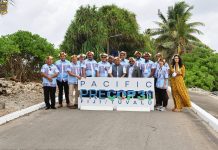
Closing the 55th Pacific Islands Forum Leaders Meeting in Koror, Whipps said the Forum had spent the week discussing major regional challenges, but implementation would determine whether those discussions made a difference.
“The real test is not what we announce in Palau.
“The real test is what our people will see in the months and years ahead,” Whipps said.
He said leadership was not simply about reaching agreements.
“Leadership is not about making decisions. Leadership is about delivering on them.
“And when we make commitments, we must carry them through,” Whipps said.
Whipps said Forum decisions and regional commitments must be felt in Pacific communities.
“When we say we stand for the Pacific, that support must be felt in our villages, our schools, our ports, our power systems, our coastlines and in the daily lives of our people,” he said.
Whipps said the Pacific was facing mounting pressure from climate change, rising seas, economic uncertainty, energy insecurity, threats to the ocean and increasing competition among larger powers.
But he said the message from Palau was clear.
“The Pacific agenda will be shaped by Pacific people
“Our partnerships must respect Pacific priorities. Our ocean must be protected for future generations. And our unity must remain our greatest strength,” Whipps said.
Whipps said the Forum’s diversity should be seen as a source of strength rather than division.
“The Pacific Islands Forum is strongest when we stand together.
“Our diversity is not our weakness. It is our source of strength, it is our source of resilience and it is our source of wisdom.”
“We may have different experiences, different priorities and different perspectives. But we share one ocean, one region, one planet and one future,” he said.
Whipps used his closing address to press for faster action on renewable energy, saying Pacific countries had spent too long discussing barriers while communities remained dependent on imported fuel.
He said energy was not simply about electricity generation but about security, economic opportunity and the resilience of Pacific communities.
“The question is not simply how much energy we can use.
“It is whether a clinic can keep medicines cool, whether a school can keep its lights on, whether a business can grow and whether a family can plan its future with confidence,” he said.
Whipps said Pacific countries needed to move from discussion to implementation.
“We have thought long enough about the barriers to renewable energy.
“Now, we must finance the projects, build the systems, train our people and make reliable, affordable and clean energy a reality for every Pacific community,” he said.
He said dependence on imported fuel left Pacific countries vulnerable to disruptions and events beyond their control.
Whipps also placed ocean stewardship at the centre of the Forum’s economic and development agenda.
He said the Pacific Ocean was not simply the space between islands but a source of identity, food security, culture, climate resilience and economic opportunity.
Using the Palauan practice of protecting resources so they can recover and endure for future generations, Whipps said the same principle must guide decisions on fisheries, coral reefs, energy, food, infrastructure and finance.
“We do not have the luxury of treating protection and prosperity as competing goals,” he said.
“An economy that depletes the ocean, weakens communities or leaves us exposed to shocks is not an economy built to last,” he said.
Whipps said the Forum had discussed how ocean stewardship could create livelihoods, how renewable energy could strengthen security, and how sustainable fisheries could deliver greater value to Pacific peoples.
He said the region also needed to ensure finance reached communities and that partnerships supported Pacific priorities.
Whipps said the work begun in Palau must now be carried into upcoming international meetings, including the United Nations General Assembly, pre-COP discussions and COP31.
“At each of these moments, the Pacific must speak with clarity, confidence and unity.
“Climate ambition must be matched with climate finance. Commitments must become implementation, and the priorities of our people must remain at the centre of global decision-making,” he said.
He said the Forum’s Ocean Forum, partnership discussions and leadership dialogue were intended to move regional cooperation beyond broad political agreement and towards practical action.
“They were part of a larger Pacific effort to turn our shared vision into work,” Whipps said.
As Palau assumes the chairmanship of the Pacific Islands Forum, Whipps said his country’s role would be to work with every member and ensure all voices were heard.
“Our role is not to speak over anyone, but to work with every member.
“To uphold the interests of the Pacific, to strengthen our unity and ensure that every voice in our Forum is heard and respected,” he said.
He said Palau would work with the Forum Troika, Secretariat and all members to carry forward the decisions reached by leaders.
Whipps said unity would be critical as the region navigated growing geopolitical and economic pressures.
“Alone, each of us faces immense challenges,” he said.
“Together, we can secure our energy future, protect our oceans, build economies that serve our people and ensure that the Pacific remains the author of its own destiny.”
Whipps closed by thanking Forum leaders, the Forum Secretariat, regional organisations, dialogue and development partners, civil society, the private sector, scientists, investors, young people and the people of Palau for contributing to the meeting.
He paid particular tribute to Palau’s traditional leaders, government workers, performers, hospitality staff, security personnel and students.
Whipps also recognised the work of Forum officials and staff who worked late into the night to complete the Leaders’ Communiqué.
“We have a communiqué that’s completed and done, and thanks to their hard work, we did it,” he said.
He also thanked the Forum’s first spouses for promoting health awareness, including action on non-communicable diseases, and for raising concerns about internet safety for children.
Whipps said Pacific countries needed to stop accepting the region’s poor health rankings for diabetes, heart disease and obesity.
“We have to stop getting the gold medals in diabetes, heart disease and obesity
“We want to get to the bottom of that list. But it takes all of us working together,” he said.
Whipps said Pacific people must remain at the centre of every regional decision.
“People must be in the centre of everything that we do,” he said.
The challenge for the Forum, he said, was now to carry the spirit of the Palau meeting beyond the conference hall and turn its decisions into results.
“We carry the spirit of this Forum beyond this hall to turn our decisions into results and to prove through action that the Pacific can lead,” he said.