
By Pita Ligaiula in Koror, Palau
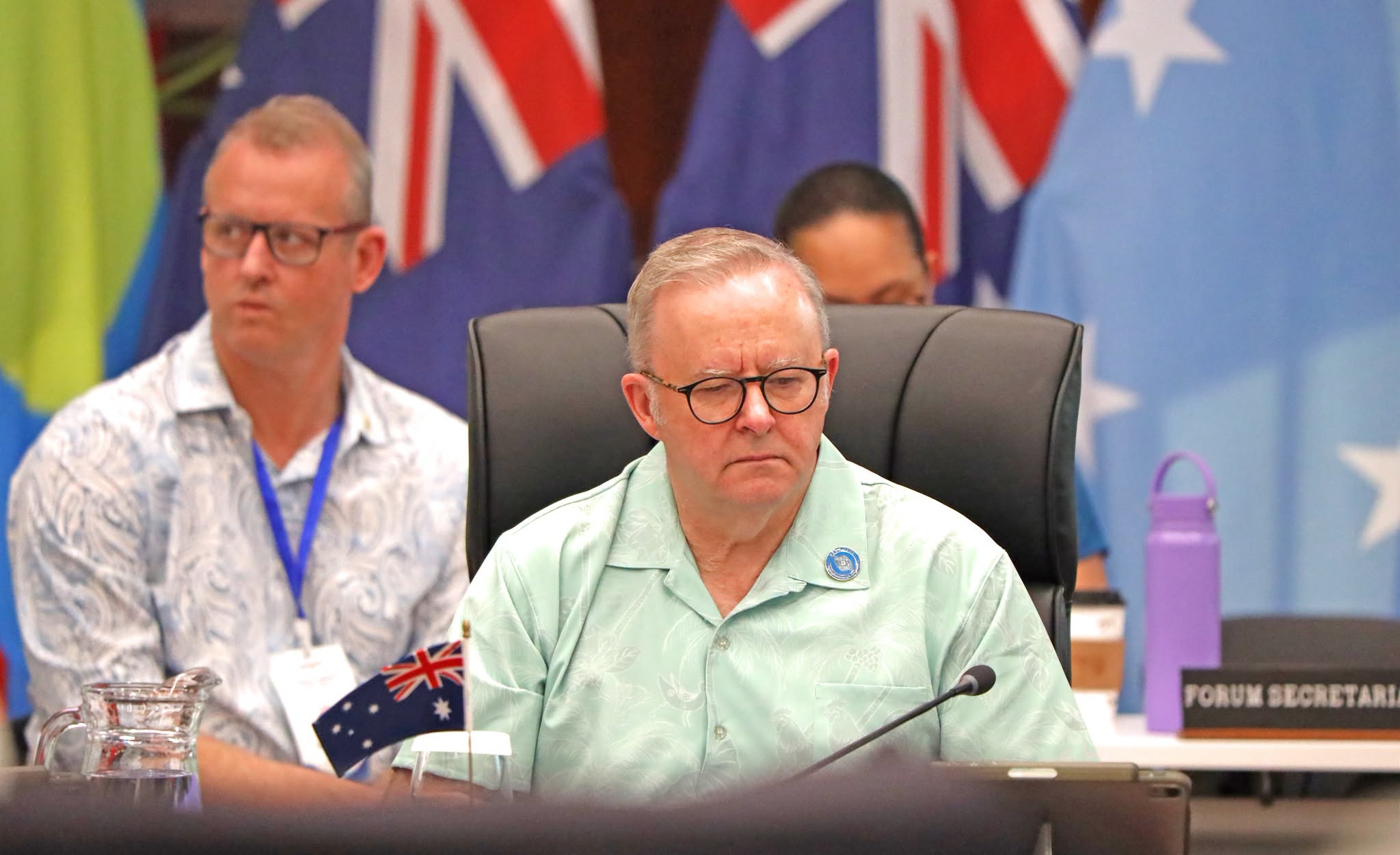
Australian Prime Minister Anthony Albanese says China’s recent ballistic missile test in the Pacific was “not acceptable” and “not the act of a friend,” as Pacific leaders prepare for major discussions at the 55th Pacific Islands Forum Leaders Meeting in Palau.
Speaking to journalists in Koror, Albanese rejected suggestions that the absence of some Pacific leaders could weaken a collective regional response to the missile test.
“I think that this is a well-attended meeting of the Pacific Islands Forum, and I don’t think it’s productive to talk it down. I’m talking it up.
“With regard to China’s ballistic missile test, we’ve made it very clear that that is not acceptable. It’s not the act of a friend. It was a provocative action, and it was inappropriate,” Albanese said.
He said Australia had made its position clear, along with a number of other Pacific countries.
Albanese was also questioned about the political uncertainty in Solomon Islands following the no-confidence challenge facing Prime Minister Matthew Wale.
The Australian leader said Canberra would not interfere in Solomon Islands’ domestic political processes.
“We have a good relationship with Prime Minister Wale. The Solomon Islands, of course, are a sovereign nation and their processes are up to them.
“One of the things we don’t do is interfere in those occurrences. But I regard Matthew Wale as a friend,” Albanese said
Asked whether he agreed with New Zealand Foreign Minister Winston Peters that outside interference could be behind the political developments in Solomon Islands, Albanese declined to speculate.
“Well, I agree with what I say. And what I say is I’m concentrating on the Pacific Islands Forum here,” he said.
On proposals for a region-wide security agreement, Albanese said Pacific leaders would have the opportunity to debate the issue during the Forum.
“Well, we’ll have debates over that. The Forum hasn’t begun yet. We’ll have those constructive discussions,” he said.
Albanese said Australia had significantly strengthened its security relationships in the Pacific in recent years.
“One of the things that you would recognise… is that the upgrading of the security relationships has been rather extraordinary.
“In a very short period of time, we have gone from being in a situation where we were not highly regarded in these forums. We have turned that around very quickly,” he said.
He said Australia’s relationships with Pacific countries were central to its national interest and reflected its responsibility as a major economy in a region facing significant development pressures.
“Those relationships really matter for Australia’s national interest. They really matter.
“We have a responsibility in the Pacific to show that leadership,” Albanese said.