


WHO Western Pacific regional director Dr Saia Ma’u Piukala has welcomed closer cooperation with Australia’s newly established Centre for Disease Control following talks with its inaugural Director-General on the sidelines of the World Health Assembly (WHA) in Geneva.
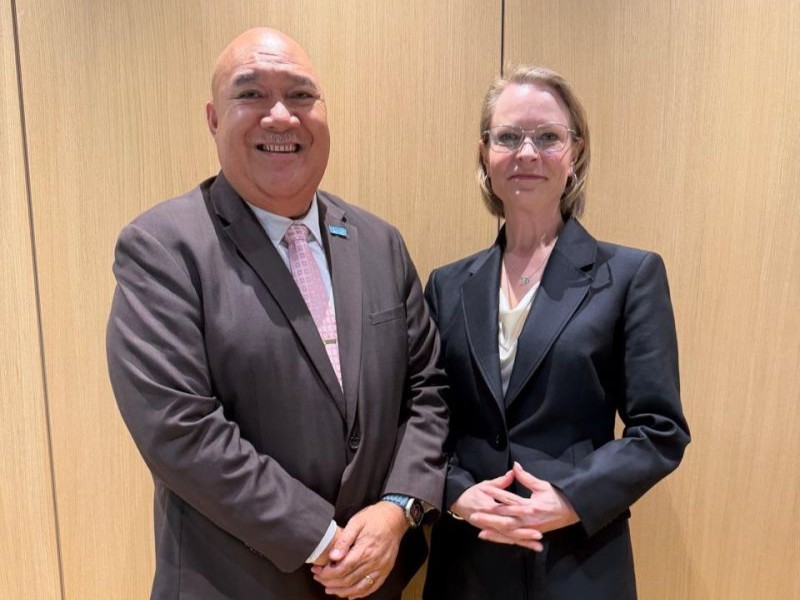
Dr Piukala met with Zoe Wainer, describing the meeting as an important step in strengthening regional health security and public health cooperation across the Pacific and Asia-Pacific region.
“An old friend, a new role – and a key partnership in health,” Dr Piukala said.
“Such a pleasure meeting Professor Zoe Wainer – the inaugural Director-General of The Australian Centre for Disease Control – at the World Health Assembly in Geneva.”
Australia established an interim CDC in 2024 with an investment of nearly AUD252 million before formally launching the independent statutory authority on 01 January 2026 in Canberra.
Professor Wainer took up the role two months later.
The Australian CDC has been tasked with overseeing national health surveillance, pandemic preparedness and public health advice.
Dr Piukala highlighted Professor Wainer’s earlier remarks outlining the agency’s mission.
“The role is to ensure that Australia is never surprised by a health threat, never isolated in responding to a health threat, and always contributing to a stronger regional and global public health system,” he said, quoting Prof. Wainer.
Dr Piukala said the WHO Western Pacific Regional Office looked forward to working closely with the Australian CDC to strengthen International Health Regulations capacities across the region.
“We at the WHO Western Pacific Regional Office look forward to collaborating with the Australian CDC in strengthening core capacities under the International Health Regulations (IHR) in the Region,” he said.
He noted that Australian support was already helping several Pacific island countries improve disease surveillance systems, laboratory diagnostics and emergency response operations.
“With Australia’s support, more countries – including several Pacific island nations – are building their surveillance alert and response systems, laboratory diagnostics and emergency management operations.”
“There’s a strong network – and strong solidarity – in the Region that can serve health security well, if we keep nurturing these relationships.”
Dr Piukala said one of the Australian CDC’s major domestic priorities would be improving data sharing between federal and state health systems, building on lessons from the COVID-19 pandemic.
Another major focus will be the One Health approach linking human, animal and environmental health.
“The approach recognises, and acts upon, the connection between human, animal and ecosystem health – sectors that simply must collaborate if disease is to be prevented and controlled,” Dr Piukala said.
He also welcomed opportunities to work together on climate and health issues ahead of COP31.
“We also look forward to working closely together on the intersection of climate and health, particularly in the lead up to COP31,” he said.
Dr Piukala added that WHO and the Australian CDC shared concerns about the growing spread of misinformation and disinformation affecting public health.
“Prof. Wainer and the CDC are also keen to counter the rising tide of misinformation and disinformation in our online, interconnected Region and world that undermine public health on so many fronts.”
Dr Piukala praised Prof. Wainer’s leadership and contributions to public health.
“My colleagues and I truly look forward to working with the Australian CDC and its new leader – a stalwart whom I have long admired and looked up to for her immense contributions to public health in her country and beyond,” he said.