


Pacific Island countries have welcomed the United Nations General Assembly’s adoption of a landmark resolution backing the International Court of Justice (ICJ) advisory opinion on climate change, with Fiji warning that statehood and maritime rights must remain protected despite rising sea levels.
The resolution, adopted by the UN General Assembly Wednesday by 141 votes to eight, reinforces that countries have legal obligations under international law to address climate change and prevent further environmental harm.
Speaking on behalf of Pacific Small Island Developing States (PSIDS), Fiji Permanent representative to the UN, Filipo Tarakinikini said the resolution was especially important for Pacific nations threatened by climate change and sea-level rise.
“For the PSIDS (Pacific small island developing States), the operative provisions on maritime zones and the continuity of statehood stand among the most consequential in this text,” Tarakinikini said.
Welcoming the adoption of resolution A/80/L.65, he said the language reflected commitments already made by Pacific leaders through regional declarations.
“The affirmations in operative paragraphs 6 and 7 reflect what Pacific Islands Forum Leaders declared in the 2021 Declaration on Preserving Maritime Zones in the Face of Climate Change-Related Sea-Level Rise and in the 2023 Declaration on the Continuity of Statehood and the Protection of Persons in the Face of Climate Change-Related Sea-Level Rise,” Tarakinikini told the UNGA.
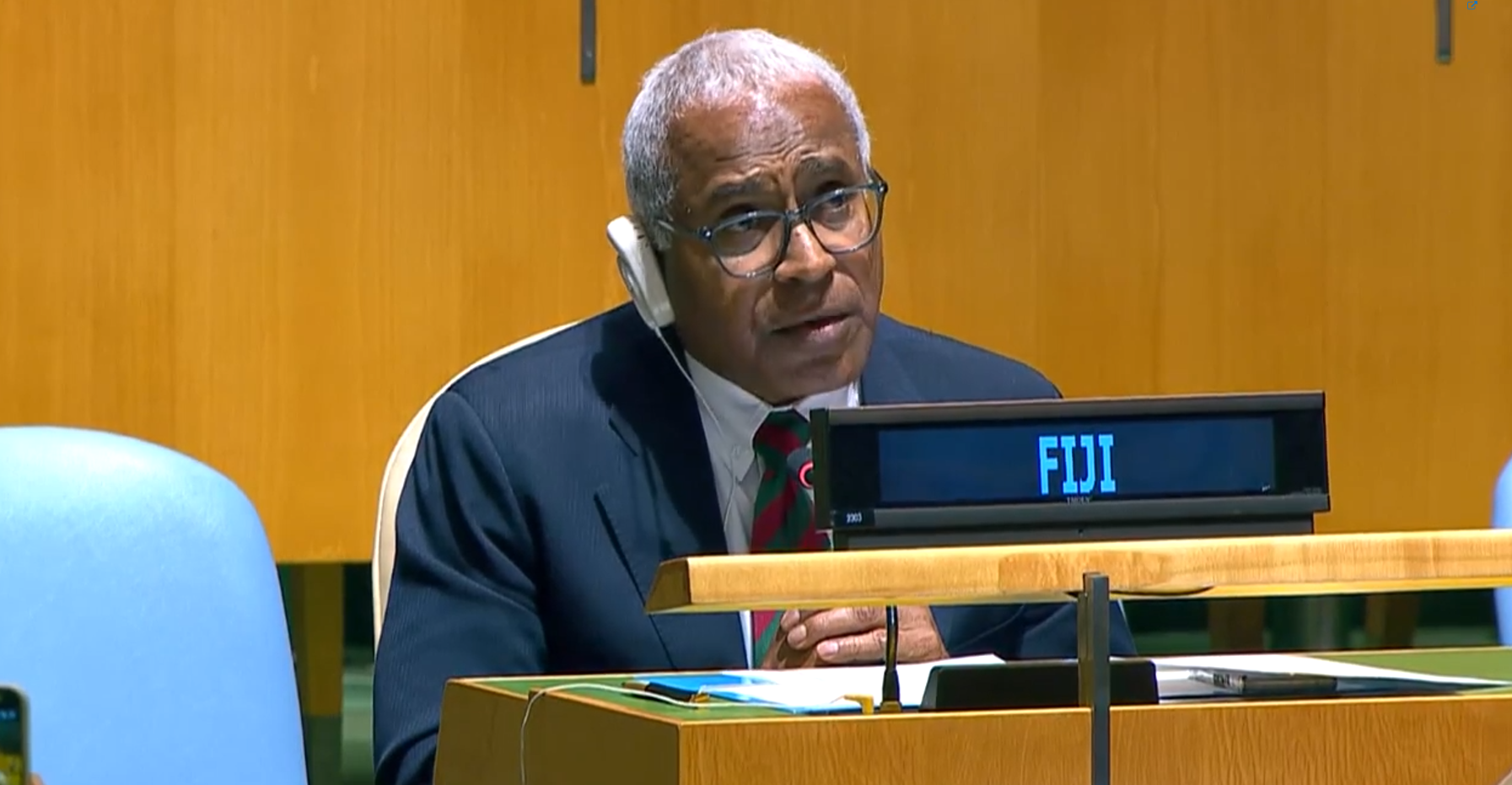
Tarakinikini stressed that Pacific countries were determined to protect their sovereignty and maritime rights despite the impacts of climate change.
“That is our maritime zones, established and notified in accordance with UNCLOS and the rights and entitlements that flow from them, shall continue to apply without reduction, and that our statehood and sovereignty will be maintained, notwithstanding any physical changes connected to climate change-related sea-level rise,” he said.
Tarakinikini said Pacific countries would continue pushing for implementation of the advisory opinion and stronger climate action.
“As a group that stands on the front line of the climate crisis and has consistently taken a leading role on this issue, we reaffirm our commitment to working closely with all Member States on the most important next step forward — our collective resolve toward its full and effective implementation,” he said.
The resolution was introduced by Vanuatu on behalf of a cross-regional Core Group of countries supporting the climate accountability initiative.
Vanuatu Permanent representative to the UN, Odo Tevi said the International Court of Justice (ICJ) opinion confirmed that climate protection is a legal obligation under international law.
“The draft resolution before you does what an Assembly should do when its own Court has spoken.
“The Opinion does not invent new law; it clarifies the law that already binds us,” Tevi said.
“It confirms that the protection of the climate system is a matter of legal obligation, not political discretion.”
“The role of this Assembly is complementary: to receive the Court’s clarification with integrity and to support cooperation and implementation across the United Nations system,” he explained, declaring: This day will be remembered as “the moment the United Nations received the considered judgment of its highest Court on the defining challenge of our time and decided what to do with it,” Tevi told the UNGA plenary.
Tevi said the advisory opinion reflected the real impacts already being experienced by vulnerable countries and communities around the world.
“The Court’s 23 July 2025 Advisory Opinion matters because the harm is real, and it is already here for low-lying islands and coastlines, for communities facing drought and failed harvests, for people whose homes, livelihoods and cultures are being reshaped by forces they did nothing to set in motion,” he said.
Tevi added that those suffering most from climate change were often the least responsible for causing it.
“The States and peoples bearing the heaviest burden are, very often, those who contributed least to the problem.”
“The Court did not look away from that reality. Nor should this Assembly,” he said.
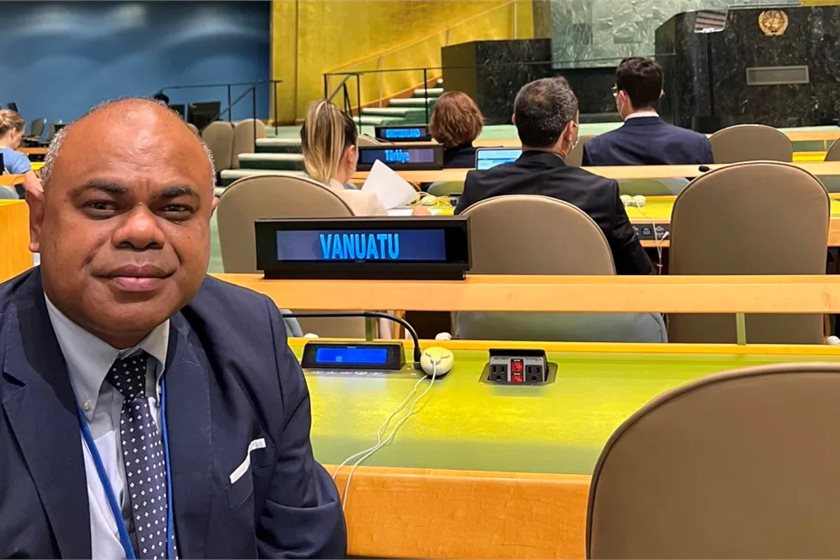
Tevi reminded delegates that climate damage is already devastating communities around the world.
“The damage is real and already being felt by low-lying islands and coastal areas, by communities facing drought and crop failures, and by those whose homes, incomes and culture are being disrupted by forces they did not set in motion,” he said.
Tevi also expressed disappointment over attempts to amend parts of the resolution during negotiations.
Several large oil-producing nations mounted a late push to weaken the text by introducing last-minute amendments.
Among them the U.S, Saudi Arabia and Russia were critical of the new resolution, arguing that it creates “quasi-binding” obligations from an advisory opinion that should be non-binding.
But the UN General Assembly rejected two proposed amendments to the resolution by votes of 91 against and 53 in favour, with 20 abstentions at the plenary in New York.
The final resolution calls on countries to act consistently with their obligations under international law and the Paris Agreement while strengthening follow-up through continued UN consideration and reporting by the Secretary-General.
“This outcome is of paramount importance for the credibility of international law and the multilateral system,” said Ambassador Tevi.
Pacific countries and climate advocates have described the vote as a major step in strengthening international climate accountability and protecting vulnerable nations facing the impacts of rising seas and extreme weather.