



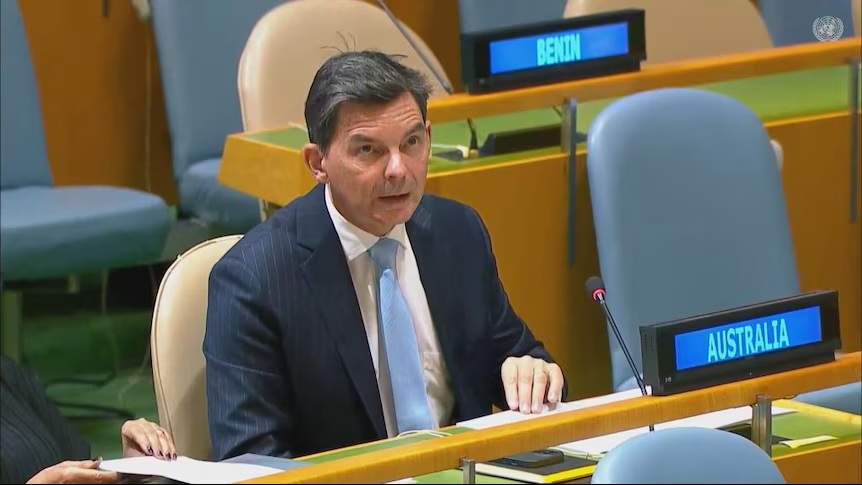
Australia has shown its support behind a landmark United Nations General Assembly resolution welcoming the International Court of Justice’s (ICJ) advisory opinion on climate change, while acknowledging differing views among states on some aspects of the Court’s conclusions.
The resolution, adopted by the UN General Assembly on Wednesday by 141 votes, reinforces that countries have legal obligations under international law to address climate change and prevent further environmental harm.
Speaking after the vote, Australia’s Permanent representative to the United Nations, James Larsen, praised Pacific nations for their leadership in advancing the issue to the world’s highest court.
“Climate change affects every nation, but nowhere acutely than in the Pacific. For our region, this is not a distant warning, but a daily reality,” Ambassador Larsen said.
He congratulated Vanuatu for its leadership, saying Pacific countries and Pacific youth had been at the forefront of calls for stronger global climate action.
“Pacific countries have long led the world in calling for stronger climate action,” he said,adding that Australia was “proud to stand with you in supporting this resolution.”
Larsen said the broad backing for the resolution underscored the need for collective action.
“The breadth of support matters. Climate change cannot be solved by any country acting alone. It demands global cooperation, and multilateral engagement remains key,” he said.
Australia welcomed the ICJ’s advisory opinion as “an important contribution” in clarifying the obligations of states in responding to the climate emergency, Larsen said, noting that the Court had favourably considered Pacific Islands Forum initiatives on climate change-related sea level rise.
He described sea level rise as “an issue of profound significance for our region” and said Australia looked forward to continued discussions at the United Nations, including negotiations on a political declaration expected to be adopted by world leaders in September.
At the same time, Larsen said Australia was still carefully considering the Court’s opinion and stressed that support for the resolution did not mean Australia agreed with every aspect of the advisory opinion.
“Our support for this resolution should not be interpreted as our agreement with every element of the advisory opinion, nor should it be read as our acceptance of the way the resolution interprets each of the Court’s conclusions,” he said.
“Rather, our support reflects our recognition of the seriousness of the climate crisis, the need for concrete action, and the positive role of the International Court of Justice opinion in support of global efforts.”
Larsen said Australia remained committed to meeting its obligations under international law to protect the climate system and acknowledged the importance of historical responsibility, particularly for developed countries.
“Historical responsibility remains important, and as a developed country, Australia will continue to do our part,” he said.
He also stressed that achieving the goals of the UN climate framework and the Paris Agreement would require “sustained ambition, especially from major emitters past, present and future.”
As it prepares to lead negotiations for COP31, Larsen said Australia would continue working with all countries to accelerate climate action.
“The case for multilateralism has never been clearer,” he said, adding that Australia would work “to accelerate global climate action at home and in support of our region,” he said.