Home Blog Page 1226

Doco highlights calls for halt to deep sea mining

Last week’s launch of a film documentary, Setting the Boundaries – Voices from the Last Frontier is part of a regional series focusing on calls for a halt to deep sea mining.

Reporting concerns from Fiji over deep sea mining (DSM) explorations, shared widely across the Pacific, Voices from the Last Frontier calls for a complete halt to DSM in the Pacific.

Highlighting the need by authorities to incorporate sufficient and stringent environmental protections, the documentary emphasises “free, prior, and informed consent” (FPIC) as the norm for Pacific peoples to ensure safeguarding the Pacific for today’s needs and future generations.

Backed by PANG, the Pacific Network on Globalisation, the doco was released as part of it’s June programme focusing on oceans.

Bua Urban Youth leader Alisi Rabukawaqa-Nacewa said there was little public understanding around the process of deep sea mining and its potential environmental impacts, underlining the need for FPIC process.

“If we don’t understand the connectivity with our inshore, with the land and everything else, how can we confidently say it’s not going to affect anything?”

Vani Catanasiga from Fiji Council of Social Services (FCOSS) spoke out about the deep sea mining agenda being set by foreign interests operating without community input or approval.

“Deep sea mining is a way for people to make profit. Who are these companies? Where do they come from? They do not come from our region. They are here to make profit from our resources, as they have done for other regions.”

Pacific writer Jacki Leota Mua criticised the industry’s track record.

“Nothing good comes from these types of industries, nothing good has ever been gained. The impacts can be felt immediately…these sorts of development options cannot be transplanted into smaller nations like ours. The impacts will be felt immediately”.

They and other regional leaders are featured in this week’s launch of the documentary, following recent news about a private company, the Korean Institute of Ocean Science and Technology (KIOST) Minerals (South Pacific) Limited.

Announcing exploration interests in Fiji waters,and claiming $30+ million(US$15 million) in investment so far, KIOST has identified five exploration sites, despite the Fiji government’s 2019 announcement of a 10 year mining moratorium.

Speaking on behalf of the Pacific Blue Line campaign, Joey Tau from the Pacific Network on Globalisation (PANG), said “the documentary shows the range of voices calling for an end to this industry yet Pacific sponsoring states and mining companies are still charging ahead with developments”.

The Pacific Blue Line campaign also launched a petition drive calling for a global ban on deep sea mining.

The petition has been sponsored by PANG, PCC, PIANGO, TuCAN, WWF Pacific, and DAWN with the endorsements of over 390 NGOs internationally.

SOURCE: PANG/PACNEWS


Fiji Rugby announce Nike as official team and training kit supplier

0

Fiji Rugby will have heads turning on and off the field of play this year with the Pacific rugby powerhouse partnering with global sporting giant Nike as its official team and training kit supplier.

The four-year deal will see the iconic Nike Swoosh feature on the Men’s and Women’s training and playing kits for both 15’s and 7’s national representative teams until the end of the 2024 international rugby season.

The flair and exhilarating play the Fijian’s are renowned for on the field of play will be replicated off it, with the range set to combine traditional Masi art that celebrates the history and tradition of Fiji Rugby with Nike’s eye-catching New Wave design.

At a press conference at Rugby House in Suva today, FRU CEO John O’Connor expressed his delight that FRU had been able to partner with such an iconic global brand for the next four years. He thanked and acknowledged the Almighty for this great blessing to Fiji Rugby.

“Nike is synonymous with greatness and it will give me and all the millions of Fijian rugby fans around the world great pride to see the famous Swoosh on our jersey the next time our Men’s and Women’s teams run onto the field of play.” O’Connor said.

Today’s announcement marks the first time Nike has partnered with a Pacific Island nation.

At todays’ press conference, the FRU unveiled the 7’s & XV’‘s training range, which features the Pacific blue colouring synonymous with Fiji’s tropical waters.

O’Connor foreshadowed that the 7’s and XV’s playing jerseys will be unveiled in coming weeks, as the 7’s teams prepare for the Oceania 7’s in late June, and the Flying Fijians for their tests against the All Blacks in July.

General Manager Commercial Brian Thorburn said “Nike is not only a massive global brand and incredible apparel powerhouse, but they have a deep commitment to innovation and product development, and our Fiji national teams will benefit from Nike’s continuous product development and performance enhancements.”

Their mission is to bring inspiration and innovation to very athlete in the world, and they’ll certainly be doing that for Fiji Rugby teams and our players”

Thorburn also thanked FRU’s Licensing agent, Velocity Brand Management for their work in growing the FRU brand and licensing program over the last four years, and in particular their efforts in bringing Nike on board with the FRU.

The 7’s playing range will be worn during the upcoming Oceania 7’s tournament to be played in Townsville in late June, with the designs set to be unveiled in mid-June once the 7’s teams emerge from Quarantine. The designs reflect the incredible skill, flair, passion and success that the Men’s and Women’s team have enjoyed across international rugby tournaments and the Olympic Games.

The 7’s playing range design will feature pyramids, triangular shapes and silhouettes of the Tabua (whale’s tooth) as well as a striking turquoise blue alternate strip that honours the tranquillity of the island nation.

The XV’s playing jersey will debut in the July tests against the All Blacks. Also set to be unveiled in early July, the 15’s range will feature traditional white and black colouring with Masi design elements including Triangular designs, rugby balls, the Ula (a traditional Fijian weapon) and 15 squares that celebrates the history, traditions and fighting spirit of the “Flying Fijians” and “Fijianas”.

O’Connor also announced that Fiji’s biggest retailer, Tappoo will continue to exclusively sell the official training and playing kits, and expects them to be very popular when available in coming weeks and months

Tappoo Executive Director, Harnish Tappoo said “Tappoo have been Nike’s Retail Partner in Fiji for over 25 years. We have also had a long association in selling Fiji Rugby products in Fiji. Hence it is especially pleasing to see Nike Partnering with Fiji Rugby. We see this as a glove-fit for our stores. Fiji Rugby is not only popular with the locals but it is usually everyone’s 2nd Favourite team internationally. We look forward to selling the Nike Fiji Rugby range to our local fans as well as Tourists that visit our shores, once Borders open”

As part of the partnership, the Fiji Women’s and Men’s 15’s teams will wear the Nike “Compete Range” at their respective Rugby World Cups (Women’s in 2022) and (Men’s in 2023). The 7’s teams will also wear the range at the RWC 7’s in 2022.

“Nike is the trusted kit supplier to some of the most iconic sporting teams, leagues and players on the planet and I am thrilled that Fiji Rugby is now part of that family” Fiji Rugby CEO Mr John O’Connor said.

“Rugby is the lifeblood of Fijian people and this is an exciting partnership not just for Fiji Rugby but for the entire nation” O’Connor said.

SOURCE: FRU/PACNEWS

The illegal, the unreported and the unregulated, and their presence in the WCPO

0

By Francisco Blaha

If you were to speak about “IUU fishing” 10 or 15 years ago, only a few fish nerds would have known what you were saying. Even today, when there is much more known about it, it is still a complex concept to grasp.

Illegal, unreported and unregulated (IUU) fishing is a broad term that captures a wide variety of fishing activity. To mark International Day for the Fight Against IUU Fishing today, we can look into what IUU fishing is and how it operates in the Western and Central Pacific Ocean (WCPO).

IUU fishing is found in all types and dimensions of fisheries; it occurs both on the high seas and in areas within national jurisdictions. It concerns all aspects and stages of the capture and utilisation of fish, and it may sometimes be associated with organised crime.

These days, we hear a lot of conversations on IUU fishing, but not much on what the term means, and how and where the fish become IUU products. Recently, I asked someone who was complaining to me about IUU fishing what specific area he was worried about. As an answer I got: “You know, the tuna factory supertrawlers”. This is something that does not exist.

People say “IUU” as if it were one word, but it is not one concept, and may not happen all at once. Also, each of its components may have a different prevalence in different ocean basins.

IUU fishing has three separate components that may not be linked

Broadly, there are three components to the IUU concept. They are not mutually exclusive, but also can be occur independently. A simplified “definition” of each of the concept follows.

Illegal fishing is conducted by vessels that fail to comply with the licensing conditions put upon their operations, types of gears, access restrictions and so on, by their own legislation, the legislation of the coastal states whose waters they fish in, and/or are parties to a regional fisheries management organisation (RFMO) but operate in violation of its rules, or operate in a country’s waters without permission.”

Unreported fishing is catch that is either not reported or is misreported to relevant national authorities or the RFMO. (As reporting accurately is a licensing condition, to a certain extent unreported fishing is also illegal fishing.)

Unregulated fishing is conducted in areas or for fish stocks where there are no applicable conservation or management measures and where such fishing activities are conducted in a manner inconsistent with state responsibilities for the conservation of living marine resources under international law. (Conservation and management measures are rules set by an RFMO that govern fishing in its jurisdiction.) This terms also covers vessels without nationality or flying the flag of states that are not parties of relevant fisheries organisations, and which therefore consider themselves not bound by their rules.

So, the first two are related to each other, and unregulated fishing is much rarer these days. There are only a few areas of the world that are not under the management of an RFMO, one of them being the South Atlantic off the coast of Argentina beyond the country’s exclusive economic zone.

Combating the different types of IUU fishing activities demands different responses, and different state actors are involved. Some responses rely on the national legal frameworks, which may need improvement, while others rely on regional organisations such as FFA, and international frameworks, as is the case of RFMOs.

For us in the WCPO, we have robust systems based on the unique coastal-state cooperation (via the Forum Fisheries Agency and the Pacific Community) that marks our region. We use common tools, like the shared registers; the vessel monitoring system; shared surveillance operations with the support of the USA, France, Australia and New Zealand defence assets; and so on.

These tools have been in use in our region for a couple of decades now. Therefore, we have achieved a solid level of control over the common understanding of what illegal fishing is, and, as said, unregulatedfishing has not been a problem in the region for many years.

Unreported fishing the main problem in the WCPO

The FFA 2016 IUU fishing quantification study (currently being updated by way of IUU mitigation progress report) showed that the key area of problems for us is unreported fishing. This can happen in different individual or combined ways, including non-reporting, misreporting (saying you caught A, when in reality you caught B) and under-reporting (declaring you got 50 when in reality you caught 70).

So, this is the area we are focusing on in the WCPO, through a series of initiatives and innovations such as strengthening our port state measures, monitoring transhipments with remotely read electronic hook scales, catch documentation schemes, and electronic reporting and monitoring, just to name a few.

A further area that is problematic is transhipments on the high seas. The coastal states have no jurisdiction, so it is up to the flag state of the vessels involved to manage and these are mostly undertaken by distant water fishing nations.

The critical problem around the tools and solutions we have for IUU fishing is that they are all remedial. This means we need to also work on the drivers of IUU fishing to prevent it from happening in the first place. This is because IUU fishers are primarily driven by the fact that the activity has a potential net economic benefit. If we don’t work on minimising the incentives for the IUU fishers to stop engage in these practices, we will always be running behind the ball.

Yet this is complex, since it involves issues that are beyond fishing and goes into other areas in the maritime domain, such as the existence of tax havens and other non-cooperative practices such as open registries and flags of convenience, which may provide IUU fishing operators with low taxes and reduced chances of getting caught. Another factor is the existence of excess or idle fishing capacity in rich countries, which incites operators to engage in IUU fishing activities to earn higher revenues and reduce fishing vessel and crew costs, coupled with the presence of subsidies that reduce the cost of IUU fishing capacity.

And, unfortunately, the prevalence of poor economic and social conditions in some countries reduces the cost of fraud, crew costs, the cost of risk, and the costs associated with maintaining appropriate safety and working standards.

I welcome that the General Assembly of the United Nations (UN) declared 5 June the International Day for the Fight Against IUU Fishing back in November 2017. Not only for people to know more about the measures that we are taking as a region, but also to understand better what IUU fishing is, how it affects the region and, more importantly, how can we deter it from continuing.

SOURCE: TUNA PACIFIC/PACNEWS

Expanding connection to science for the Pacific Fisheries people

0

Over one hundred participants from twenty-two Pacific island countries and territories met this week at the thirteenth SPC Heads of Fisheries meeting, focusing on important topics and fisheries priorities for Pacific people. Enhancing scientific knowledge and technical tools to better serve members are key priorities for the coming years.

Heads of Fisheries, senior fisheries managers, field officers, fisheries officers, donors, other regional agencies, and NGOs, attended this regional meeting remotely to discuss the emerging priorities for fisheries and aquaculture in the region for the coming years. These priorities are being aligned to the SPC member needs in the post-COVID recovery environment and include: digital transformation to enhance safe and secure access to fisheries data, the Pacific framework for action on scaling-up Community-Based Fisheries Management, and the availability of scientific knowledge about climate change impacts to inform fisheries management decisions.

“Improving scientific support for the Pacific fisheries includes the development of web portals and data visualisation tools, as well as the application of Artificial Intelligence in electronic monitoring to improve data collection,” explained Neville Smith, SPC Fisheries, Aquaculture and Marine Ecosystem (FAME) Division Director. “Enhancing existing strategic scientific assets will unleash the potential to perform genetic and ecosystem analyses to answer specific scientific questions from members and to build capacity in the region.”

This meeting also discussed and endorsed the draft Pacific framework for action on scaling up community-based fisheries management (CBFM). Recognising the diversity of contexts among Pacific island communities, this framework for action provides a tool to strengthen coastal communities’ effort in managing their fisheries resources. Digital transformation can play a pivotal role in this area, providing relevant and timely information for the fisheries community.

“The United States was pleased to chair the thirteenth Heads of Fisheries meeting and seeing the scale of the work done by the Pacific Community and members is impressive,” acknowledged Alexa Cole, acting Deputy Assistant Secretary for International Fisheries at the National Oceanic and Atmospheric Administration and this year’s chair for the Heads of Fisheries meeting.

Following four days of valuable discussion, the Heads of Fisheries refined and endorsed the SPC FAME’s work priorities for 2021 and beyond. The meeting outcomes will be forwarded to the upcoming Regional Fisheries Ministers Meeting, which will be held in late July this year.

Media contacts:Toky Rasoloarimanana, Communications Officer, Fisheries Division, Pacific Community tokyr@spc.int, Mob: +687 89 93 94 – Whatsapp: +230 57 43 36 61
Alexandre Brecher, Senior Communications Officer, Corporate Communications Office, Pacific Community alexandreb@spc.int, Tel: +687 26 20 00

SOURCE: SPC/PACNEWS

UN health agency urges nations to donate 250 million doses of COVID-19 vaccine

Some two billion doses of COVID-19 vaccine have been distributed globally but only 0.5 per cent have reached low-income countries where frontline health workers and the elderly have yet to receive a shot, the World Health Organisation (WHO) said on Friday.

“This week, we’ll probably pass the two billion doses – if we have not already passed it…in terms of number of doses of these vaccines, these new COVID vaccines that have actually been developed. And these have been distributed now in over 212 countries,” said Dr Bruce Aylward, Head of the Access to COVID-19 Tools Accelerator (ACT-A) Hub.

Dr Aylward, who is also Senior Advisor to the WHO Director-General Tedros Adhanom Ghebreyesus, noted that of those two billion doses, “over 75 per cent” had gone to just 10 countries, notably China, the U.S and India.

This trio “account for about 60 per cent of those doses”, said Dr Aylward, speaking via Zoom, adding that “at the other end of that spectrum” only about “point five per cent of doses” had reached the lowest income countries, which account for about 10 per cent of world population.
This had led increasingly to “a two-track recovery”, characterised by the successful rollout of vaccines to high-risk populations and even younger populations in higher income and vaccine-producing countries.

By contrast, “in the lower income countries, they’re still struggling to get sufficient product just to be able to vaccinate the health care workers, older populations, who are really the key to getting out of the health, societal and economic crisis that we’re in the midst of”, Dr Aylward explained, in an urgent appeal for 250 million doses to protect frontline workers and the most vulnerable people.

“The call is for a quarter of a billion doses through the period through end of September, to be donated, at least 100 million of those in June and July – that’s what we need to get the system going.”

He noted that on Thursday the United States had helped to kickstart the appeal and bolster the UN-partnered equitable vaccine distribution scheme COVAX with the announcement that it intended to donate up to 80 million doses, including an initial 25 million shots, this month. “That’s an important start (but) we need many other countries to be joining and important for the US, crucially, is they said these doses are going to come in June.”

It was “absolutely ridiculous” that some countries were still unable to protect their key workers amid “escalating epidemics” even though vaccines had been available for six months, he said.

Briefing reporters in New York on Friday, the UN Spokesperson Stéphane Dujarric welcomed the announcement made by the Biden administration that it will be sharing millions of vaccine doses with both the COVAX facility as well as bilaterally with countries in particular need.

He said Secretary-General António Guterres was extremely grateful to the U.S Government for the inclusion of UN personnel and Member States delegates serving in the U.S, in its national vaccination programme, “and for the generous offer to provide vaccines for United Nations frontline personnel serving in the most challenging and dangerous locations around the world.”

“The Secretary-General renews his call to the international community to come together to address the unprecedented challenge of this pandemic, and for countries to share vaccines, particularly with those that are struggling to cope with new surges and variants” he added.

Highlighting the progress made against the coronavirus compared with a year ago, veteran emergency health expert Dr. Aylward, insisted that the development and increasing number of COVID-19 vaccines should not distract from the continued need by all countries to test, trace and treat their populations.

People will continue to die unless a US$16 billion funding gap is filled to pay for sufficient personal protective equipment, ventilators, oxygen and steroid medication to help the poorest nations treat their sick, Dr Aylward insisted.

“We still do not understand well enough this pandemic, because we are not enough testing enough”, he said.

“Remember, Tedros talked about ‘test, test, test’ literally months and months and months ago…we’ve made highly accurate, highly affordable rapid diagnostic tests, but with the fixation on vaccines, we’re not getting the money (needed) over there. And we’ve all seen what happens when this disease hits a country that doesn’t have the oxygen and dexamethasone.”

Globally, as of 04 June 2021, there have been 171,708,011 confirmed cases of COVID-19, including 3,697,151 reported deaths, according to WHO.

SOURCE: UN NEWS CENTRE/PACNEWS

UN launches Decade on Ecosystem Restoration to counter ‘triple environmental emergency’

Heads of Government, religious leaders, activists and artists joined the United Nations on Friday in a rallying cry to heal the planet, launching the UN Decade on Ecosystem Restoration.

It calls for stepping up efforts to prevent, halt and reverse degradation of areas such as grasslands, forests, oceans and mountains, essential to all life on Earth.

With humanity facing a “triple environmental emergency” of biodiversity loss, climate disruption and escalating pollution, now is the time to act, UN Secretary-General António Guterres said in a video message for the online virtual gala.

“We are reaching the point of no return for the planet,” he warned.

“We are ravaging the very ecosystems that underpin our societies, and in doing so, we risk depriving ourselves of the food, water and resources we need to survive.”

The UN Decade runs through 2030, which is the timeline scientists have identified as humanity’s last chance to prevent catastrophic climate change.

The UN Environment Programme (UNEP) and the Food and Agriculture Organisation (FAO) are co-leading this global movement to re-imagine, recreate and restore ecosystems, which is crucial particularly as countries strive to emerge from the COVID-19 pandemic.

Inger Andersen, the UNEP Executive Director, said Governments must ensure their stimulus packages contribute to recovery that is sustainable and equitable.

“Businesses and the financial sector must reform operations and financial flows so that they restore and not destroy the natural world”, she added.

Recent research from the UN agency and partners revealed that investments in nature-based solutions will have to triple by 2030 to counter the climate, biodiversity and land degradation crises.

Andersen also highlighted a to-do list for individuals and consumers: “Re-think your choices, demand deforestation-free products, vote for sustainability in the polling booth, and raise your voice loud and clear.”

As the world moves to recover from the pandemic, healthy ecosystems are more vital than ever, according to the FAO Director-General, Qu Dongyu.

With pressure on the planet’s natural resources increasing, undermining the well-being of 3.2 billion people, or roughly 40 per cent of the global population, he stressed that “business as usual is not an option.

“We need to prevent this and reverse the degradation of ecosystems worldwide, including farmland and forests, our rivers and oceans”, said Qu.

“More efficiency and inclusive, resilient AgriFood systems can help restore ecosystems and safeguard sustainable food production, leaving no one behind,” he added, echoing the promise of the Sustainable Development Goals (SDGs) which, like the UN Decade, have a deadline of 2030.

SOURCE: UN NEWS CENTRE/PACNEWS

Cook Islands detects first positive Covid-19 case

A Cook Islands man who has been on holiday in Rarotonga since 21 May, 2021 has tested positive for Covid-19, after requesting to be swabbed Friday evening. The alert level remains unchanged and the risk to public remains low, government says.

The man who arrived in Auckland from Egypt on 05 May, 2021, and tested positive when in managed isolation (MIQ) in Auckland, according to a statement issued by Te Marae Ora Ministry of Health.

TMO says the man was asymptomatic and his test was deemed a historic case. As of Saturday evening, he remains asymptomatic.

According to TMO, a historical case means such cases are no longer infectious.

Because he needed to have a Covid-19 test before returning to Egypt, he requested one late Friday and the result came back positive. The man was not showing any symptoms of the disease.

In a statement, Secretary of Health Bob Williams said: “Te Marae Ora staff acted with urgency and have taken this matter very very seriously.”

At 11.30pm Friday night upon confirmation of a positive test result, the Health Intelligence Unit was activated, and staff recalled.

Investigations took place to find out whether this person was infectious, where he had been and his travel history.

Between 1am and 6am Saturday morning the man, his wife, son, and nine close contacts were all tested and were self-isolating while the tests were processed.

The man was also tested again and again he returned a positive result.

His wife, son, and close contacts have returned negative test results, and no-one has been required to self-isolate.

“Our systems have been tested and have worked and I am confident with the results,” said Williams.

“Indications are that the positive test has reacted to an historical infection of COVID-19. Overseas, people have been known to continue testing positive for the virus for some considerable time after they have recovered from it and are no longer infectious.”

“The Cook Islands Police are presently investigating the matter in relation to the information the man provided in his arrival health declaration form,” Williams added.

The country remains at Alert Level 1.

SOURCE: COOK ISLANDS NEWS/PACNEWS

Fiji reports alarming 83 new positive cases; new cluster in Naitasiri Province

Fiji has recorded an alarmingly high 83 new cases on Sunday, its highest daily figure yet.

Ministry of Health and Medical Services permanent secretary Dr James Fong said the majority of those cases were from known clusters or areas already under containment or lockdown protocols.

Those areas include Waila, CWM Hospital, IMT-HQ, IMT Warehouse, Caubati, Navy, Samabula, Shop N Save Supermarket, Nawaka Nadi, and Navosai.

Dr Fong said new clusters had been reported in Naitasiri.

The new cases reported in Naitasiri are from the following localities:

*2 cases from Matasinasau Village, one of whom was recently discharged from CWM and one case who had moved to Tavua Village by the time the results were known
* 1 case from Laselevu
*1 case in the Savusavu settlement; and
*1 case in Vuisiga Village, Vunidawa.

“The Naitasiri Containment Response team have also had to stand down due to exposure to a positive case,” Dr Fong said.

He said one case had been confirmed in Tavua in a traveller who recently arrived from Lautoka.

“The cluster of greatest concern is at CWM Hospital where our medical teams are going to great lengths to provide critical treatment without exposing themselves and their patients to the virus.

“In Lautoka, we cordoned off the hospital as a COVID-care facility and deployed a field hospital to handle non-COVID care. We will be replicating the success of that model at CWM Hospital.

“The CWM Hospital will become a full-time COVID-care facility with tightly controlled movement into the hospital.

“Access to Laboratory, Maternity and Paediatric Units will be through escalated screening protocols and package decontamination protocols. A field hospital for the treatment of non-COVID patients in the vicinity of the CWM Hospital is being established in conjunction with our partners from Australia.

“In total, 11 of the 83 cases confirmed today are of unknown origin and will be classified as cases of community transmission until proven otherwise”

Dr Fong says the high number of cases signals a much larger proportion of cases in the community.

He said they expected more days of high numbers of confirmed cases.

“We sadly expect more hospitalisations as more severe cases of the disease develop,” Dr Fong said.

“But thanks to the massive step-up in the pace of our testing, we can continue to fight this virus in a targeted way – a way that allows Fijians to access essential services and allows the economy to function as normally and safely as possible.

“Fiji is now testing at the highest rate in Oceania.

“We have never been more equipped than today to confront an outbreak, and we should take faith in our constantly strengthening capacity against this invisible enemy.

“But we know the front of this battle extends everywhere and to everyone. It will ultimately be won by all of us through the decisions we all make every day,” he said.

Meanwhile, Fijian Prime Minister Voreqe Bainimarama says nothing has changed since last week when he had said that he will not be bullied by fear.

He said he would continue to stand firm and confident that “I will not be denied my salvation from this crisis”.

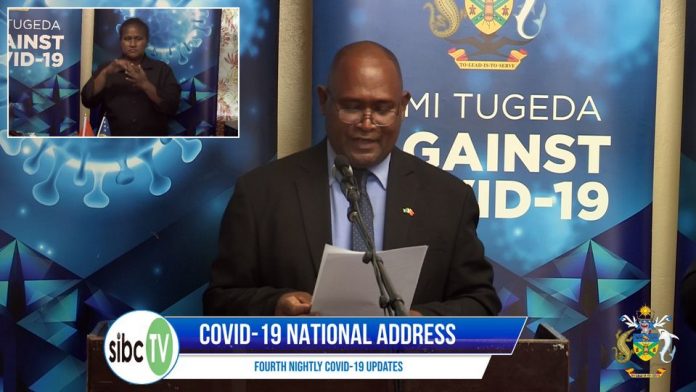
In his national announcement delivered on television, Bainimarama said Fijians would not be denied their salvation, and will the country not be denied its salvation from the COVID-19 pandemic.

“I say this because we – Fiji – have mastered difficulties before. We mastered those difficulties and we won opportunities,” Bainimarama said.

“But as always, we continue to hear the voice of doubt.

“We continue to see the emergence of false prophets who are bent on stopping our progress.

“Some point fingers at our frontliners, at our disciplined Forces.
“Some have questioned our decision to lift movements around Fiji, even though they will all be done under very strict COVID-safe protocols.

“Some have questioned the efficacy of the vaccine.

“They see difficulties in every opportunity to set us free.”

However, Bainimarama said he saw opportunity in every difficulty.

“Opportunity to protect you. Opportunity to safeguard you. Opportunity to make you flourish under these difficult circumstances,” he said.

SOURCE: FIJI TIMES/PACNEWS

New Samoa Government should be delayed: Fonotoe

Samoa’s Human Rights Protection Party (HRPP) deputy leader Fonotoe Pierre Lauofo says no Government should be formed in Parliament until election-related legal issues have been sorted out of respect for the constitution.

Fonotoe argues that the only way Samoa can have a constitutionally-aligned Government is to respect a Court of Appeal decision last Wednesday confirming that Parliament should be expanded to include at least six women. But he claimed that can only be achieved once all the election petitions are decided on.

Some 28 petitions and counter-petitions have been lodged in the Supreme Court challenging election results. They are expected to take months to resolve and could result in by-elections that will change the composition of Parliament.

Answering questions raised during an online broadcast PMN Live episode Fonotoe offered what he said was his opinion on ways to resolve Samoa’s political standoff while saying he was not privy to the party’s broader negotiation strategy.

While the deputy leader of the HRPP.says he has been kept in the dark about the details of discussions been made between the leaders of the two major parties, he believes the “way forward” for Samoa is to wait for the election petitions to be resolved.

“I believe the meeting [between the caretaker Prime Minister and the Prime Minister-elect on Thursday] was just a way to discuss the way forward from now for Samoa,” Fonotoe said.

“Now we have a decision from the Court of Appeal on an issue that was disputed by both parties and also involving the Electoral Commissioner.

“I understand the negotiations are ongoing, and they’re [HRPP leader, Tuilaepa Sa’ilele Malielegaoi and Fa’atuatua i le Atua Samoa ua Tasi (FAST) party leader Fiame Naomi Mata’afa are] meeting again sometime next week but I do not know of the details.

“But if we go back to the Court of Appeal’s decision that was handed down last week […] the decision was handed down, confirming that, or stating that the correct number of women representation in the house should be six since women representative in the house should constitute a minimum of ten per cent.

“But there was also a condition to the decision which I believe says that the sixth woman cannot be added until all the election petitions, all the 28 of them which are currently before the court are being decided on.”

Fonotoe believes that only after all the 28 election petitions are being decided upon, will Samoa be in a position to form a Government to rein over the country for a five-year term.

He called on the courts to speed up the process of determining the outcome of outstanding election petitions.

“I think that’s the catch to the decision,” he said.

“You know Article 44 under the Constitution cannot be activated so that this extra woman representative is sworn and brought into Parliament unless all the election petitions are done with.

“So I guess, one of the things that they’ll be looking at is, what can be done about the election petitions.

“Maybe speed up the election petition process, I don’t know exactly what they (the judiciary) have in mind.

“But the election petitions are scheduled to commence Monday this week. And there are 28 election petitions and 28 counter petitions.

“I guess the discussions will be around the decision and what can we do about the petitions.

“One obvious way is to let the court process take its course. So I guess we will have to go through all the elections.”

Fonotoe insisted that the leader of the HRPP, Tuilaepa, is still the caretaker Prime Minister and HRPP “is still [in] Government.”

“Right now, Tuilaepa is still the caretaker Prime Minister and the HRPP is still in Government until all these election issues are being sorted out.

“You know we still have to convene Parliament because, under the Constitution, it says parliament or the Legislative Assembly is constituted under Article 44 of the Constitution. And under Article 44 of the constitution, it stipulates that a minimum of ten per cent of women’s representation for Parliament.

“So the Parliament of Samoa requires six women, but now, we only have five. And the decision from the Court of Appeal says on Wednesday that a sixth woman member can only be brought in after all the election petitions. But that’s the catch there, an extra condition.”

Fonotoe agrees that Parliament should convene.

However, he says only a “constitutional Government” could be formed after the legal battles concluded.

“My view is, we cannot have parliament sworn in unless we have ten per cent women’s representations in Parliament,” he said.

“Right now, we do not. And the constitutions requires ten per cent minimum representation of women in parliament. So in my own personal view, it’s unconstitutional to convene parliament at this point in time, because we need to have six women and we can only have a sixth woman after all the election petitions.

“The decision was handed down on Wednesday, so we have to obey the court’s decision and follow the rule of law.

“In Samoa, we have a constitutional document and we have to obey and comply with the constitution. And the Constitution in Samoa is the supreme law of the land.

“So we do not want to part away from the constitution and we have to form a constitutional government.

“So moving forward, we have to satisfy the Constitution and the laws passed by Parliament.

“The caretaker Prime Minister and leader of HRPP respects the court of appeal for handing down such a decision that confirms what the Electoral Commissioner and the HRPP have been saying all along.

“So we would like to see six women in Parliament, unfortunately, we do not have it now, until all the election petitions are heard.”

With the appointment of an additional HRPP woman voided by the Supreme Court, the number of seats now stands at 26 FAST and 25 for HRPP.

However, Fonotoe still believes that HRPP had garnered the majority of votes.

“You got to look at the facts and some of the facts states that about 58 per cent of the voting population for Samoa, voted for HRPP,” he said.

“Only 38 per cent of the voting population voted for FAST.

“So there is much more support in Samoa for the HRPP party than the FAST party.”

When asked for his opinion on the claims that the results of April’s election had “split the country right down the middle,” Fonotoe said: “I don’t see it that way.

“About 60 per cent of the voting population voted for HRPP and those are the facts. So I don’t agree with the statement that the country is split down the middle,” he said.

“Most of the seats that FAST won are over in the big island of Savai’i. which is sparse in population. But the more populous island as you know is the main island of Upolu the where the majority of the population are living, and most of them voted for the HRPP.”

If after all the election petitions are decided by the courts and Samoa once again are tied in terms of the number of seats, Fonotoe believes the solution is to call for a fresh election.

“If that’s the case, then I guess most probably we’ll have to go back to the polls and take the issue back to the people to decide,” he said.
SOURCE: SAMOA OBSERVER/PACNEWS

FFA study on marine pollution to boost compliance with fishing rules

The Pacific Islands Forum Fisheries Agency (FFA) is stepping up efforts to stop the dumping of plastic waste at sea in the western and central Pacific Ocean (WCPO).

The agency has completed a consultancy study into ways of improving compliance with the rules. It focuses on plastic waste dumped by tuna fishing vessels.

Since 1 January 2019, the central fisheries management organisation for the area, the Western and Central Pacific Fisheries Commission (WCPFC), has prohibited the dumping of plastic waste through conservation and management measure (CMM) 2017-04.

FFA Director General Dr Manu Tupou-Roosen said the study was one step towards cleaning up plastic pollution in the ocean environment.

“CMM 2017-04 is an excellent step in the right direction, and getting the CMM agreed to was a huge win for Pacific Island states. But the reality is we need to do more to discourage fishing vessels dumping plastic overboard while at sea,” said Dr Tupou-Roosen.

“With our study, we want to focus more on incentives that will help fishers comply with the rules. To do that, we have to know what is dumped and how much, by different types of fishing vessels. It’s a very complex operation to collect data and then calculate quantities.

“It’s not as simple as keeping waste on board and offloading it at Pacific Island ports, because the waste facilities of many of our small island nations are already full.”

She said the consultants who conducted the study had experience in commercial oceanic fishing, monitoring tuna fishing, and managing waste in the region.

“So, we now have well informed expert advice on how to more effectively promote and monitor compliance with CMM 2017-04 and improve mitigation of fishing vessel plastic waste dumping through requiring fishing vessels to comply with the rules,” Dr Tupou-Roosen said.

“On this World Environment Day, it is important to acknowledge all the efforts that all people are making, step by step, on fishing vessels and in our regional fisheries organisations, to clean up our world and our oceans.”

The study was undertaken in the period January to March and tabled at the annual FFA MCS Working Group meeting and the 118th Meeting of the Forum Fisheries Committee.

The work provides a detailed analysis of the volumes of plastic waste generated by fishing vessels, current disposal practices and challenges, and a series of key actions that can be taken both at regional and national levels.

“The challenge now is to support national and regional efforts to better mitigate plastic waste dumping and this is a challenge for all of us to take up” said Dr Tupou-Roosen….PACNEWS

SOURCE: FFA/PACNEWS

Stay connected

529FansLike
172FollowersFollow
156SubscribersSubscribe
- Advertisement -