Home Blog Page 1212

COVID-19 Fiji: Infections total 279 today; highest daily total in current outbreak with four deaths recorded

Fiji has reported its highest daily total of positive COVID-19 infections as of 8am today with 279 cases reported this evening.

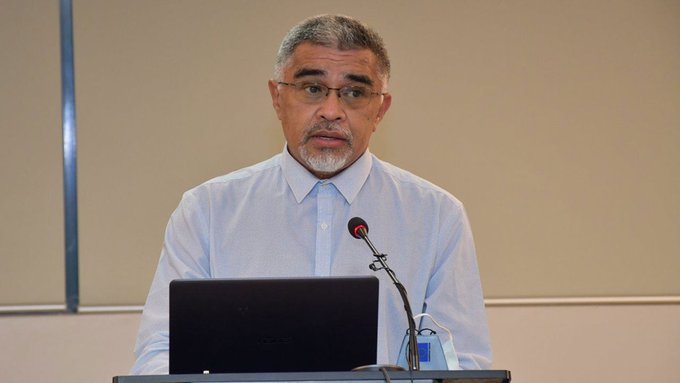
Ministry of Health and Medical Services permanent secretary Dr James Fong said of those cases, 46 are from existing containment zones or quarantine facilities in Nadi.

That includes 22 from Nawajikuma, 8 are from Tramline, and 16 are close contacts in quarantine facilities.

He said the remaining 233 cases are from the Lami-Nausori Containment Zone, and 196 cases of which are from existing areas of concern.

“… That means they are either from known clusters or they have a potential link to an existing case,” Dr Fong said.

“All 279 of these new patients are currently in isolation at home or in a facility.”

“Unfortunately, we can confirm four deaths today due to the virus.

“That tells us two things: One, this virus is a killer that no Fijian can afford to treat lightly. And two, we must fully-vaccinate all of our adult population as quickly as possible. That means two doses for every eligible Fijian. So, if you have already received one dose, please come forward for dose number two. If you have not had the chance to be vaccinated, we will make that opportunity available to you soon,” said Dr Fong.

SOURCE: FIJI TIMES/PACNEWS

Court decision on legality of FAST swearing-in next Monday

Samoa Supreme Court’s decision on the legality of the swearing in ceremony performed by the FAST Party on 24 May 2021 in a tent outside Parliament’s locked doors, will be delivered Monday 28 June.

The legal arguments were heard this week by Justice Lesatele Rapi Vaai, Justice Vui Clarence Nelson and Justice Fepuleai Ameperosa Roma.

The legal challenge by the Attorney General raised a number of constitutional issues such as the powers of the Head of State, the jurisdiction of the Court to hear such matters, the relevant actors that could solve the current problem and take things forward and the missing notice that called the first sitting of the 16th Parliament in 2016.

Leading the submissions was Paul Rishworth QC representing the Attorney General and the Human Rights Protection party.

He set down two common grounds in his submission that the hearing must proceed on the basis that the Assembly or Parliament has not yet met and the answer must be related to the Constitution which is the basis and foundation of the claim on the legality of the swearing-in ceremony.

Central to Rishworth’s submission was the suggestion that the swearing in of the Speaker (Papalii Li’o Masepa’u) was not properly done because it was not done before the Head of State.

The Head of State was absent so the Speaker was not duly sworn in as required by the Constitution, said Rishworth.

Because the Parliament building was locked, FAST conducted the swearing-in ceremony under a tent on Parliament premises at Mulinu’u.

Rishworth said the Constitution requires the Assembly to meet in the Parliament chambers at Mulinu’u, and that can only change when the Head of State appoints elsewhere for Parliament to meet.

“The place the Assembly sits is called the Chamber where its sessions and business are conducted,” said Rishworth.

However, the Constitution does not mention that specifically and Rishworth noted that, but quickly pointed out the affidavit of the Clerk of the Legislative Assembly Tiatia Gramme Tualaulelei.

Tiatia’s affidavit stated that when Parliament meets elsewhere, they need the endorsement of the Head of State for a specific location for them to meet “and that is the significance of this affidavit,” he said.

“The interpretation of the proclamation must meet in chamber, such is the norm, nonetheless, there is no specific requirement in the Constitution that the Assembly can only assemble in the Chambers, perhaps however, is the expectation,” said Rishworth.

It was at this point that Justice Vui Clarence Nelson pointed out to Rishworth that there was a time the Parliament building was under construction and the Legislative Assembly had to meet at the TATTE complex and at Tuana’imato.

Vui asked whether there is a document before the court of the order given by the Head of State in respect of those meetings.

Richworth asked Fuimaono Ainuu of the Attorney General’s office to confirm the whereabouts of the document.

“We could not locate the notice calling the 16th Parliament, but the document calling Parliament at TATTE,” Fuimaono told the court.

“What happened to the notice calling the 2016 Parliament?” Justice Vui asked.

“We could not locate the notice Your Honour,” Fuimaono replied.

“Or you put it in the rubbish,” Fuimaono – Vui responded (to courtroom laughter).

Rishworth’s argument comes down to the Speaker not being properly sworn in and questions if the Court can do anything or rule on this case.

According to Rishworth, there is not much reason for the Court to even consider it.

He agreed that the current (political) situation in Samoa is delicate but because the Assembly had not yet met to warrant the use of the doctrine of necessity.

“This needs to be dealt with by “relevant actors” as soon as possible,” he argued.

Justice Vui asked that if the Court declared the swearing-in as constitutional, was that a legal basis for the next step to be taken by the relevant actors to implement a way forward?

Rishworth said “yes”.

He referred to Parliament to convene 45 days after the general election and what needs to be done now that the 45 days had been and gone.

“I’m interested in the suggestion of “relevant actors” once the Court answered the question and a way forward, but are you saying it is not our function to make any direction on that regard?”

“Yes sir,” Rishworth replied.

“Would it be fair to say one of the “relevant actors” would have to be the Clerk of the Legislative Assembly?” asked Justice Vui.

“When I made the submission, that was not one of the relevant actors I had in mind,” Rishworth responded.

Justice Lesatele Rapi Vaai pointed to Rishworth’s submission where he conceded that the calling of Parliament on the 24 May was mandatory.

“Yes I do accept that the Supreme Court made the 20 May order, was also a proclamation consistent with the Constitution,” Rishworth responded.

Rishworth‘s answer was to refer to a scenario in a previous election and a writ.

“And with the 26/25 number, a new government is elected, and the Caretaker Government ceases, right?” asked Lesa.

“Your Honour, the question takes us to a different direction. The legal question pertaining to the legality of what took place that day. Your Honour’s question is what could be done in relation to the 26/25 of….” Rishworth argued.

Lesa pushed on saying that if the new government was elected, what happens to the Caretaker Government? No Government?

Rishworth responded that that was a matter for the Court to decide and Lesa reminded him of his submission that there were no compatible reasons for the Court in Samoa to consider the validity of the swearing in ceremony.

“I put it to you that the current situation in Samoa is delicate?” asked Lesa.

“Yes” Rishworth responded.

“We had an election on the 9 April. It is now 2 months, and elector’s answers have not been fulfilled. The Respondents answered. Are you saying that there are no compatible reasons for the Court to consider the validity of it?” asked Lesa.

“The answer is within the Constitution and with assistance from several partners such as the Court, relevant actors, and even the political parties,” Rishworth responded.

Counsel for the Respondents, Benjamin Keith said the voters are not served by prolonging the case and there is a need to be served on the purpose why they voted.

Keith’s submission touched on the importance of democracy and Government’s existence is a critical point to democracy.

When asked about the absence of the Head of State at the swearing-in ceremony, Keith pointed to the proclamation the Head of State made.

He said the plaintiff after stopping the convening of Parliament, cannot come and rely on their arguments in Court.

Justice Lesa asked if the Court should stop here or move forward to which Keith said “move forward.”

“The Court can go as far as considering the meeting, the election and the swearing in and they can go further,” Keith argued.

“My learned friend said there is no emergency but I differ because this is more of an emergency matter after two months of elections and there is still no Government,” said Keith.

SOURCE:TALAMUA ONLINE/PACNEWS
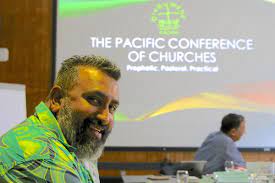
Churches warn against misuse of theology to prevent Covid-19 vaccination and protocols

– Pacific churches have called on Christian leaders not to take advantage of the COVID-19 situation in Fiji to manipulate Christians and proselytize.

In a statement, Pacific Conference of Churches General Secretary, Reverend James Bhagwan, noted with concern the use of misguided theology by some Christians to create.

“Over the past few months, some church communities are using immature or undeveloped theology to play to the fears and anxieties of the community,” Bhagwan said.

“In particular, some are manipulating theology, for example on the supreme authority of God and telling their congregations that following COVID-19 prevention protocols such as physical distancing, maintaining bubbles, wearing masks, and taking the vaccine is like saying ‘I don’t have faith and I’m not holy’.

“The impact of COVID-19 has severely impacted the social and economic situation in Fiji.

“The symptoms of mental health issues related to lockdowns and uncertainty, lack of economic empowerment, violence in the home and also in the community, children missing out on education etc.

“Christianity calls us to demonstrate our faith in God through love, compassion and care for one another and in particular the least among us.

“As members of the Body of Christ we are called to support the work of Jesus to ensure that people may enjoy abundant life (John 10:10).

“We also note that there are many rumours on social media based on images, videos taken out of context and incorrect or fake news which are being spread within the Christian community.

“Some of this is based on a growing mistrust of the government and is being expressed in religious language, particularly by some who believe that they are part of the fight of good versus evil.

“Those who are feeding fear into the community, have an incentive to keep stoking that fear because people keep clicking on these posts, and people keep listening.

“Social media has made it easy to amplify vaccine misinformation and active disinformation – calling the virus a hoax, saying that masking was a sign of fear, that the vaccine was a ‘mark of the beast’ or that it would ruin our immune systems, and suggesting the virus is a cover-up for billionaire Bill Gates to implant traceable microchips into people.

“The mark of the beast, from a Christian faith perspective, is taken from the Book of Revelation – a vision attributed to the Apostle John.

“Over the almost 2000 years since this vision, the ‘mark of the beast’ has been taken out of context and proof-texted to almost every major crisis humankind has faced. It is saddening that something that is actually lifesaving as a mark towards something that is anti-Christian or anti-faith.”

“There is also disinformation that nano-chips are being implanted in vaccines, which will allow the government and corporations to surveil people who get the vaccine. Microsoft founder Bill Gates and cell towers using 5G technology are also allegedly involved.

“To this we note that if the technology did exist and was cost-effective, the microchips would have to find their way into the many different vaccines created by different companies all over the world.

To those who are listening to these types of rumours, we simply say that a normal cell-phone with current 3G and 4G towers can already do that.

“In terms of misinformation or wrong information, we note a video stating that vaccines will alter your DNA, the molecule that contains a person’s genetic code. However the video appears to confuse DNA with messenger RNA, which are entirely different molecules, used by the new vaccines to direct cells to create components of the Coronavirus, though not the entire thing. Immune cells detect those components and create antibodies that ward off the actual coronavirus should a person be exposed.”

The Fiji Council of Churches is expected to issue a similar statement today.

SOURCE: PCC/ISLANDS BUSINESS/PACNEWS

PNG deputy PM Basil to face leadership tribunal

Papua New Guinea deputy Prime Minister and member for Bulolo, Sam Basil will be facing a leadership tribunal.

Chief Justice Sir Gibbs Salika appointed the Leadership tribunal to enquire into allegations of misconduct in office by the member for Bulolo.

The appointment follows a request by Public Prosecutor Pondros Kaluwin, to the chief justice under section 27 of the organic law on duties and responsibilities of leadership.

The tribunal will be chaired by Justice Allen David and other members.

The tribunal will commence its inquiry on the date and time to be fixed by the tribunal.

SOURCE:NBC PNG NEWS/ PACNEWS


Numbers of drifting FADs underestimated, SPC study shows

0

By Claire Heath

The numbers of drifting fish-aggregating devices in the Western and Central Pacific Ocean (WCPO) have been underestimated, an ongoing study by the Pacific Community (SPC) shows.

Dr Lauriane Escalle, at SPC’s Oceanic Fisheries Programme (OFP), said they had counted 159 FADs or satellite buoys around Wallis and Futuna in the first year of a project with Wallis and Futuna Fisheries Service.

Dr Escalle has written about the first year of data collection in issue 164 of SPC Fisheries Newsletter, which has just been published.

Nearly 60% (93) of the drifting objects counted were unattached satellite buoys. Of the drifting FADs, 43 had no buoy attached, and 22 did. Most were found on the eastern side of Wallis Island.

Dr Escalle is collecting data on drifting FADs that become beached or drift into the waters of Wallis and Futuna from elsewhere in the Pacific. The study will help OFP scientists and the Western and Central Pacific Fisheries Commission understand the impact of FADs and just how many there are. The project began in early 2020.

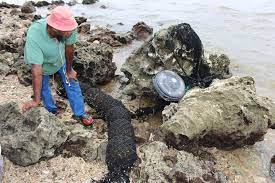
She said most of the retrieved components had been recycled, and were now being used in hammocks, or as nets for chicken pens, anchored FADs or outdoor solar lamps and phone chargers.

Wave buoys help track FADs

An experiment in which a wave buoy was added to a FAD has shown that national fisheries agencies can gain valuable data by collaborating with meteorology agencies.

The buoy, which records wave heigh, provides the GPS location of the FAD it is attached to, making it easier for fisheries to track and recover the FAD because it monitors position in real time.

Data from the wave buoy can also be used to help keep tuna fishers and others at sea safe. The buoy in the experiment withstood waves 7.1 m high when Tropical Cyclone Niran passed through New Caledonian waters during the experiment. Wave height had been forecast to reach 5.8 m, said SPC researchers Adrien Moineau, of SPC’s Geoscience, Energy and Maritime Division, and William Sokimi, of the Fisheries, Aquaculture and Marine Ecosystems (FAME) Division.

They said other advantages to fisheries agencies were in understanding how moored FADs react to currents and wind, and that FADs could be tracked if the mooring line broke.

Are variations in El Niño natural or due to the climate crisis?

In the same newsletter, Dr Patrick Lehodey from OFP reports that the complexity of the patterns of El Niño Southern Oscillation (ENSO) make it difficult to work out how much these reflect natural variability and how much they might be changing because of the climate crisis.

“We now know that profound changes driven by ENSO – at the scale of the whole Pacific Ocean – have an impact on many ecosystems and marine resources, including changes in the distribution of tunas,” Dr Lehodey said in issue 164 of Fisheries Newsletter.

“El Niño or La Niña directly affect the horizontal movements and vertical distributions of the main exploited tuna and tuna-related species (e.g. skipjack, yellowfin, bigeye, albacore, swordfish and marlins,” Dr Lehodey wrote in SPC Fisheries Newsletter.

He said that the International Panel on Climate Change projects that, under “business as usual” scenarios, both La Niña and El Niño phases will be more extreme. The 2015–2016 El Niño was extreme. But because observations of the climate and oceans have occurred for a relatively short time compared with climatic changes, they don’t know whether it was within the range of natural variability – or if it marks the beginning of what people can expect in El Niño years. Their analysis was made more difficult because the La Niña phase that followed was unexpectedly mild.

Growing focus on marine pollution

The latest Fisheries Newsletter also reports on the FFA-commissioned study into waste generated by fishing vessels in the WCPO and ways that the marine pollution burden might be lessened. There is also an article on the Pacific Fisheries Leadership Programme, funded by the New Zealand Ministry of Foreign Affairs and Trade to help Pacific Island states meet the goals of the Regional Roadmap for Sustainable Pacific Fisheries.

SOURCE: TUNA PACIFIC/PACNEWS

Former Oil Search boss Peter Botten says UBS ‘greedy’ on fees

Former Oil Search managing director Peter Botten has branded UBS “greedy” for the fees it charged on a deal in Papua New Guinea and said he was uncomfortable with the investment bank being on both sides of the transaction.

In much-anticipated evidence to the royal commission into the so-called “UBS loan scandal”, Botten singled out the investment bank for criticism.

Former Oil Search boss Peter Botten, bottom left, giving evidence to the UBS Royal Commission on Tuesday.

“Unfortunately, investment banks sometimes are particularly greedy. And unfortunately, in this case I think that might be an appropriate characterisation,” he said.

The criticism is certain to sting UBS, which has refused to co-operate with the inquiry, given Botten was their client at the time. The bank has always maintained the fees it charged the PNG government to borrow $1.2 billion (US$906,000) to purchase a 10.1 per cent stake in Oil Search were appropriate.

Documents tendered to the commission show that Paddy Jilek, a senior adviser to UBS at the time, was one of the main bankers on the deal. The other UBS banker named in the tendered emails was Mitch Turner, who remains at UBS as head of Australasian Energy, according to his LinkedIn profile.

At the time Guy Fowler was the head of investment banking at UBS, while Matthew Grounds was the country head. Both men are now at Barrenjoey Capital Partners.

Botten said Oil Search had retained Goldman Sachs to conduct a $1.2 billion (US$906,000) capital raising in 2014, with the proceeds to be used to purchase a 22 per cent interest in the Elk Antelope gas fields. He said that once the PNG government decided it would take up the entire share issue, UBS took over the mandate from Goldmans, along with its role advising the state.

Asked by counsel assisting, James Renwick, SC, if he was “content” with the arrangement, Botten replied: “I would not use the word content … It was the reality of the day.”

Botten resigned as head of Oil Search last year and earlier this year became chairman of AGL Energy.

In earlier evidence on Tuesday by former PNG Treasurer Don Polye, UBS was accused of having a conflict of interest given it advised the PNG government, providing of the loan and conducted the capital raising for Oil Search.

“UBS preyed on a poor country like PNG,” he said. “The people that devised this loan are the enemies of PNG.”

The investment bank is estimated to have made more than $100 million (US$75 million) in fees and interest from the deal. The inquiry heard on Monday that PNG lost US$432 million from the transaction – equivalent to almost 70 per cent of the country’s annual health budget.

The Pacific nation was forced to sell its 10.1 per cent stake in Oil Search when the stock declined and it did not have the funds to put extra capital into the loan.

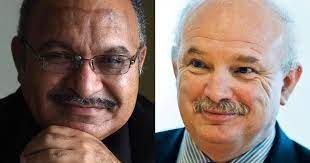
Former PNG Prime Minister Peter O’Neill, who championed the deal, falsely claimed in 2017 that PNG had made a $39 million (US$29 million) profit on the deal.

Botten said he didn’t have direct knowledge of the fees UBS charged PNG, but he was aware of the fees the investment bank was proposing to charge Oil Search for a similar deal if the placement to the PNG government fell over.

The inquiry has heard that at least three senior cabinet ministers opposed the deal and that it was unconstitutional, as O’Neill did not seek parliamentary approval for the “highly speculative” transaction.

SOURCE: AFR/PACNEWS

Vanuatu government to file civil case today

The 19 Members of Parliament (MPs) on the Vanuatu Government side who are subject to the ruling of Justice Oliver Saksak, will be filing a civil case through their legal counsel today.

Public Relations Officer (PRO) to the Prime Minister’s Office, Fred Vurobaravu, confirmed this to the Daily Post.

The MPs which include Prime Minister Bob Loughman, Deputy Prime Minister and Minister of Internal Affairs, Ishmael Kalsakau and other state ministers and government backbenchers have had their seats vacated through a ruling of former Speaker of Parliament, Gracia Shadrack which was upheld in a recent Supreme Court decision. The decision was stayed through a verbal request.

The civil case relates to their presence in three consecutive sittings in Parliament, between Government and former Speaker, Shadrack.

In related news, Vurobaravu said counsel Robert Sugden is working on the Government’s appeal in relation to Justice Saksak’s ruling.

SOURCE: VANUATU DAILY POST/PACNEWS

Cook Islands to consider proof of Covid-19 vaccination

Proof of Covid-19 vaccination from countries with “rampant” cases of the virus are a future consideration, says Cook Islands Prime Minister Mark Brown.

“Our travel bubble with New Zealand doesn’t require vaccination and that’s working well but of course as we go on and people start to travel more, we may consider that (proof of Covid-19 vaccination) as a requirement for people coming out of countries like India or others where Covid-19 is rampant,” Brown said.

The Prime Minister said the country is looking to extend the travel bubble with Australia and when it does it will probably not require vaccination proof.

He said both Australia and New Zealand have managed the Covid-19 situation well.

“But definitely I think proof of vaccine for those coming from other countries may be something we will consider,” Brown said.

If proof of vaccination rule is implemented, it would not differ from the Pa Enua and Rarotonga “but be consistent throughout the country”.

Te Marae Ora Ministry of Health have implemented vaccination certificates and vaccination identification cards. The certificate costs $15 (US$10) and an ID costs $50 (US$35).

Secretary of health Bob Williams said both forms of verification should be accepted overseas as vaccination proof because they are issued by the Ministry of Health.

“A few residents have already as of this week used it for their travel to countries in Europe,” Williams said on Friday.

“It’s still early days and many countries have not yet developed their vaccination certification process and each country is sovereign in deciding its own system.

“For the Cook Islands so long as the vaccination certificate is issued by an authorised officer of the Ministry of Health of another country with the vaccination details which can be verified, it can be accepted.”

Williams said the Cook Islands vaccination verification could not be forged. “The vaccination information is specific to that person only and cannot be duplicated to someone else,” he said.

In Parliament on Thursday last week, Health Minister Rose Toki-Brown said Te Marae Ora could not confirm at present if airlines would accept the vaccination appointment card, therefore the vaccination certificate and ID were created.

The Opposition Democratic Party has questioned the cost of the vaccine ID card and certificate and said it should be free.

On Thursday, Minister Toki-Brown said: “The initial fee of $50 (US$35) set for the vaccination ID card is to cover the cost for the materials, the printing and staff time to produce the ID card. It is a one-off cost.”

SOURCE: COOK ISLANDS/PACNEWS

Civil unrest and political instability threaten Fiji as COVID-19 outbreak takes hold

As Fiji’s COVID-19 outbreak continues to devastate the country’s economy, there are mounting fears the crisis could spark social unrest in the small Pacific island nation.

Those concerns have ramped up after a wild street brawl erupted in a poor neighbourhood in the capital, Suva, over the weekend, following a number of rare protests by quarantined villagers.

A video of the fight in Jittu Estate has been shared widely on social media in Fiji.

Police said drunken youths were to blame, but local reports said it was sparked by the theft of food crops in an atmosphere where people are anxious about feeding their families.

Even before the current outbreak, the pandemic had devastated Fiji’s tourism-dependent economy, causing widespread job losses.

Social workers said people were becoming increasingly stressed and angry, though one expert does not think it will bring down the government.

Jeremaia Merekula is a team leader at Lifeline and said the demand for telephone counselling has more than doubled since the same time last year.

“In the village, there are tensions that are rising where there are people who have lost their jobs and would want to go and plant cassava … but they don’t have any land,” he said.

“Last month, domestic violence helpline reached 800 calls … child helpline had 500 … a huge number of calls from Fijians going through crisis.

“The number of calls that are coming in doesn’t compare to the thousands of people out there who are finding it hard to call for help. We have always had this culture of silence that means it’s hard for us to talk about what we’re going through.”

Apolosi Ranawai Lasei from the District Council of Social Services has seen the impact of Fiji’s COVID-19 crisis firsthand.

He was at a recent protest by quarantined villagers who had run out of food.

“They broke the rules of social distancing and just came out because they needed help,” he said.

Protests are rare in Fiji, which is still emerging from a period of military dictatorship where all forms of protest were suppressed.

But there have been at least three in recent weeks.

Risk consultancy firm Fitch Solutions has pointed to the increased risk of social unrest in its latest outlook for Fiji.

Fisk’s Anwita Basu said the key livelihoods of average Fijians was at risk.

“Because it is a tourism-dependent market, and the country was hoping to reopen specially to neighbouring New Zealand and Australia, and that’s where we see the risks coming from mostly,” Basu said.

Fijian historian Brij Lal said the recent protests were significant, and the outbreak is damaging the government of Prime Minister Frank Bainimarama.

“A lot of anger, a lot of frustration, a lot of fear right across the country,” he said.

But he doesn’t think the people’s anger and frustration will destabilise the government.

“I do not think that will lead necessarily to overt rebellion against the authorities,” he said.

“Because the authorities have their hands firmly on the apparatus of public security and the military is placed in strategic positions around the country.”

Meanwhile, the government was hoping its relatively successful vaccine programme will bring the outbreak to an end.

It has resisted calls for a nationwide lockdown, believing that would cause even more economic pain, opting for localised restrictions instead.

So far more than 250,000 people, or more than 40 per cent of the eligible population, have received their first dose of the AstraZeneca vaccine.

There have been 2,090 cases of COVID and seven deaths recorded in Fiji, according to Johns Hopkins University.

SOURCE: ABC/PACNEWS

New Caledonia tension simmers over referendum date

Political tension is rising in New Caledonia as a third referendum on independence from France is planned in December.

The decolonisation process under the 1998 Noumea Accord is nearing its conclusion and scenarios are being drawn up for how to deal with the result.

In 2018 and 2020, a majority voted against independence, but the winning margin shrank from 56.7 percent to 53.3 percent, leaving the electorate as divided as ever.

The path to the third referendum has been fraught as no consensus for a date could be found, with Paris ruling out the period straddling next year’s French presidential election.

In 2018, the date of the first referendum was approved in a unanimous vote by New Caledonia’s Congress.

Last year, because of the emergence of Covid-19, the vote was slightly delayed but Paris chose October as a compromise between the dates proposed by the rival sides.

This year, anti-independence parties wanted the vote to be held as soon as possible while the pro-independence parties wanted it to be held as late as officially possible, which is by October 2022.

Although the Noumea Accord stipulates a two-year gap between the votes, the overseas minister Sebastien Lecornu announced in Paris earlier this month that the referendum would be held on 12 December.

The announcement came after a meeting with New Caledonian leaders invited to Paris last month to canvass the territory’s future.

While anti-independence politicians have in the main welcomed the date, the pro-independence side keeps describing the choice as a “unilateral decision”.

Daniel Goa of the Caledonian Union said the date chosen by France was one to “suit itself” and “to respond favourably to the ‘no’ supporters, giving them to hope for an easier victory.”

He added that those who “think of purging the question of independence by shortening the referendum deadlines are seriously mistaken”.

Louis Mapou of the pro-independence UNI, which stayed away from the Paris talks, told Radio Oceane his side “is mobilising to continue to demand that the referendum be held in 2022.”

However, a signatory to the Noumea Accord and former New Caledonian president, now member of the French Senate Pierre Frogier views the referendum process as “useless”.

“Neither of the two camps will ever submit to the convictions of the other and whatever the result, our convictions and those of the separatists will not vary”, he warned.

At the Paris meeting, Lecornu discussed France’s outline of what the legal, economic and financial implications of a ‘yes’ or a ‘no’ vote would be.

Both options raise complex issues, be they short or long-term.

Within the next few weeks, the Paris meeting will be followed by an official sitting of the signatories to the Noumea Accord although the exact date and venue are yet to be announced.

Usually convened once a year and chaired by the French prime minister, the meeting will allow the parties to table their agendas and discuss the final phase of the Accord.

The post-Accord challenges have been raised by Lecornu at the Paris meeting, describing them as vital for voters to know when they cast their ballots.

He has also spoken of a post-referendum “convergence period” to June 2023 in case of a no-vote, which would be followed by another referendum on a new arrangement with France.

According to Noumea university academic Mathias Chauchat, this risks the undoing of Noumea Accord provisions anchored in the French constitution.

“There is a contradiction between the lapsing and irreversibility of the Noumea Accord. The two concepts cannot be made to coexist. Either the Accord is void or it is irreversible”, he noted.

Louis Mapou said the parties making up UNI will soon vote on whether to boycott any additional referendum as suggested by Lecornu.

He hinted at the stance taken by the pro-independence side in 1987 when a French-run plebiscite was rendered pointless by the wholesale absence of Kanak voters.

SOURCE: RNZ PACIFIC/PACNEWS

Stay connected

529FansLike
172FollowersFollow
156SubscribersSubscribe
- Advertisement -