Home Blog Page 1154

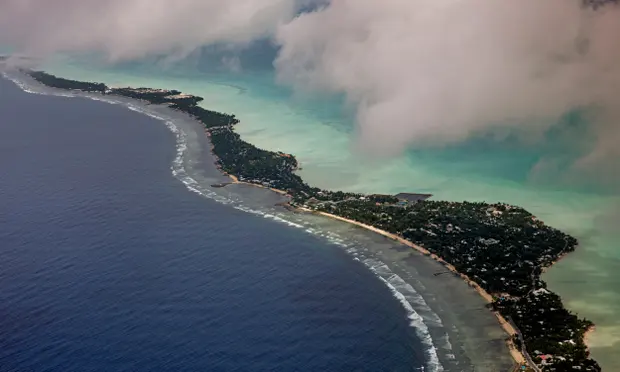
Kiribati seafarers ask Government to prevent SPMS from leaving country

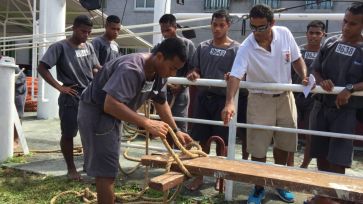
Kiribati Minister for Employment and Human Resource has assured Government will try its best to ensure that the South Pacific Marine Services (SPMS) does not leave the country before end of this year.

Taabeta Amuera Teakai made the assurance to seafarers and their families who marched to Parliament House last Thursday to request government to convince SPMS not leave the country.

SPMS has announced it will leave the country at the end of the year.

Taabeta said Government is also planning repatriation of the remaining Kiribati seafarers stranded overseas, particularly in Fiji.

SPMS has been providing recruitment and employment of Kiribati seafarers overseas, particularly on German merchant ships for more than 50 years.

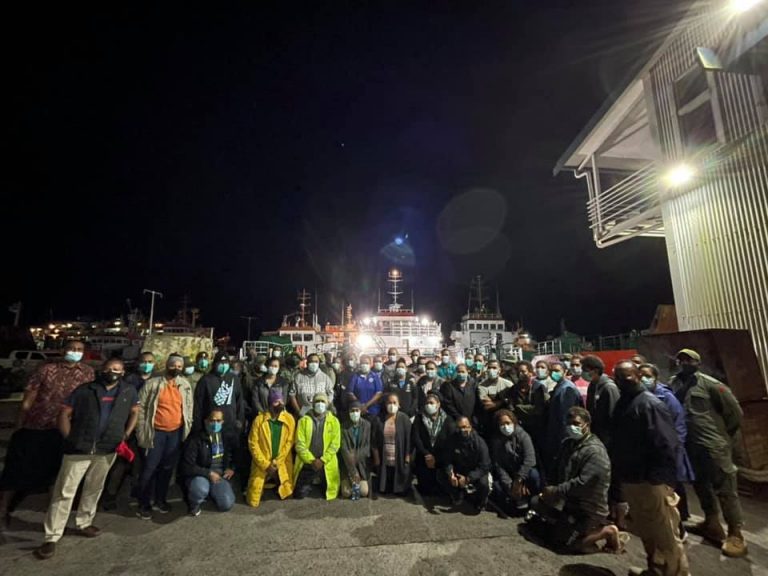
Hundreds of Kiribati seafarers stranded overseas are pleading with their government to allow them to return home as the country continues to shut its border to international flights.

With a COVID-19 outbreak sweeping Fiji, 165 seafearers been confined to their hotel in Nadi where their meals and room is paid for by the German shipping company they work for.

But since arriving in Fiji their basic wages have stopped and the men can no longer send money home.

Their situation has prompted a consortium of German shipping companies to terminate a decades long agreement to train and recruit i-Kiribati workers.

The companies said they could no longer recruit workers without a way to return them home and ended the arrangement in June after talks with the government collapsed

SOURCE: RADIO KIRIBATI/PACNEWS

UK Government supports Pacific island progress on extended continental shelf submissions

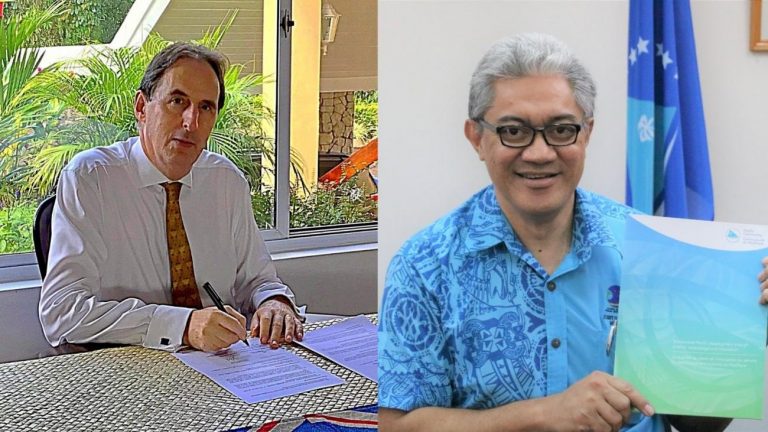
The UK Government has signed an agreement with the Pacific Community (SPC) for £263,000 (US$359,000) that will help Fiji, Vanuatu, Solomon Islands, and Tonga to secure the rights and responsibilities over their respective ocean spaces.

The ocean sustains a multitude of activities that fuel local, national and international economies, providing livelihoods and food security for 10 million Pacific Islanders across the region.

Pacific Island Countries (PICs) are the custodians of 20% of global maritime zones. To optimise the management, use and conservation of this vast ocean space, PICs require certainty over their maritime zones as defined by the United Nations Convention on the Law of the Sea (UNCLOS). This includes the extended continental shelf (ECS) areas beyond their 200 nautical mile exclusive economic zones (EEZs).

Clarifying sovereign rights over these ECS areas is crucial for the stability and development of PICs. Until these gaps in the world map are closed, PICs may not be in a position to fully protect their interests and achieve their blue economy aspirations.

The UK Government, through its Conflict, Stability and Security Fund (CSSF) will provide timely assistance in partnership with the Pacific Community (SPC) to build the capacity of PICs in all aspects of progressing their ECS submissions.

Currently, there are 10 PICs with 17 ECS submissions at various stages awaiting examination by the Commission on the Limits of the Continental Shelf (CLCS). Among these states, the Solomon Islands, Vanuatu, Tonga, and Fiji have two joint and three individual submissions awaiting examination – North Fiji Basin, Charlotte Banks, South Fiji Basin, Eastern Kermadec Ridge, and Western Lau-Colville Ridge.

British High Commissioner to Fiji, George Edgar said,

“We are glad to support this project which aims to help Pacific Island Countries ensure that their maritime zones are well defined. That will provide a basis for management and protection of these areas and enable sustainable use of marine resources to generate income and create employment, and ultimately contribute to the reduction of poverty.”

PICs have worked individually and collaboratively to develop submissions and preliminary information to define the outermost limits of their continental shelves. They have been supported by the SPC and a consortium of partners in the technical process and with the additional assistance from UK Government, work on ECS submissions can be further developed that will enable PICs to exercise their sovereign rights to explore, manage, or conserve seabed resources on the continental shelf extending beyond the EEZ.

Dr Paula Vivili, Deputy Director-General Science and Capability said,

“On behalf of the Pacific Maritime Boundaries consortium of partners, SPC welcomes this contribution from the UK Government to continue the vital work of supporting our member states to prepare and defend their ECS submissions. This will help countries achieve sustainable development goal Target 14.C– to enhance the conservation and sustainable use of the oceans and their resources by implementing UNCLOS– and it comes at a critical time in the development of regional ocean governance, at the beginning of the UN Decade of Ocean Science for Sustainable Development.”

The ECS project will contribute to the broader Pacific Maritime Boundaries programme of work coordinated by SPC and supported by a consortium of partners, including the Pacific Islands Forum Secretariat, the Office of the Pacific Ocean Commissioner, the Pacific Islands Forum Fisheries Agency (FFA), the Australian Department of Foreign Affairs and Trade (DFAT), Geoscience Australia, Attorney General’s Department- Australia, University of Sydney, New Zealand Ministry of Foreign Affairs and Trade (MFAT), GRID-Arendal, as well as the European Union and Sweden through the Pacific European Union Marine Programme (PEUMP).

SOURCE: SPC/UK GOVERNMENT/PACNEWS

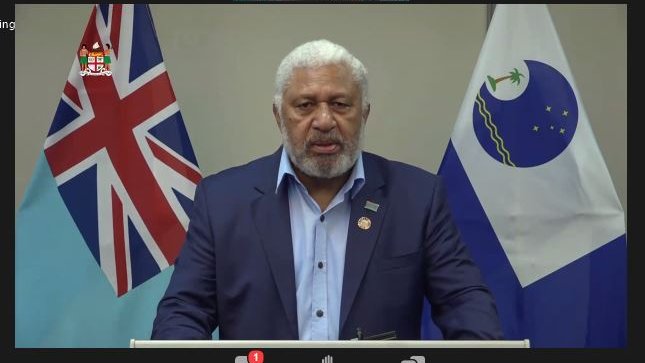
“A nuclear-free Blue Pacific must remain our legacy”- Forum Chair Frank Bainimarama keynote to Pacific event ahead of International Day against Nuclear Tests

0

This Sunday, our Forum family joins the global community to commemorate the International Day against Nuclear Tests. A day devoted to honouring all victims and survivors of nuclear tests, to raising public awareness about the fatal consequences of nuclear explosions, and to remembering why nuclear testing must come to a permanent end.

This day was declared by the UN General Assembly in 2009, following a resolution initiated by Kazakhstan to mark the closure of the Semipalatinsk Nuclear Test site on 29 August 1991. This was an unprecedented act to demonstrate to the world that it does not need powerful nuclear tests and weapons, and led the way for the closure of other testing sites, including in Mururoa and Kiribati.

Although the Semipalatinsk Nuclear Test Site closed 30 years ago, the region’s residents are still affected by more than 450 nuclear tests that were conducted there by the Soviet Union.
This is a story all too familiar for our Blue Pacific Continent, which was the theatre for some of the most powerful nuclear tests ever conducted in world history; and what we consider atrocities perpetrated on our people without our consent.

We endured five decades, from 1946 to 1996, of more than 300 nuclear tests at atmospheric, surface and underground levels. These were conducted on Bikini Atoll and Enewetak Atoll in the Marshall Islands, in the Montebello Islands in Australia, near Malden Island and Kiritimati Island in Kiribati, on Johnston Atoll, and on Mururoa and Fangataufa Atolls in French Polynesia.

The impacts have been nothing short of devastating; from the local, regional and global fallout, to the residual contamination and radioactivity in our ocean and lagoons. From the permanent relocation of resident populations in the Marshall Islands, to the serious and lasting impacts on the health, environment and human rights of our affected communities.
The darkest of these days was the 1st of March 1954, when the Pacific witnessed the largest ever nuclear test explosion, the Castle-Bravo test, in the Marshall Islands. In the hours after the test, life-threatening radiation doses were received by people in nearby atolls.

The nuclear testing legacy has left a gaping wound in our otherwise peaceful and bountiful Blue Pacific. A just resolution of outstanding issues remains evasive to this date, and we call on those responsible to take meaningful steps to address these lingering issues. There is no question that the unresolved nuclear testing legacy issues in the Pacific continue to pose a clear and present danger to the livelihoods of the peoples of the Blue Pacific.

As Leaders of the Pacific Islands Forum, we have been steadfast in calling for action on longstanding nuclear testing legacy issues in our Blue Pacific and advocating for effective remedial action to mitigate against the threat to the health, security and prospects of our Blue Pacific, as a consequence of the nuclear testing programs.

Currently, we are engaging with the Government of Japan and international partners to ensure the prevention of any further harm to our region from Japan’s plans to discharge ALPS treated water into the Pacific Ocean as part of efforts to decommission the Fukushima Daiichi Nuclear Power Plant.
As we commemorate this important day, and indeed our 50th Forum Anniversary this year, it would be remiss of us not to pay tribute to the foresight of our fore bearers in this regard, for their strong vision of a Blue Pacific, free of nuclear weapons – a vision emphatically embedded in the language of our South Pacific Nuclear Free Zone Treaty – more commonly known as the Treaty of Rarotonga. The Treaty successfully led to the permanent cessation of nuclear testing in our region in 1996. Though a product of its time, the Treaty of Rarotonga is one of our very first and most significant achievements as a Forum family; a legally binding instrument with a regional and global reach that continues to serve and inspire our region, and protect our people and our prospects to this day, and no doubt, into the future.

The Treaty is a powerful testament to what we can achieve through regionalism, under the framework of international law, and in support of the rules-based international order to which we all subscribe. It is a product of strong regional consensus and a collective determination to expunge the nuclear threat from our Blue Pacific region.

Just seven months ago, the States Parties to the Treaty of Rarotonga met for the first time. Their Ministerial Statement reinforced the principles underpinning our Nuclear Free Zone, including the freedom to live in peace and independence, and the enjoyment of peaceful social and economic development free from the threat of environmental pollution.

As we look towards 2050 and our shared future as a united Blue Pacific, the threat of nuclear proliferation remains a reality. We only know too well the damage it has done to our environment, health, and wellbeing. As a Forum family, we must never be complacent; we must always call for peaceful and just action.

In this regard, I reiterate the call by Forum Leaders in 2019 for remaining states to sign and ratify the Comprehensive Nuclear-Test-Ban Treaty.

I am also heartened by the entry into force of the Treaty on the Prohibition of Nuclear Weapons on 22 January 2021. I call on every peace-loving member of the global community of nations yet to sign the Treaty to consider doing so, thus contributing meaningfully to ending the proliferation of nuclear weapons, and bolstering world peace.

As a united Forum family, we honour the victims and survivors of nuclear tests, and we celebrate our proud Blue Pacific success and activism against nuclear tests and nuclear threats.

As we envision the safe and peaceful world we want to leave for our children, a nuclear-free Blue Pacific must remain our legacy, and the total elimination of nuclear weapons must be the highest disarmament priority in the world.

SOURCE: PIFS/PACNEWS

Pacific Webinar discusses key findings of the IPCC’s Sixth Assessment Report

The Pacific Climate Change Centre in collaboration with the Australian National University hosted a Pacific webinar to provide the most up to date synthesis of relevant climate change information to diverse Pacific Island audiences.

The webinar was held on 25 August 2021 with more than 300 participants that attended the event.

The recently released Intergovernmental Panel on Climate Change’s (IPCC) Sixth Assessment Report on the Earth’s climate, is a clear warning for the Pacific and the world that we are running out of time to avoid the negative impacts of a rapidly changing climate.

The report, which is only produced once every seven years, focuses on the physical science of climate change, covering Pacific climate phenomena including temperature rise, rainfall, marine heatwaves, tropical cyclones, sea level rise, ocean acidity and coastal flooding. IPCC reports are the world’s most authoritative sources of climate science.

The Sixth Assessment Report reinforced key messages from earlier reports, that urgent change is needed to keep global warming below the 1.5 degrees’ limit target that many countries have agreed to work towards as part of the Paris Agreement. But what does that mean for the Pacific?

Director General of the Secretariat of the Pacific Regional Environment Programme (SPREP), host of the PCCC, Kosi Latu, said, “This is our last chance, all of us must act now. We must call upon humanity, we must have the political will to act – everyone must make the changes needed to reduce greenhouse gas emissions today.”

In his welcoming remarks he stated that the report is clear, urgent changes must be made to limit global warming to the Paris Agreement’s 1.5oC while there is still time.

“For us in the Pacific, the report spells out alarming consequences starting with us first, if the world fails to listen to the warnings in the report. Contributing to less than 1% of the world’s total greenhouse gases, our Pacific islands are on the frontline, and amongst the most vulnerable, to the impacts of climate change,” Latu said.

The Chief Executive Officer of the Ministry of Natural Resources and Environment of Samoa, Frances Brown-Reupena, as the keynote speaker emphasised that urgent and transformative action is requited to keep global warming to 1.5 oC.

She further elaborated that Pacific island countries are at the frontline of climate change impacts, climate change is a global problem requiring urgent action from all countries. “We can no longer ignore the devastating impacts of climate change.”

The event included an esteemed panel of climate change experts, including Professor Mark Howden, Director of The Australian National University Institute for Climate, Energy & Disaster Solutions. Professor Howden is an IPCC a Vice Chair of Working Group II and was directly involved in the final approval process of the report.

While delivering a presentation on the key findings in the report for the Pacific, Professor Howden highlighted the seriousness of the situation, but also cause for hope, “All greenhouse gas scenarios are likely to exceed 1.5oC in the 2030s. The good news is that in a very low-emission scenario we will only temporarily exceed 1.5 oC but then bring temperatures back down – we can make up for lost ground.”

An enthusiastic panel discussion followed the presentation, where attendees asked questions and engaged in constructive dialogue on the best way forward for the Pacific.

Joining Professor Howden for the panel discussion were IPCC authors Dr Morgan Wairiu, a Pacific Coordinating Lead Author of Working Group II and Dr Michael Grose, a Lead Author of Working Group I and Senior Research Scientist for the Commonwealth Scientific and Industrial Research Organisation.

They were also joined by representatives of key Pacific climate organisations, including Mr Espen Ronneberg, Director of Climate Change for the Pacific Community (SPC) and Salesa Nihmei, Meteorology and Climatology Adviser for SPREP

The webinar is one of the ways in which the Pacific Climate Change Centre hopes to help Pacific people to better understand the graveness of the report and the seriousness with which we need to act to avoid a fast-approaching climate catastrophe.

For more information on this webinar, please contact pccc@sprep.org

SOURCE: SPREP/PACNEWS

World tuna capital

0

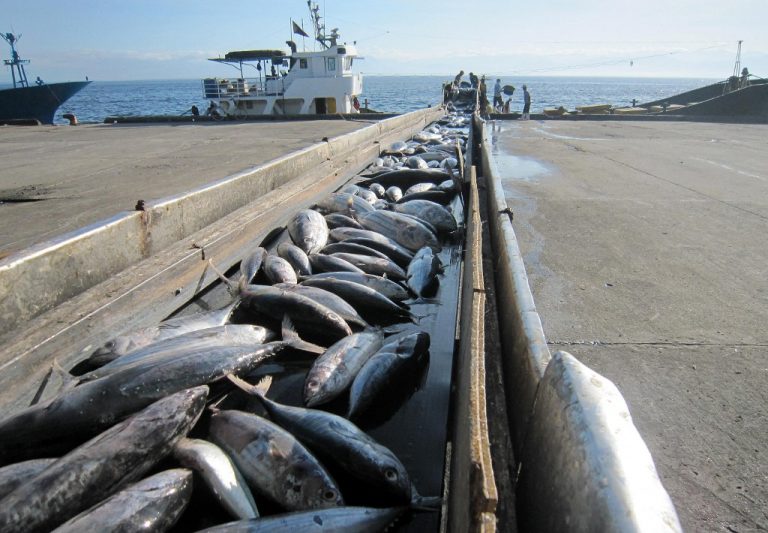
Papua New Guinea National Fisheries Authority (NFA) is eying a move into the private sector to enable it to realise its potential of earning about K1 billion (US$285 million) kina compared to the K600-K800 million (US$171- US$228 million it is turning over annually.

NFA chairman Ango Wangatau said if they are allowed to operate freely as a private company in the commercial space, they can achieve the full earning potential of the fishery sector and turn PNG into the tuna capital of the world.

Wangatau told this paper that the way in which the industry is going to develop is not by imposing laws and regulations, it can operate in a commercial space.

“We have the market in EU.

NFA is the certifying authority for EU, so any product that is produced in PNG we have an accessible market… As in business, you look for the resource and the market but we have the market but for successive governments we haven’t done it.”

He said despite the country’s fisheries Exclusive Economic Zone (EEZ) of 2.4 million square kilometres which supply about 18 per cent of the world’s tuna catch, and revenue collected between K600 to K800 million on average, most of these revenues are received from foreign vessels that pay access fees and take fish offshore for processing.

“However, these yields fall below PNG’s real potential to become a world leader in supplying fisheries products particularly tuna.

“The plan intends to work toward realising the full potential of the sector to deliver on the Government’s goal of growing the economy.

“Among the critical impediments is the inadequacy of onshore processing facilities, especially for coastal fisheries.

Millions of kina in revenue that should have been generated through value adding are being lost,” he said.

“This loss is further exacerbated by the fresh tuna exports or over exploitation of tuna by licensed fishing vessels that take fish for processing off shore, illegal, unreported and unregulated fishing within PNG waters are impediments that must be addressed.”

Minister for Fisheries Dr Lino Tom said PNG unfortunately earns around K400 million each year on average from the rents collected from the vessel day scheme.

“We own the resources, we have one of the best preserved marine eco-systems in the world but yet we have been simple rent seekers by virtue of the mandate bestowed on us by the NFA Act and other unfriendly government legislation policies.

“This plan now seeks to unlock these restraining cuffs and allow NFA to go into in the commercial space apart from its regulatory protection,” he said.

Dr Tom said this is not to compete with our private sector but to enrich capitalisation and capacity building through the provision of enabling infrastructures, legislations and special type of vehicles like the PMIZ to make investment in the sector more attractive for all the private sector and most importantly, citizens .

“Huge potential in there, we’re just getting rents but if you look at the actual value of the product that we can sell which the strategic plan addresses for us to own the resource and sell every resource, you’re looking at a billion dollar revenue every year,” he said.

Dr Tom said the industry through its strategic plan now is looking at getting NFA exempted from the Public Money Management Regularisation Act and the National Procurement Act and operate as a company.

“For us to provide enabling infrastructures we can’t wait for tender processes.

“What we are seeking is just like other state owned enterprises where the government allows them their own procurement, that is what we are basically seeking in a way it speeds our process.

“To compete in this industry we have to be efficient and effective. With PMMR even though the court rules in our favour, they still hold on to our funds, we can’t access the funds so we’re looking at government in relaxing those issues,” he added.

“Exempt us from PMMR and NPC Act so we act basically as a company. In order for us to compete in the commercial space we must operate as a company otherwise the cumbersome government processes will impede our progress, we can’t really compete.”.

Meanwhile, the Pacific Maritime Industrial Zone in Madang Province will be re-developed to become a regional fish processing hub.

The design of the development and financing strategy of the project is being put together by National Fisheries Authority and the Treasury Department.

National Fisheries Authority chairman Ango Wangatau said the regional processing hub will bring in other Pacific Island nations together to create a critical massing of tuna processing and export from the Pacific.
PNG as the hosting hub will naturally emerge as the lead country.

He said with the vision of opening up PMIZ, the industry is looking at getting more than 30,000 new employment with revenue-generating over K3 to K4 billion (US$385 million –US$1.1 billion)

“Maximising export earnings is contingent on increasing value-adding production and the PMIZ redevelopment is the platform to achieve it.

“The NFA Board is confident that this investment will lift PNGs value-adding capacity to another level in the commercialisation agenda.”

Wangatau said the National Fisheries Board is committed to being part of these developments and is confident that the road map prescribed in the plan will enable the fisheries sector to contribute towards the vision of, “Taking Back PNG and leaving no child behind”.

He said he has been talking to the super funds to partner with NFA and invest in infrastructure and letting the private sector investment, this can enable the industry to build more facilities that will allow the industry to produce the expected results.

SOURCE: POST COURIER/PACNEWS

Vanuatu to trial in-country quarantine for seasonal workers

0

Vanuatu could be the first country in the region to trial pre-quarantining of seasonal workers in country, as Australia looks to meet its commitment to double the number of Pacific labourers by March.

Australia’s Agriculture Minister David Littleproud told ABC’s AM programme, earlier this week, that the arrangement would include Vanuatu.

“This month we’ll be trialling in country quarantine in Vanuatu.”

“[South Australia’a] chief health officer has got comfortable with the risk profile of Vanuatu that they’ll allow them to quarantine in country,” he said.

Vanuatu’s Director of Foreign Affairs Yvone Basil said they’d hoped for it to start this month following talks with the Australian High Commission but so far no date has been set on when it would be rolled out.

“We have agreed to the process…we are just looking at the technical part on how to implement this new process for pre-quarantine,” he said.

Dan Dempsey a Vanuatu seasonal worker agent has welcomed the move saying it would free up quarantine space in Australia and would be a cheaper option for farmers compared to what they’re paying now.

He said it would also be a more humane approach for Vanuatu workers who have complained of not being able to contact family back home when they enter into quarantine in Australia.

“We’ve had feedback to say that there has been some sort of mental issues with having someone quarantine alone in a room for people that are really quite gregarious,” he said.

Dempsey is sending more than a 100 workers to mango farms in the Northern Territory this week who will be quarantining at the Howard Springs facility but he said an in-country option is a better choice.

He said the concept was first put forward several months ago but there’s been concerns about Vanuatu’s ability to provide a robust quarantine service.

Basil from the Department of Foreign Affairs said health authorities in Vanuatu would be responsible for getting Vanuatu prepared to handle in country quarantine.

SOURCE: ABC/PACNEWS

Dr Tudravu: COVID will become an epidemic disease in Fiji

COVID-19 will remain in Fiji just like common flu, says Ministry of Health and Medical Services chief medical advisor Dr Jemesa Tudravu.

He highlighted this during a virtual conference with members of the Fiji Principals Association.

Dr Tudravu said the virus would become an endemic disease just like common flu.

“So, where are we heading,” he said.

“From a health perspective, we believe we are heading towards COVID-19 becoming an endemic disease in Fiji, similar to the flu virus.

“So, we are not going back to a COVID contained or COVID free country, we are going ahead to a Fiji where the disease will be endemic.

“What that means is that there will be a low number of disease cases right throughout the year with a small number of hospitalisations and severe disease but what will suppress this is the level of vaccination that we will have in the community.”

He said it was anticipated to happen,” Dr Tudravu said.

Meanwhile, the Ministry of Health is considering the possibility of vaccinating school children between the ages of 12 and 17 as part of its plan on the safe resumption of classes.

Dr Tudravu said that they’ve had discussion on the issue and are working hard towards it.

He said they are also looking at current developments in terms of safety of vaccines for those less than 12-years-old.

“Our ideal plan is to protect everybody, vaccinate everybody because everybody can hold the virus, everybody can carry the virus. If we protect everybody then our chances in spreading the disease amongst us would be minimum”.

The Pfizer vaccine is being used by most country for children who are 12 to 17 years old.

Currently, only the AstraZeneca and Moderna vaccines are available in Fiji.

SOURCE: FIJI TIMES/FBC NEWS/PACNEWS


Bring COP to the Pacific: climate activist

Climate activist Gladys Habu has challenged world leaders to bring the next climate change COP (Conference of the Parties) to the Pacific region, in order for global leaders to see for themselves the impacts of climate change.

The COP conferences are annual meetings held to access countries’ progress in reducing emissions and developing strategies for doing more.

COP26 is a forthcoming climate change conference about science and innovation in the face of climate disaster and will be held in Glasgow, United Kingdom later this year.

Habu had made the call in a video where she was half-submerged in water, where Kale Islands in the Solomon Islands once was and is now overtaken by the sea-level rise.

In an interview with the Samoa Observer, she said that logistics wise it can be very difficult to try to organise and host such a big annual climate event, but she does not think it is impossible.

“I think if we really wanted to understand how the most vulnerable people and the most directly impacted countries are here in the Pacific, and you know the way these face climate change, I think we would be able to host an event like COP,” Habu said.

She explained that if countries like New Zealand and Australia could facilitate such an event if the Pacific islands are too small or lack facilities that large to host such an event.

“But to be honest that is just an excuse. We shouldn’t use that as a barrier that limits us from being able to host COP,” she said.

“I think the world, I think countries in Europe and in America and all these developed western countries need to come over to us to really see what we are going through.

“A lot of people don’t really understand the severity or the urgency that people face here due to the impacts of climate change and they hear about it but they don’t see it for themselves so because of that they don’t really understand why it means so much to us that we have to take action now.”

She is of the view that this could be justified if COP comes to the Pacific.

“Come and stand for yourselves in our oceans and feel the significance. Like me standing half-submerged in Kale is basically what it feels like for many of us already,” she said.

“There are people out there who are losing their homes, their land, and there are people that have already gone past that and are slowly recovering and trying to go about their lives despite the difficulty that this has been.”

With 26 COP’s this year, Habu feels that everybody is talking about it too much and aren’t really doing enough to do their bit to mitigate the issue.

“I admire a lot of Pacific Islanders for standing up and sharing our stories, our personal experiences on how climate change affects us and I admire the strength that we have in using the little that we have,” she said.

“You know the traditional materials that we have in our midst to help us adapt to it.

“But all this talk about helping the vulnerable countries access climate finance or adaptation are you now helping to combat or reduce carbon emissions to 1.5 degrees Celsius, it’s really not working for us.

“I just feel like people are just saying a lot but we aren’t really feeling it here. So we definitely need to step up more and hence why I believe Pacific island countries need to take the lead on this and hence why I called on Pacific Island leaders to declare a climate emergency because we all need to show the world how significant this is for us.

“And if we’re not declaring it an emergency, no one’s gonna act now, no one’s gonna act with the urgency that we need for climate action. And if we can at least get a few countries, at least before this COP26 to stand up and declare a climate emergency, I believe this will bring a very powerful message to the rest of the world.

She said that hopefully, this will be something that would be pushed on behalf of the Pacific to bring COP closer to the islands, and hopefully host it in a Pacific Island nation.

“New Zealand is the only country that has declared a climate emergency so why can’t the rest of us?” she said.

Kale Island was a place that Habu had held close to her heart, remembering it as a big island while growing up.

“By 2009 was when I realized that it was becoming smaller and smaller than I remembered and within a span of the next decade, Kale completely disappeared.”

Losing the island that she cared about according to her, happened fast and no one had expected it.

“Like one day we just decided to have one of our normal family gatherings at Kale like we always do every December and we took the boat out and it was just no longer there,” she said.

Asked about how others can join the call she has made, Habu stated that the best way now would be to take the call that she made seriously.

“And this is with regards to me requesting that Pacific Islands countries should declare a climate emergency,” she said.

“I don’t believe that this requires finance, too much finance, or anything like that to make such a decision. Declaring a climate emergency is just a bill that needs to pass you know, in parliament.

“We just need to write it down and agree on it in Parliament and make the declaration. And if we can all make the declaration as pacific islanders, and share that message to the rest of the world.

“I believe in that sense we can take the stand together and agree to push or put pressure on the Government on the COP26 organisers to bring the next COP to the Pacific.”

Habu then applauded the work of climate activists in Samoa who helped share her story and is looking forward to more young people and other Pacific islanders joining the call.

The Editor of Pacific Environment Weekly Lagipoiva Cherelle Jackson told the Samoa Observer on Tuesday that over the years there have been calls to host the COP in the Pacific, however, due to the logistics and cost, Governments have hesitated to do so.

“Fiji hosted the COP but due to accommodation challenges and other issues, they ended up hosting it in Bonn where the facilities were already in place to host such a large conference,” she said.

“The fact that these meetings are generally held in freezing conditions and three days’ travel away from the Pacific, puts Pacific negotiators in a disadvantage in terms of numbers of delegates, capacity to negotiate after such long commutes and the cost of sending larger delegations.

“These are the disadvantages that I have witnessed in the COPs with the participation of Pacific islands in the negotiations.

She emphasised that the call to host the COP in the Pacific is understandable from the lenses of equity, in that islands deserve the equal treatment in the hosting of such a significant event.

“However realistically, from my experiencing covering the COPs and as part of Pacific delegations, it would be a logistical challenge from an organisational standpoint,” she said.

“If Fiji, who has some of the largest facilities and number of rooms in any of the Pacific islands could not host it due to capacity constraints, then the same challenge would definitely apply to other islands.”

On 20 August, the Chair of the Pacific Islands Forum (PIF) and Prime Minister of Fiji Voreqe Bainimarama called on every leader to take immediate action that limits global warming to the Paris Agreement’s 1.5-degree Celsius threshold.

He made the comments in response to a report recently issued by the Intergovernmental Panel on Climate Change (IPCC), which found that within the next two decades, global temperatures are likely to rise by more than the previous 1.5 degrees’ Celsius global target, which would bring about widespread environmental destruction and extreme weather.

“We must keep the goal of 1.5 alive. It is not only critical for the survival of Pacific nations, it is imperative for the well-being of the global community and the economies that connect us. That has long been our mantra, and this report shows it is slipping from our reach,” he said in a statement.

When the ocean is lapping at your door, fires approaching your home, or flood waters are sweeping through your community, the 1.5-degree target is not a preference –– it is vital. We believe the 1.5-degree target can be reached because we believe in the potential of collective action. But the window for action is closing even faster than we expected.

Bainimarama emphasised that there are less than 80 days to heed IPCC’s warning and deliver the required climate ambition, climate finance, and climate action at COP26.

“I have led the global climate negotiations and joined recovery efforts at the front line of climate-fuelled super-storms,” the Fijian Prime Minister said.

“As a former COP President, as the Fijian prime minister, as a grandfather and faithful steward of the Blue Pacific, I demand that commitments to cut emissions are implemented through tangible policy changes, new investments, and other actions.

“High emitting countries hold the levers for change. They have outsized control over our collective fate. They must take responsibility or live with the consequences of inaction.

“I call on all Forum members to work as a collective and use every possible avenue to demand global action. This is not the time for polite Pacific diplomacy.

“We should not quietly sit by and watch our islands lost to the seas. We should not meekly accept the loss of our livelihoods and the lives of our loved ones. This is not the time for speeches or green-washed commitments.

“We need action –– real action with reliable measures of accountability. This cannot be a moment of concern, it much become a transformative movement.

“A movement that does not tolerate science deniers or selfish interests or short-sighted profiteering that relies on the destruction of our homes, our economies and our future, but a movement that prioritizes the preservation of our ecosystems, livelihoods, and existing cultures.”

Bainimarama said that they will continue to uphold their moral authority and call on the world to honour the Paris Agreement and to sacrifice, now, to ensure a safe, stable, and viable future for the children.

“Do not miss the transformative opportunities that climate-centric innovation can offer. Do not push this crisis on to our children or onto your children.

“This crisis is ours to own and ours to solve. By the time leaders come to Glasgow at COP26 –– it has to be with immediate and transformative action that are implementable and that make climate commitments achievable,” he said.

“Come with commitments for serious cuts in emissions by 2030 –– 50% or more. Come with commitments to become net-zero before 2050. Do not come with excuses. That time is past,” said Bainimarama.

SOURCE: SAMOA OBSERVER/PACNEWS
Fiji records 423 new COVID-19 cases, nine new deaths reported

New COVID-19 cases from Labasa and additional cases on Malolo Island reported Thursday as infections are now recorded in Fiji’s major divisions.

Fiji has recorded 423 new cases of COVID 19 and nine new deaths increasing the total number of cases in the island nation to 45,098 and 466 deaths since the outbreak in April.

Permanent secretary for Health, Dr James Fong said 328 cases are from the Western division, 92 cases are from the Central division and three cases are from the Northern division.

Dr Fong said the three new cases in the North were detected in the Namara Tiri Settlement in Labasa.

“The index case is a freight vehicle driver who works at the Nabouwalu wharf and was tested as part of the routine surveillance programme for those working within the Nabouwalu wharf operations,” Dr Fong said.

“He tested positive on 24 August and subsequently two household contacts have also turned positive. His previous negative swabs on 14 July and 03 August, and 12 August were negative, suggesting recent exposure and infection.”

Dr Fong said six more individuals had tested positive for COVID-19 in Malolo.

He said there were now 23 active cases on Malolo Island.

Dr Fong said a medical team from Lautoka had travelled to Malolo Island to assist the onsite medical team with the necessary response, including isolation of cases, contact tracing, and quarantine of contacts.

He also announced nine COVID deaths reported from 19-25 August included a 94-year-old elderly woman of Somosomo Village, on Naviti island, in the Yasawas.

He said they were now investigating how this person became infected.

“… The ministry’s response team in the West are conducting contact tracing and testing of contacts to identify more cases on the island. More information will be provided to the public as investigations progress.”

“There have been 230 new recoveries reported since the last update, which means that there are now 19,280 active cases. 9,568 active cases are in the Central Division, 9,573 active cases in the Western division, 4 active cases in the Northern division (Nabouwalu and Macuata) and 135 active cases in the Eastern division (all in Kadavu).

“There have been 45,098 cases during the outbreak that started in April 2021. We have recorded a total of 45,168 cases in Fiji since the first case was reported in March 2020, with 25,138 recoveries,” said Dr Fong.

Dr Fong said of the nine deaths, one was reported in the Central division and the rest in the Western division.

There are currently 233 COVID-19 patients admitted to hospitals in Fiji.

“102 patients are admitted at the Lautoka Hospital, 36 patients are admitted at the FEMAT field hospital, and 95 admitted at CWM hospital, St Giles, and Makoi. 39 patients are considered to be in severe condition, and 11 are in critical condition.

As of 25 August, 553,399 adults in Fiji have received their first dose of the vaccine and 251,396 have received their second doses.

“This means that 94.3 percent of the target population have received at least one dose and 42.9 percent are now fully vaccinated nationwide,” he said.

SOURCE: PACNEWS/FIJI TIMES

Ten Pacific states have not had any Covid-19 cases says WHO

The World Health Organisation (WHO) says ten Pacific states have not had any cases of Covid-19 to date.

They are American Samoa, Niue, the Cook Islands, Pitcairn Island, Kiribati, Tokelau, the Federated States of Micronesia, Tonga, Nauru and Tuvalu.

Another five Pacific states have had no cases in the past 100 days.

They are Wallis and Futuna; Solomon Islands, Vanuatu, Samoa, and the Marshall Islands.

But the WHO is stressing the importance of continued vigilance as the Delta variant has had dramatic impacts in other parts of the Pacific and Asia recently.

The regional director for the Western Pacific, Takeshi Kasai, said at this point in the pandemic it is up to everyone to stay the course.

“A lot remains uncertain but at this critical moment in the pandemic we must continue to make the best decisions we can, based on our experience, shared learning and reliable data, in order to create the future that we want.

It is within our power to reduce the threat of the virus,” he said.

SOURCE: RNZ PACIFIC/PACNEWS

Stay connected

529FansLike
172FollowersFollow
156SubscribersSubscribe
- Advertisement -