


By Pita Ligaiula in Koror, Palau
Asian Development Bank (ADB) President Masato Kanda has pledged a new push to connect the Pacific through digital infrastructure, private investment and country-specific development programmes, declaring that the region is “not the edge” of Asia-Pacific but at the centre of ADB’s future.
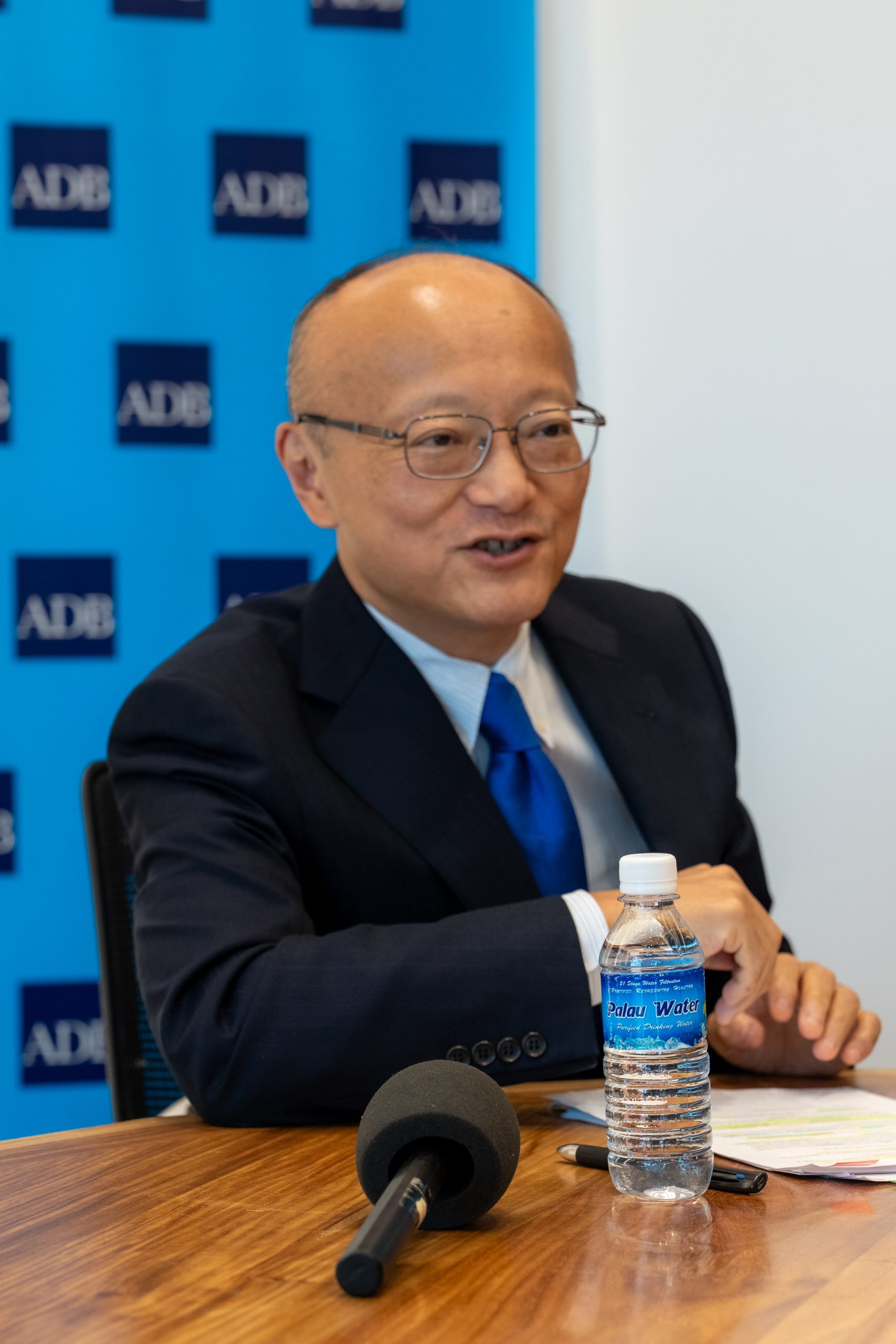
Speaking at a media roundtable on the margins of the 55th Pacific Islands Forum Leaders’ Meeting in Koror, Kanda said he deliberately chose Palau for his first meeting with the media following the announcement of his re-election as ADB President.
“This is my first time speaking with the press since the announcement of my re-election.
“So, this is a bit special to me, and I chose to do it here in Palau, in the Pacific. That is deliberate
“The Pacific is not the edge of our region or the Asia-Pacific, but it is at the centre — centre of how ADB thinks about the future,” Kanda said.
Kanda said he viewed his re-election not simply as an endorsement of his first term, but as a mandate for the next five years.
“I take it not as an endorsement of my first term, but as an instruction about the next five years,” he said.
Kanda said Asia and the Pacific were increasingly connected by global risks but had yet to fully connect the opportunities available through stronger infrastructure, markets and investment.
“Asia and the Pacific is connected for risk, but not yet for opportunity,” he said.
He highlighted the impact of conflicts and global shocks, saying they could quickly drive-up fuel, food and transport costs across the Pacific.
“When a conflict erupts on the other side of the world, the price of fuel, food and flights rises within weeks,” Kanda said.
He said the physical foundations for greater regional connectivity already existed through cables, grids, ports and agreements, but stronger links were needed to bring them together.
“What is still missing is what connects into one market — the interconnectors, the exchange points and the common rules,” he said.
“Changing that is the work of the second term.”
“One region, one connected future,” Kanda said.
Kanda said the ADB had committed US$70 billion to build what he described as an Asia-Pacific digital highway.
He said the Bank had also amended its charter for the first time in its history, unlocking 50 percent more finance without requiring additional capital from shareholders.
“We have committed US$70 billion to the Asia-Pacific digital highway,” he said.
Kanda said ADB was also aiming to increase private investment fourfold to US$13 billion annually by 2030.
The increased focus on private sector investment is expected to be a major part of the Bank’s next phase of work in the Pacific, where governments have repeatedly raised concerns about limited public sector capacity and the need to attract more private capital.
Kanda said his visit to the Pacific Islands Forum Leaders’ Meeting was aimed at listening to Pacific governments and responding to their priorities.
“I came to this Pacific Islands Forum Leaders’ Meeting to listen and to act,” he said.
He said ADB was strengthening its presence in the region by upgrading its office in the North Pacific and opening a private sector hub in Palau.
The Bank is also supporting Palau’s renewable energy transition and fiscal reforms.
Kanda said ADB was developing a new Pacific approach based on priorities identified by Pacific countries themselves.
“Our regional strategy is shaped by what you have asked of us,” he said.
“Not what we are imposing, but you told us what to do.”
Kanda said ADB would move away from a one-size-fits-all approach and develop long-term programmes tailored to the circumstances of individual Pacific countries.
“Long-term programmes tailored to each country — not one size fits all, but tailored to each country’s specific circumstances,” he said.
He said the Bank also wanted more decisions to be made closer to Pacific communities.
“Listening more and prescribing less,” Kanda said.
Kanda said the Bank wanted to work with the Pacific as a connected region rather than through fragmented approaches.
“We will not face the future as a fragmented vision.
“We will step forward as one.”
“Step forward as one with ADB as a steadfast anchor,” he said.