

By Pita Ligaiula in Koror, Palau
Pacific leaders have warned that the region’s ocean, livelihoods and low-lying communities face escalating risks if global warming exceeds 1.5 degrees Celsius, calling on major emitters to cut fossil fuel emissions and deliver on climate commitments before a temporary overshoot becomes permanent.
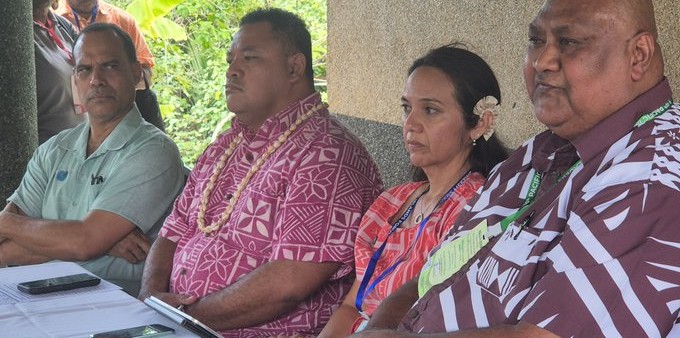
At a press conference on the margins of the 55th Pacific Islands Forum Leaders’ Meeting in Koror, Vanuatu Climate Change Minister Ralph Regenvanu, Tuvalu Climate Change Minister Dr Maina Talia, Marshall Islands Climate Envoy Tina Stege, SPREP Director General Sefanaia Nawadra and Pacific Community Deputy Director-General Dr Andrew Jones issued a renewed call for urgent global action.
Regenvanu said the latest scientific findings reinforced the need for governments to act immediately.
“Urgent action is needed by the international community to reduce greenhouse gas emissions.
“We must urgently accelerate the transition away from fossil fuels,” Regenvanu said
He warned that if emissions were not rapidly reduced in the next four years, an overshoot of 1.5 degrees Celsius would increase in both duration and severity, intensifying climate impacts and loss and damage across the Pacific.
“Loss and damage is a reality that currently exists in my country, in the countries represented here. It will only accelerate with any overshoot,” Regenvanu said.
He said no amount of finance could fully restore the losses facing Pacific communities.
“No finance can fully restore our lands, our ancestral lands, our heritage, our identity,” he said.
Regenvanu said the 1.5-degree pathway remained possible, but only under the highest level of global ambition.
“That means urgent and immediate global commitments and actions to keep overshoot extremely limited in both magnitude and duration,” he said.
The Vanuatu minister said this required a rapid transition away from fossil fuels and fossil fuel subsidies.
“There’s no other way,” he said.
Pacific leaders are also pushing for a 1.5-degree-aligned regional pathway, including a 100 percent renewable energy future for Pacific Small Island Developing States.
Regenvanu said the Belau Declaration being considered by Forum leaders again identified climate change as the Pacific’s greatest security threat.
“This report makes it clear that high ambition is the only way we are going to get through this,” he said.
Tuvalu Minister for Climate Change and Environment, Dr Maina Talia said the latest report on a possible 1.5-degree overshoot was particularly alarming for low-lying island countries.
“The message is very clear from the report that was released yesterday — we need to do more,” Talia said.
“We need to do more in order for all people to stay in their God-given land.”
He said climate change was already having disproportionate impacts on Pacific countries and warned that the consequences were no longer a distant threat.
“It’s real now, it’s here now, it’s no longer a distant threat for the Pacific,” Talia said.
Talia said the impacts could extend beyond sea-level rise to Pacific tuna stocks, threatening countries such as Tuvalu that depend heavily on the fisheries sector.
“The only way out for us is to ensure that we continue to push for 1.5 to stay alive,” he said.
He said projections once expected over the next century could now become reality much sooner.
“The scenarios that may happen in the next 100 years or so could happen within the next 10 years or so,” Talia said.
Marshall Islands Climate Envoy and Regional Envoy for Oceania for COP31, Tina Stege said the report showed that an overshoot would sharply increase the investments needed for mitigation and adaptation.
She said urgent and concrete progress was required on climate finance, including support for loss and damage.
“We should all be very frank — that fund is empty,” Stege said, referring to the need to ensure financing mechanisms can respond to growing climate disasters.
Stege also called for concrete measures to reduce bureaucracy and improve Pacific countries’ access to climate finance.
She highlighted the Pacific Resilience Facility (PRF) as an example of Pacific-led action, describing it as the region’s first Pacific-owned and led sustainable financial facility.
“It’s a lifeline,” she said.
“This report is just yet another alarm bell to wake up the rest of the world,” Stege said
SPREP Director General, Sefanaia Nawadra said the risk of overshooting 1.5 degrees had been known for some time because major global commitments had not been translated into sufficient action.
“We are no longer trying to get an upward trend down, but now we have to overshoot and go down again,” he said.
Nawadra said a temporary overshoot would only remain temporary if governments acted.
“It’s only temporary if you take the action as leaders,” he said.
He said Pacific Island countries had continued to push for faster action, but major emitters needed to fulfil their pledges.
“We’re doing our part. But what we need to do is to get the big emitters to fulfil the pledges that they made,” Nawadra said.
He warned that the world was approaching dangerous tipping points.
“The elasticity is almost gone,” he said.
“If you reach the tipping point, the rubber band snaps, then we are all in really big trouble,” Nawadra said.
SPC Deputy Director-General. Dr Andrew Jones said Pacific scientists were already documenting what rising sea levels could mean for low-lying countries.
For Tuvalu, a flooding event currently considered a one-in-100-year event could become a one-in-10-year event by 2050, according to the figures presented by SPC.
Such events could cause between US$35 million and US$45 million in damage each year.
By the end of the century, flooding could become a one-in-five-year event or even more frequent, with annual damage potentially reaching US$63 million.
But Jones said the most serious threat could be the loss of habitability.
“Long before these countries reach that area, habitability is going to be a real issue,” he said.
Saltwater overtopping could affect freshwater supplies, agriculture and communities.
“The key point about sea level rise is that it won’t come back.
“We really need to mitigate, we need to adapt, to give us more time to put the sort of adaptation measures in place that will allow these low-lying countries to deal with this 1.5 overshoot,” Dr Jones said.
The Pacific leaders’ message was clear that the region will continue to push to keep 1.5 degrees alive, but global commitments must now be matched by immediate action.
“There’s no other way,” Regenvanu said.