
By Nic Maclellan
A speech before the United Nations mentioning Vanuatu’s claims of sovereignty over Umaenupne (Matthew) and Umaeneag (Hunter) islands has sparked a bitter war of words in neighbouring New Caledonia, after a leading anti-independence politician
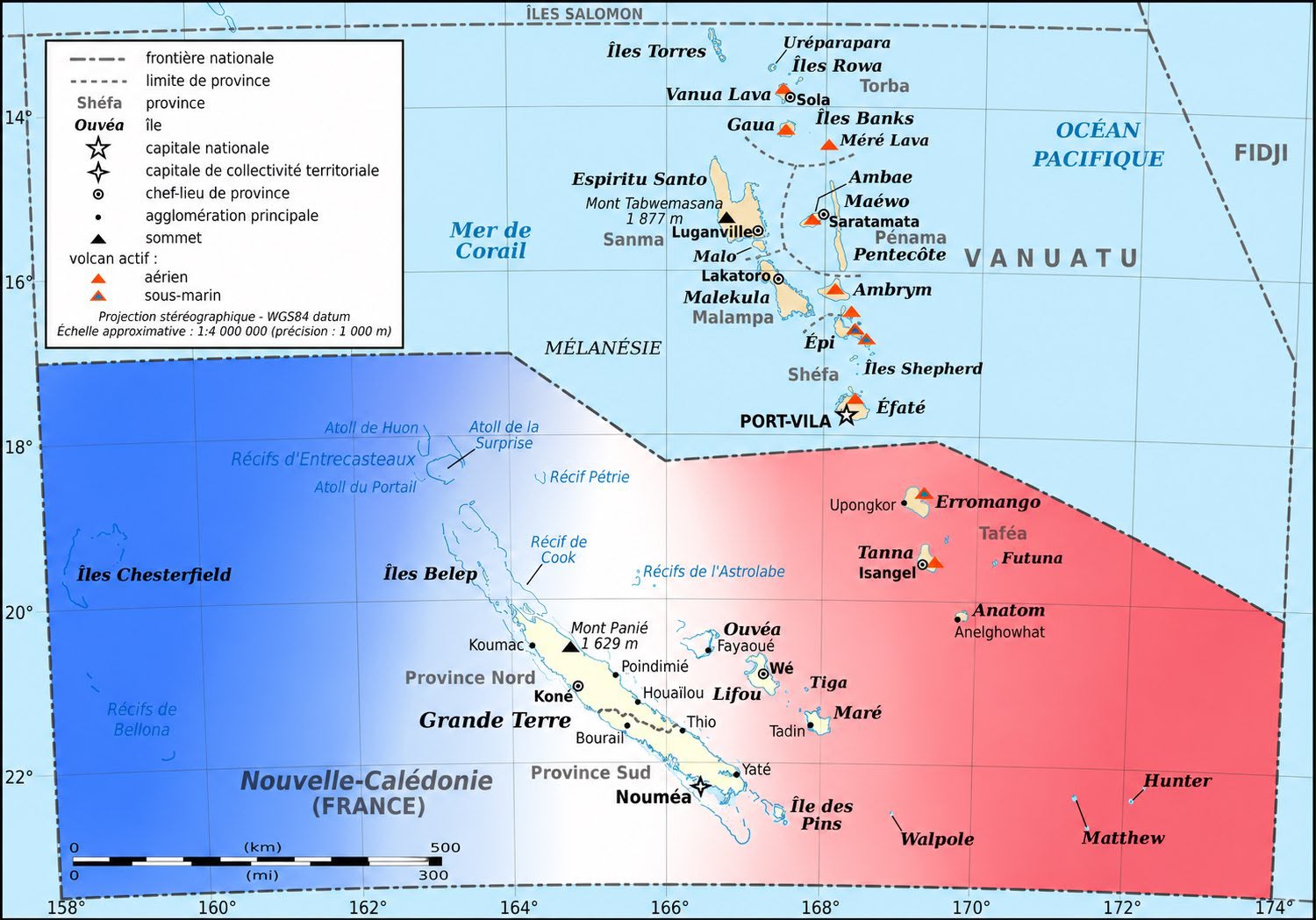
Addressing the UN General Assembly on 28 September, Vanuatu’s Permanent Representative to the United Nations Ambassador Oda Tevi briefly mentioned that his nation had lodged an application with the world’s highest court, the International Court of Justice, seeking recognition of its sovereignty over Matthew and Hunter.
The UN speech sparked an angry response from Nicolas Metzdorf, one of two New Caledonian deputies in the French National Assembly, who issued a sarcastic and racist open letter to Vanuatu Prime Minister Jotham Napat. Metzdorf’s polemic is part of a wider campaign by far-Right parties in France and New Caledonia to undercut any negotiated solution to the long running dispute over sovereignty of the two uninhabited islands.
ICJ arbitration
France and Vanuatu have long claimed sovereignty over the two uninhabited volcanic islands, located east of New Caledonia and southeast of Vanuatu. However, Tevi stated that “these islands are an integral part of Vanuatu’s territory, grounded in customary governance, longstanding historical connection, indigenous ownership and seen as a part of our duty as ancestral custodians to protect and preserve.”
Vanuatu’s position has been endorsed by the national councils of chiefs in both island nations – Vanuatu’s Malvatumauri and New Caledonia’s Sénat Coutumier (Kanak Customary Senate) – as well as the New Caledonian independence coalition Front de Libération Nationale Kanak et Socialiste (FLNKS). The support of New Caledonian customary and political leaders for Vanuatu’s sovereignty claim was codified in the 2009 Keamu Accord.
The decision to launch an ICJ case in late August came after the Vanuatu government walked away from bilateral negotiations with France, over the sovereignty claim and the disputed maritime boundary with the neighbouring French Pacific colony of New Caledonia. However, France does not accept the ICJ’s compulsory jurisdiction over disputes with other states, and the French government is yet to announce whether it will participate in the arbitration over Matthew and Hunter.
Addressing the UNGA, Ambassador Oda Tevi sought to encourage the French State to participate in the ICJ arbitration.
“We recognise France as a steadfast champion of the international rules-based order and, under the leadership of President Macron, a strong supporter of international judicial institutions” Tevi said.
“France has stood alongside Vanuatu in advancing global climate action, including through its support for our initiative before the International Court of Justice. We greatly value this partnership and France’s leadership on issues of international importance. It is in that same spirit of mutual respect and commitment to international law that we respectfully invite France to consent to the jurisdiction of the Court.”
It’s notable that when he addressed the UN General Assembly on 22 September, French President Emmanuel Macron personally endorsed the work of the ICJ, noting that “it is also because there can be no peace without justice that France continues to provide both political and operational support to international mechanisms for justice, investigation and evidence-gathering – in particular fact-finding missions – and that we continue, and will continue, to support the International Court of Justice and its central role.”
Despite President Macron’s words of praise for the ICJ and international law, the French government is under pressure from far-Right parties in both France and New Caledonia to reject Vanuatu’s claim of sovereignty.
Polemics in New Caledonia
With just five months before the next French presidential election – when Macron completes his second term in office – the far-Right are mobilising to ensure the French government rejects the jurisdiction of the ICJ in the Matthew and Hunter case.
Metzdorf, leader of the conservative anti-independence party Générations NC, is a leading member of the Loyalist bloc and a fierce partisan of French colonialism in New Caledonia.
Writing to Prime Minister Jotham Napat of the “Condominium of the New Hebrides” on 1 October, with carbon copies to Emmanuel Macron and Xi Jinping, Metzdorf’s sarcastic polemic reflected the bitter opposition to Melanesian identity that is a feature of the New Caledonian Right.
Referring to Vanuatu as the New Hebrides is a calculated insult designed to remind ni-Vanuatu of the period of joint British-French rule, during the condominium between 1906 until 1980.
It is a standard trope of the colonial Right that Vanuatu’s independence in 1980 led to poverty and economic disarray, and Metzdorf wrote: “You are clearly seeking to extend to these isolated rocks the exemplary model of success that has characterised the New Hebrides ever since it changed its administering power. Who could doubt your eagerness to share with these islands and their populations of shearwaters, terns and whitethroats your economic dynamism, your social model, your education system and the power of the vatu?”
Successive French governments have sought to maintain the claim to the Exclusive Economic Zone around Matthew and Hunter. Metzdorf went further, issuing a map that posed a revised maritime boundary between New Caledonia and Vanuatu, incorporating Vanuatu’s southern islands Tanna, Erromango, Aneityum and Futuna into New Caledonia by means of a “land lease for an indefinite period.”
Metzdorf said that if those islands joined the French colony, the offer would include free schooling and health care and “we would also be delighted to offer the residents of these islands French nationality and a European passport.”
FLNKS condemns “racial hatred”
In a statement, the New Caledonian independence coalition Front de Libération Nationale Kanak et Socialiste (FLNKS) condemned Metzdorf’s “supremacism and racial hatred” and called for an apology to the government and people of Vanuatu.
“In a condescending tone, steeped in neo-colonial paternalism and contemptuous irony, the deputy for New Caledonia’s first constituency – who often sets himself up as the spokesperson of the French Republic – has once again taken it upon himself to insult a people and a nation. He seems to forget that our ancestors had been criss-crossing the Pacific for millennia long before his forebears arrived to settle permanently amongst us in Melanesia.”
FLNKS President Christian Tein called on the French Government and French National Assembly to disavow Metzdorf’s polemic: “Racist, xenophobic and childish remarks directed at our sister nation in Melanesia must no longer be tolerated. Addressing a letter to the Prime Minister of the ‘New Hebrides Condominium’ constitutes a diplomatic offence too gross to be ignored.
“The FLNKS strongly condemns the remarks made by deputy Metzdorf and solemnly calls upon his group leader in the National Assembly, as well as the President of the French Republic, to take disciplinary action against him and to offer France’s apologies to the Prime Minister and the people of Vanuatu.”
The war of words over Matthew and Hunter will likely continue in coming months until the French presidential elections. But will President Macron have the courage to back up his words on the importance of the ICJ and accept its jurisdiction in this case, or stay silent and highlight France’s ongoing colonial role in the region?