Negotiations in the Mitigation work stream of COP31 continue as the second and last week of COP31 in Türkiye kicks into gear.
Along with Adaptation, Mitigation is one of the two central approaches in the international climate change process. Mitigation involves human interventions to reduce the emissions of greenhouse gases by sources or enhance their removal from the atmosphere by “sinks”.
A “sink” refers to forests, vegetation or soils that can reabsorb CO2.
Carbon dioxide is the largest contributing gas to the greenhouse effect.
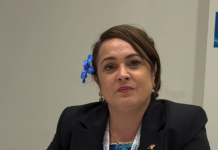
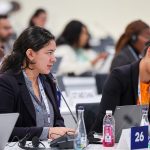
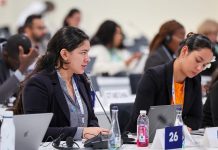
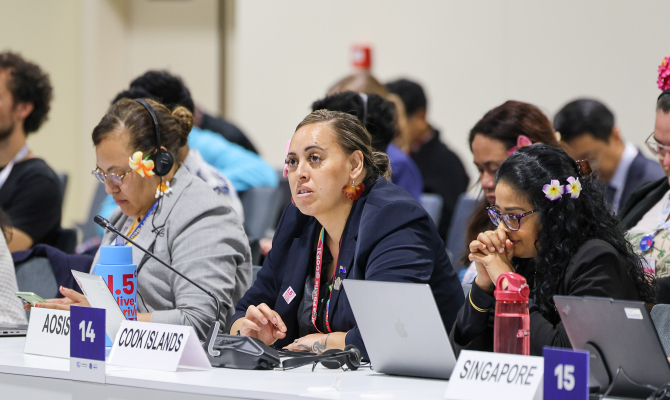
“The Mitigation team continues to hold the line on 1.5 supported by the best available science from IPCC,” says AOSIS and PSIDs Mitigation Coordinator, Charlene Hoff, from the Cook Islands, on the progress of their work.
At the start of Week 2 of COP31 in Antalya, Ms Hoff and her team provide us with an update from the Mitigation work track:
QUESTION: Can you tell us what the key asks are from the Pacific at COP31?
ANSWER: The key asks for the Pacific in Mitigation centre around keeping 1.5 alive as well as ensuring the best available science from IPCC is protected to achieve our 1.5 goal.
Pacific countries also came to push for the continuation of the Mitigation Work Programme (MWP) with enhanced improvements to urgently scale up mitigation ambition and implementation in this critical decade, as well as for the MWP to be the implementation space for the GST1 para28 – Energy Package (including tripling renewable energy package and double energy efficiency).
We call on all parties to urgently cut emissions through accelerating the transition away from fossil fuels especially major emitters. The Pacific also believe that in the current fossil fuel energy crisis which is crippling SIDS’ economies, renewables are the way to energy security and to limit the magnitude and duration of overshoot.
We encourage Parties to deliver on their promises in their NDCs, as well as to ensure the Special Circumstances of SIDS are recognised in all decisions being made.
QUESTION: How have negotiations progressed/or the lack of progress in Antalya?
ANSWER: In the Mitigation Work Programme (MWP) room, there has been convergence from all Parties for the continuation of the MWP. Everything else to do with the MWP is now being negotiated – duration, mandate, objective, scope, etc
Two informal notes were released on Thursday and Saturday. However, Parties stated they were not given enough time to review the second iteration of the text so there was much divergence in the room on Saturday afternoon.
The last MWP convening at 10pm on Saturday night was where Parties agreed to revert to the first informal note from Thursday and have that forwarded to CMA8 this week.
In the NDC Features room, Groups of Parties and Parties are still making interventions on what their interpretation is of NDC Features and what all that entail. There has bee no informal note. Negotiations continue.
QUESTION: How do you see negotiations playing out in the remaining days of COP31. And what will it take for a positive outcome in as far as the Pacific is concerned?
ANSWER: We are hoping that the duration, mandate, objective, scope and all other matters pertaining to the (new) MWP will be resolved this week at CMA8. The Mitigation team continues to hold the line on 1.5 supported by the best available science from IPCC.
The 31st Conference of the Parties (COP31) to the UN Framework Convention on Climate Change (UNFCCC) is taking place from 9-20 November 2026 in Antalya, Türkiye.
The Pacific Islands Parties to the UNFCCC are Cook Islands, Federated States of Micronesia, Fiji, Kiribati, Republic of Marshall Islands, Republic of Naoero, Niue, Palau, Papua New Guinea, Samoa, Solomon Islands, Tonga, Tuvalu and Vanuatu.
For further information on the Pacific at COP31 please visit: www.sprep.org/cop31