

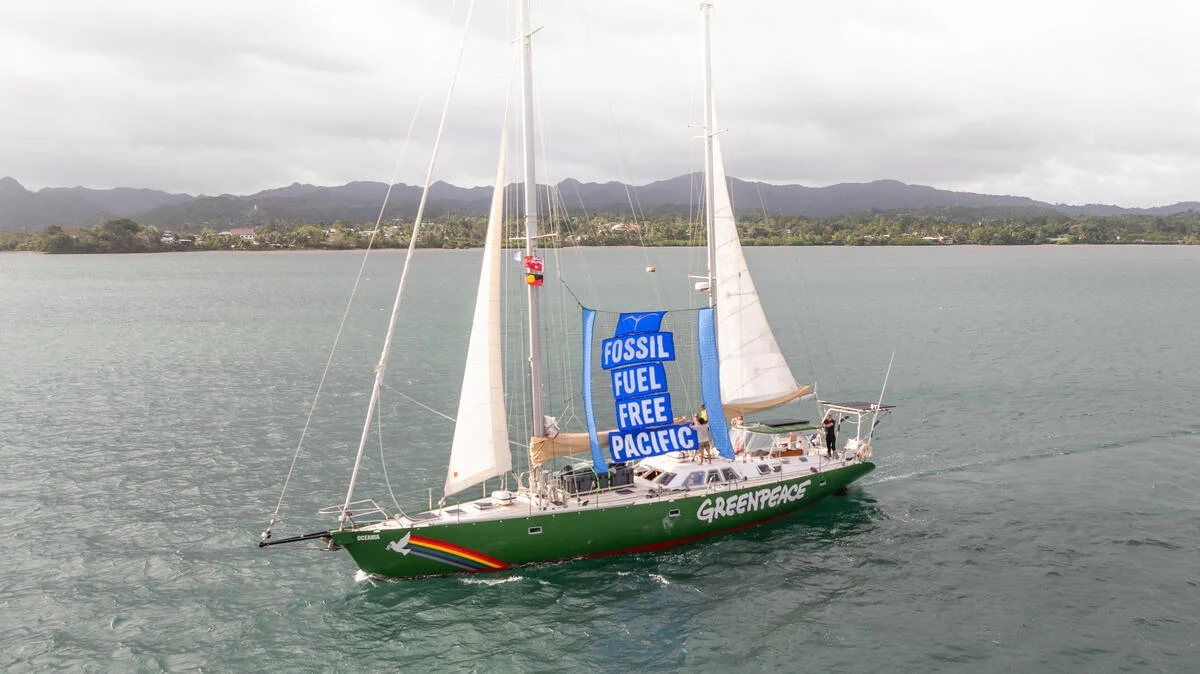
Greenpeace Australia Pacific and Amnesty International are calling on governments meeting at the Pacific Pre-COP31 in Fiji and Tuvalu to turn climate commitments into action, with an immediate focus on ending fossil fuel expansion and increasing climate finance for vulnerable countries.
The organisations say the Pre-COP meeting must put Pacific priorities at the centre of preparations for COP31 in Türkiye, warning that Pacific communities cannot continue to bear the consequences of a climate crisis they have contributed little to causing.
Speaking in Nadi, Greenpeace Australia Pacific Head of Pacific Shiva Gounden said governments needed to listen to Pacific leaders and communities and respond to the scale of the climate crisis.
“We must listen to Pacific leaders and communities who are sick of Australia’s double talk on climate, and want to see the actions of the most polluting nations respond to the urgency and scale of the crisis we face,” Gounden said.
He said the Pacific should not become a “sacrifice zone” for major polluters and fossil fuel companies.
Gounden said the 1.5°C target remained a scientific, moral and legal limit and pointed to the Pacific-led International Court of Justice advisory opinion on climate change obligations.
“As Australia prepares to chair the upcoming COP31 talks in partnership with the Pacific, it must do much more to turn empty rhetoric into real action to end the fossil fuel chokehold,” he said.
Greenpeace COP31 Lead and climate expert Simon Bradshaw said Australia’s role as President of Negotiations at COP31 gave it an added responsibility to demonstrate climate action.
He criticised the Australian Government’s continued approval of fossil fuel projects, saying climate commitments needed to be matched by action to phase out coal and gas.
“At the Pre-COP, words must be matched with real action to phase out fossil fuels.
“We cannot help decarbonise the world without action at home to halt fossil fuel approvals and phase out coal and gas exports,” Bradshaw said.
Amnesty International Secretary-General Agnès Callamard also called for stronger action, saying the absence of some world leaders from the Pre-COP should not become an excuse for inaction.
“World leaders have spent years talking about the climate threats facing the Pacific. Now they must come to Fiji and Tuvalu, listen to Pacific communities and act.
“An empty seat is not the greatest failure. The greater failure is an empty promise,” Callamard said.
Amnesty said climate change was already affecting human rights across Pacific island countries through rising seas, extreme heat, drought and saltwater intrusion, threatening access to water, food, health and adequate housing.
The organisation highlighted Tuvalu’s exposure to climate change despite contributing less than 0.003 percent of global greenhouse gas emissions.
Callamard said governments had a legal and moral responsibility to protect communities from climate change.
“Climate action is no longer simply a political choice. It is a legal and moral imperative,” she said.
Amnesty is calling for governments to end fossil fuel expansion, accelerate a just transition to renewable energy and increase public, grants-based finance for mitigation, adaptation and loss and damage.
It also called for greater support for communities affected by the transition away from fossil fuels, including Indigenous Peoples.
Callamard said Australia, as President of Negotiations at COP31, should use its role to secure an ambitious, human rights-centred outcome.
“Pacific leadership has helped keep the fight for 1.5°C alive, but Pacific communities cannot carry the burden of global climate leadership alone,” she said.
Both organisations also raised concerns about the treatment of environmental human rights defenders and called on governments to ensure civil society, Indigenous Peoples and affected communities can participate in climate decision-making and peacefully protest without intimidation or reprisals.
Amnesty said Australia and Fiji should ensure environmental defenders can participate meaningfully in climate discussions.
“Environmental defenders are protecting our shared future. Governments must listen to them, protect them and ensure they have a meaningful say in climate decisions,” Callamard said.
The Pacific Pre-COP31 meetings are being held in Fiji and Tuvalu ahead of COP31 in Antalya, Türkiye, in November.