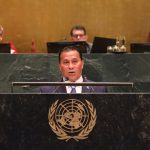


For Fiji’s Ambassador to the United Nations, rising seas threaten more than coastlines. They threaten the bonds between people, place and identity — and his country’s experience offers lessons in protecting them.
Filipo Tarakinikini knows what it means for a community to leave home.
Long before he became Fiji’s Ambassador to the United Nations, he grew up hearing stories about the floods that forced his own community to move.
In the 1950s, Delailasakau and Naseuvou — the two villages that make up his community in Fiji’s Waidina River valley — were relocated. But the memories of what was left behind endured.
“I grew up with the stories of what it cost our elders to leave the land where their ancestors lay,” he recalls.
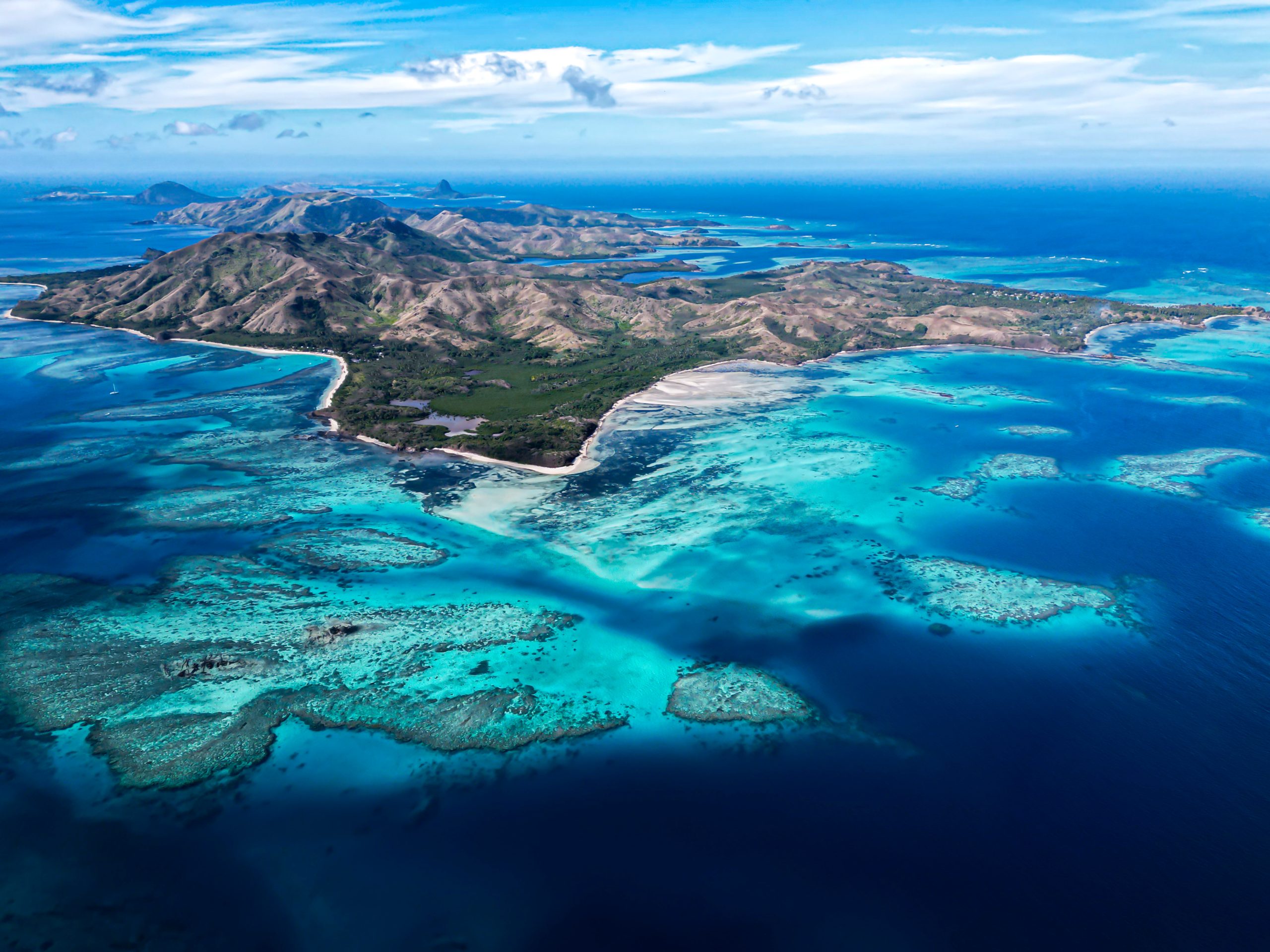
Today, communities along Fiji’s coast face a similar choice as seas rise. Seawalls are failing. Saltwater is reaching gardens. Graves are being exposed by the tide.
And the question is no longer simply where people can move. It is what they risk losing when they do.
River flows through lush valley in Fiji.
More than a place
Speaking in a virtual interview with the UN Department of Global Communications on 18 August 2026,Tarakinikini describes a connection to land that cannot simply be rebuilt somewhere else.
For Indigenous Fijians, or iTaukei, identity is bound to the vanua — the land, the people and their ancestors together.
“When I go home to Fiji, I return to a place that reminds me who I am and why I left to work abroad.”
What happens, then, when people can no longer live there?
“The question many Pacific people now carry is what becomes of our tradition and culture if that place is gone.”
It is a question with growing relevance far beyond the Pacific.
Around 770 million people worldwide live less than five metres above the high tide line. Rising seas are already bringing saltwater into freshwater and farmland, damaging schools and hospitals and disrupting fisheries and tourism. The effects reach into health, livelihoods and cultural heritage.
The science points to an accelerating problem. As the planet warms, seawater expands and melting glaciers and ice sheets add more water to the ocean. Between 2014 and 2023, the global sea level rose by an average of 4.7 millimetres a year. In 2024, the rise reached 5.9 millimetres.
Some further sea level rise is already unavoidable, but cutting emissions can limit how much more occurs.
What does the threat mean for people?
For Tarakinikini, that is the essential question.
Before entering diplomacy, he spent 22 years in Fiji’s military and another 22 in UN security service, working in places including Darfur, Yemen, Libya and Pakistan.
“That earlier work taught me to judge threats by what they do to ordinary people, not by how they look on paper.”
The same principle guides his thinking about communities threatened by rising seas.
Relocation, he says, should be a last resort, after other ways of adapting have been exhausted. And when moving becomes unavoidable, communities need to be at the centre of the decision — with information, time and the right to say no.
“Moving a village is not a construction project. It is about protecting lives while preserving culture, identity, livelihoods and a community’s bond with the vanua.”
Fiji has been trying to put those principles into practice. The country adopted Planned Relocation Guidelines in 2018, established a Climate Relocation of Communities Trust Fund and approved Standard Operating Procedures in 2023.
Tarakinikini says work on a cultural checklist and a framework for free, prior and informed consent aims to give culture and community voices a stronger place in relocation decisions.
But Fiji has also learned from what did not work. Some early relocations, carried out before the guidelines existed, are still being put right.
“We learned that moving houses is the easy part. Maintaining livelihoods, land rights, water, schools and the bond between people and place is the hard part.”
Can a country survive if its land cannot?
For some low-lying island nations, rising seas pose an even more fundamental question: what happens to a country if its territory becomes uninhabitable — or disappears beneath the sea?
The answer matters for nationality, self-determination and preventing statelessness.
The International Law Commission and the International Court of Justice have identified strong support among States for the continuation of statehood in the face of rising seas.
There is another issue beneath the waves: maritime rights.
Under the UN Convention on the Law of the Sea, maritime zones are measured from baselines generally drawn along the coast at the low-water line. If those lines were required to move as coastlines retreat, countries’ rights over fisheries and other marine resources could be affected.
Both UN bodies have clarified that the Convention does not require States to update baselines or the outer limits of maritime zones once established in conformity with it.
For Tarakinikini, these legal debates ultimately come back to people.
“We are not asking for new rules for ourselves. We are asking that the law continue to protect us as the sea rises.”
From sympathy to action
And yet, laws alone will not protect communities on the front line.
Tarakinikini calls for practical support: grants that arrive when they are needed, simpler funding applications that small administrations can manage, and investment in early warning systems and local expertise.
The Pacific region is also developing its own response to that financing gap. The Pacific Resilience Facility is the first climate and disaster resilience financing institution led, owned and managed by Pacific countries themselves. Hosted in Tonga, it is designed to get grants directly to communities for locally chosen projects — including climate adaptation, disaster preparedness and responses to loss and damage.
Fifteen Pacific Islands Forum Leaders signed the treaty establishing the Facility in September 2025, and it entered into force in May 2026. The region is now working towards an initial capitalization of US$500 million by the end of 2026, with a longer-term goal of US$1.5 billion.
For communities faced with saltwater intrusion, failing seawalls and, in some cases, relocation, the challenge is often not a lack of plans but finance that arrives too late or through processes that are difficult for small administrations to navigate. The Facility is the region’s attempt to close that gap.
“And we need debt relief that recognises you cannot adapt while still repaying the costs of the last disaster.”
These questions will be in the global spotlight at the General Assembly’s high-level meeting on sea level rise on 24 September .
What does the Ambassador want the meeting to deliver?
“Clear political commitment in place of sympathy.”
That means commitments on maritime zones, continued statehood and the protection of affected people — backed by finance, data and adaptation.
For the communities he represents, the stakes are intensely personal. The decisions being made today will help determine not only whether people can remain safe, but whether they can hold on to the relationships, livelihoods and traditions that turn a place into home.
“The sea does not negotiate, but we can.”
And his final message is not only for people living on small islands.
“To the public, I would say: do not treat this as a distant island story. It is the story of every coastline, and it is arriving everywhere at different speeds.” .