
Pacific nations have warned that the first United Nations Declaration on Sea Level Rise falls short of the legal protections and climate action needed to safeguard vulnerable island states, despite welcoming its adoption by consensus.
Speaking during the UN General Assembly debate on 12 October, Pacific representatives highlighted gaps in the declaration on maritime boundaries, continuity of statehood, human rights, climate finance and the need to reduce greenhouse gas emissions.
Papua New Guinea delivered the strongest criticism, warning that negotiations had weakened important provisions to secure agreement from all countries.
“The purpose of consensus should be to confer broad legitimacy. It should not become a veto by attrition,” PNG told the Assembly.
PNG said the process had forced the majority to accept weaker language to accommodate a small number of countries whose short-term economic interests remained tied to high greenhouse gas emissions.
“This veto by attrition transfers the price of consensus to the most vulnerable states,” its representative said.
Despite the shortcomings, PNG joined the consensus adopting the declaration, describing sea-level rise as an issue directly affecting the lives, livelihoods and future of its people.
The declaration, adopted on 24 September 2026, establishes a shared political framework for international action on rising seas. However, Pacific countries stressed that adoption must lead to practical measures and stronger protection under international law.
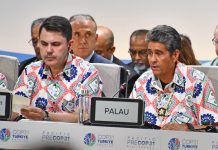
Speaking on behalf of the Pacific Islands Forum (PIF), Palau said rising seas were already affecting coastal communities, freshwater resources, food security and critical infrastructure across the region.
The representative called for accessible, predictable and adequate climate finance, including international support to capitalise the Pacific Resilience Facility, which the region has identified as a priority investment mechanism.
Palau also urged urgent global emissions reductions to keep the 1.5-degree Celsius temperature goal within reach.
“Every fraction of a degree matters, particularly for countries and communities already experiencing the consequences of climate change,” Palau told the Assembly.
Kiribati, speaking on behalf of the Pacific Small Island Developing States, highlighted the need to protect the human rights of people affected by sea-level rise, including the principle of non-refoulement, which protects people from being returned to places where they face serious harm.
Kiribati said climate finance must reach affected communities in good time and through processes that are simple to access.
Tuvalu stressed that rising seas must not undermine its statehood, sovereignty or maritime entitlements, warning that the physical changes to its territory could not be allowed to erase its rights under international law.
“Our rights under international law cannot be allowed to sink with our islands. Our maritime entitlement must endure,” Tuvalu said.
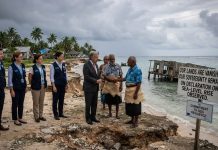
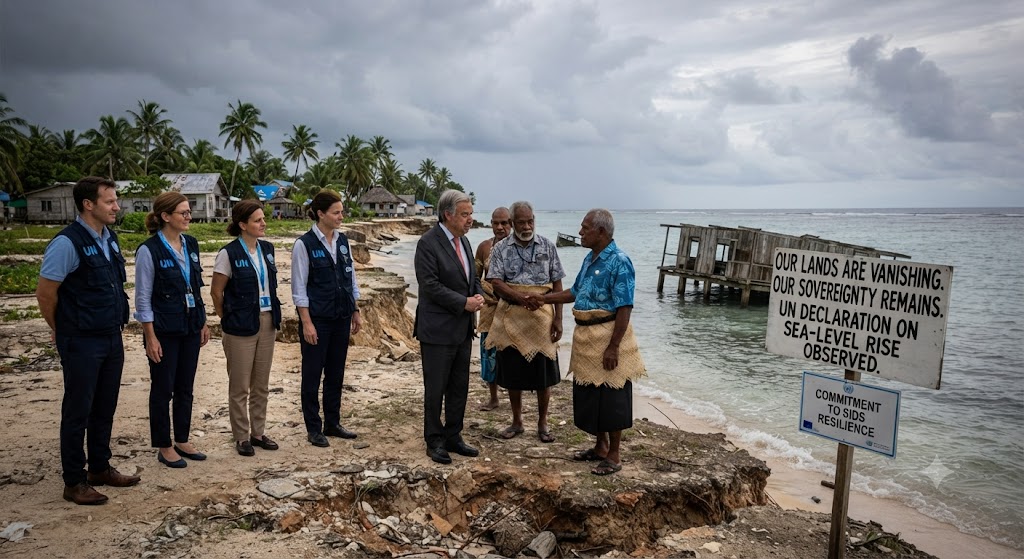
The country described sea-level rise as an existential threat, with seawater entering homes, contaminating freshwater, damaging crops and infrastructure, eroding coastlines and washing away ancestral graves.
Tuvalu called for accessible adaptation finance on better terms to support coastal protection, land reclamation and land elevation, alongside continued recognition of the continuity of statehood and the stability of maritime zones.
Vanuatu also called for stronger implementation, saying the declaration must mark the beginning of action rather than the end of negotiations.
Vanuatu told the Assembly that sea levels around the country could rise by up to 122 centimetres by the end of the century, potentially making more territory uninhabitable.
It cited the 2025 International Court of Justice advisory opinion on states’ obligations regarding climate change, saying the court had confirmed legal obligations to prevent significant harm to the climate system, cooperate in good faith and protect human rights.
Vanuatu called for time-bound national and regional action, scaled-up and predictable finance, technology and capacity-building support, and community-led approaches to climate mobility that protect people’s dignity, culture and choices.
“Small islands are showing that the way forward under international law” is possible in the face of unprecedented challenges, Vanuatu said.
The country also warned of continuing gaps in legal frameworks, planned relocation pathways, finance and political commitment.
The Pacific interventions reaffirmed the region’s position that rising seas must not extinguish statehood, sovereignty, established maritime zones or rights under international law.
The countries also pointed to earlier Pacific Islands Forum declarations in 2021 and 2023, which set out the region’s position on preserving maritime zones and ensuring continuity of statehood despite climate-related sea-level rise.
While welcoming the declaration as an important international achievement, Pacific representatives said its value would depend on implementation, stronger climate action and resources reaching the communities most affected.
For the Pacific, the central challenge remains ensuring that rising seas do not threaten the legal identity and rights of island nations, while global action keeps pace with the physical impacts of climate change.