

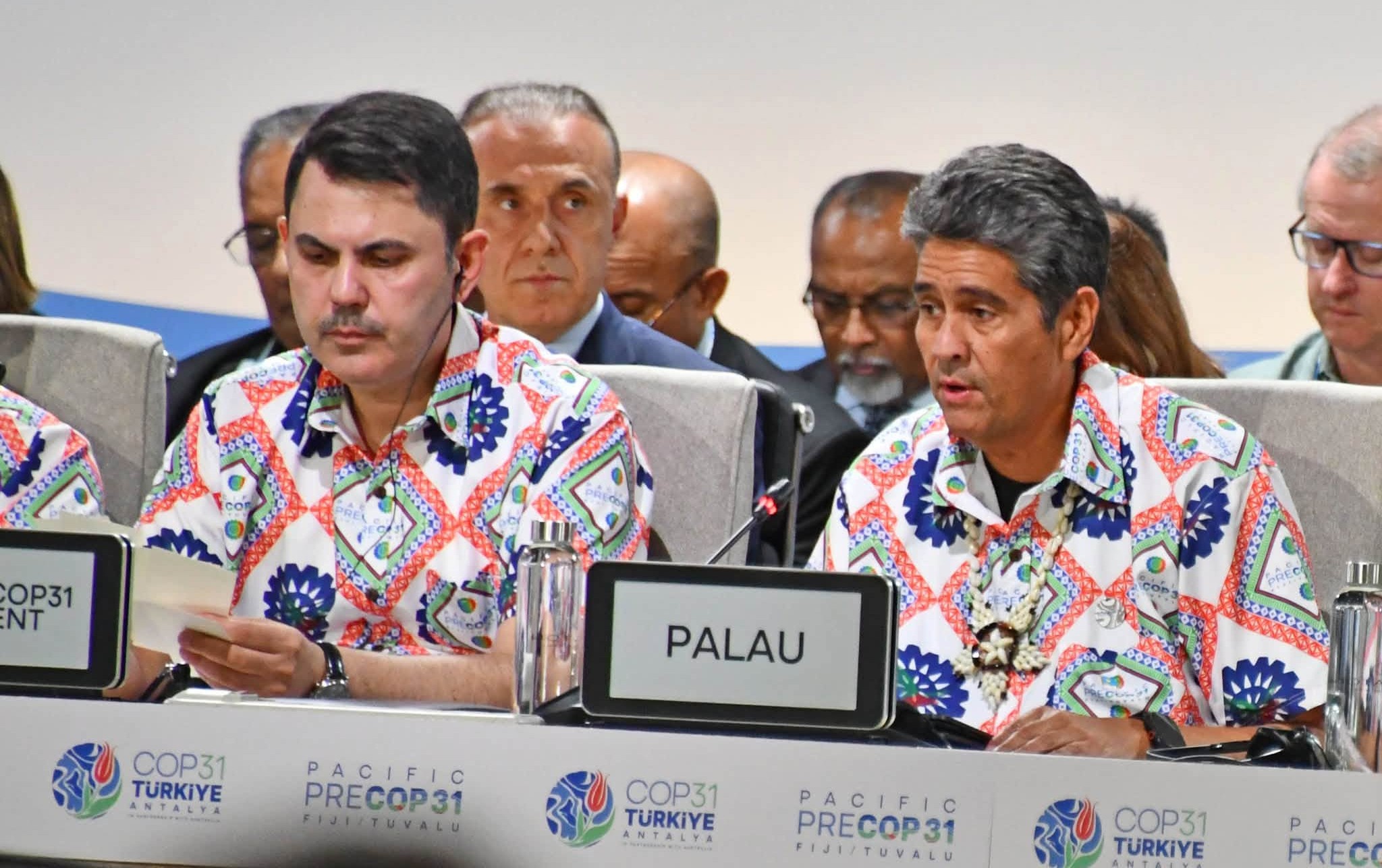
Palau President Surangel Whipps Jr claims the Pacific island nation of just 18,000 people is under assault from an influx of illegal drugs that threaten governmental and social stability.
The culprits, he says, are Chinese nationals.
“Drugs have been on the rise, especially crystal meth, and we now have 13 Chinese imprisoned in Palau,” Whipps told reporters during the Pacific Islands Forum Leaders Meeting (PIFLM) his country hosted from late August to early September, expressing exasperation at a situation that has compounded prison overcrowding.
The archipelago’s only jail, with a capacity of 65 prisoners, held 113 as of the end of September, the 13 Chinese accounting for 11.5 percent of those incarcerated. Six Chinese nationals were sentenced between July and October last year for trafficking, possessing or attempting to import illicit drugs, according to announcements posted on Palau’s Ministry of Justice’s Facebook page.
On Tuesday, the overall number of prisoners stood at 107, with the number of Chinese at 12, or 11 percent of the total, according to the ministry. Chinese made up the largest foreign nationality, it said.
Palau is one of few countries that maintain diplomatic relations with Taiwan rather than China and Whipps has been critical of Beijing. In 2024, he accused it of being behind a cyberattack on his country. China’s foreign ministry countered that the country “firmly opposes and cracks down on all forms of cyberattacks.”
And while Whipps did not claim any direct Chinese government involvement in the drug issue, he told Nikkei Asia that what the Chinese nationals bring in is “directed at the Palau market” so they “can make money here and they can weaken our government and our social structures.”
In May 2025, a court in the Northern Mariana Islands sentenced a Chinese national to 25 years in prison in a methamphetamine case that stretched from Saipan and Guam to Palau, where he had fled and was convicted of manslaughter in the killing of another Chinese national before being extradited.
Whipps cited the case as an example of the problem’s cross-border nature and called for greater cooperation and improvement in sharing information in the Pacific region to prevent such “bad actors” from entering the region “because they are destroying our youth, destabilising our countries.”
Nikkei Asia has reached out to China’s foreign and justice ministries for comment.
Palau, located east of the Philippines and north of Indonesia, is not the only Pacific country facing drug challenges, the causes of which vary.
The leaders recognise the problem and agreed in their PIFLM communique last month to “strengthen cooperation against transnational organised crime and illicit drug trafficking through enhanced intelligence sharing, coordination and maritime security cooperation.”
David Manning, Papua New Guinea’s police commissioner, told Nikkei Asia that while meth and its precursors brought there arrive “mostly out of Asia,” the “large majority” of illegal drugs coming through is cocaine from Central and South America.
That route, commonly known as the Pacific Drug Highway, brings narcotics via yachts and semi-submersibles destined for the lucrative Australian and New Zealand markets. Between January and May, 17 metric tons of illicit drugs, mostly cocaine, were seized in the Pacific, compared to 4.6 tons in all of 2025, Australian Federal Police said in May.
Caught in the middle of the route are small countries like Fiji, traditionally a transit point, but which is now seeing drugs on its streets. The Fiji Police Force recorded 2,446 cases of illicit drug activity in the year to May 2025, with 50 cases involving juveniles.
Driven by a sharp rise in intravenous meth use and unsanitary needle sharing. Fiji has seen an estimated increase of more than 3,000 percent in new HIV infections since 2010, according to UNAIDS modelling. It faces the fastest-growing HIV epidemic in the world, with health authorities in September declaring a national emergency for HIV, the virus that causes AIDS. One in every 60 adults now has HIV, says the Ministry of Health.
Jennifer Olegeriil, Palau’s justice minister, sees Fiji as a cautionary tale, saying it could be her country in five to 10 years.
“We can reach that point if we do not do the proper intervention at this point, and we need to do it big.”
Virginia Comolli, head of the Pacific Programme at the Global Initiative against Transnational Organised Crime, said Chinese criminal groups are exploiting opportunities in Palau, as it “presents a combination of characteristics that can make it attractive to transnational criminal networks.” Those include its proximity to Asia and “limited law-enforcement, border-control and regulatory capacity.”
In 2020, 57 Chinese nationals were convicted in Palau and later expelled after law enforcement conducted an online gambling raid at a hotel they were operating in without a license and without paying taxes, according to the Office of the Special Prosecutor.
Other similar incidents have followed, including a police raid in January 2025 that uncovered an online gambling and scamming operation involving 9 Chinese nationals working in a hotel who were later deported, according to a 2025 National Security Coordination Office (NSCO) report.
While Chinese or Chinese-speaking criminal networks have also conducted similar activities across Southeast Asia, “what makes Palau particularly significant is the scale of this activity relative to the country’s very small population and institutional capacity,” Comolli told Nikkei Asia.
John Hennessey-Niland, a former U.S Ambassador to Palau, said Chinese criminal organisations have long been active in the country and “really are a menace to the people here, and to good governance and stability,” specifically through cybercrime.
“They realise that because Palau doesn’t have official relations with Beijing, this may be a more benign place to operate,” he told Nikkei Asia.
“The long reach of Chinese police and authorities may be a little bit harder to get to here because Palau recognises Taiwan, so they may have felt this is a perfect spot.”
Olegeriil said she knows where the drugs come from, but did not identify the location.
“I enforce the law, so I deal with numbers and I follow the leads, I follow where the drugs come from, I follow where the money’s coming in from, and it’s leading me to one specific country and origin,” she said. “I haven’t seen any other leads taking me somewhere else.”
She added that smugglers bring drugs in suitcases, on their persons, through parcels delivered to the post office, drop offs on outer islands and containers on commercial cargo vehicles.
Graeme Smith, senior fellow at the Australian National University’s Department of Pacific Affairs, cited Palau’s ease of entry as an issue. “That is part of the problem of a lot of tourism-dependent Pacific countries, in that you rely on Chinese tourists, but you also rely on them being truthful when they enter the country. That’s a big vulnerability.”
China is currently Palau’s largest single source of tourists, with 20,792 Chinese visitors recorded in the first 8 months of 2026, making up over one-third of total international visitors, according to Bureau of Immigration data.
There has been some cooperation with authorities in China. Intelligence sharing by Palau with Macao uncovered a cross-border drug trafficking syndicate operating in the region and several arrests were made in the Chinese special administrative regions of Hong Kong and Macao, preventing 3.4 kilograms of meth from entering the Pacific country, according to the 2025 NSCO report.
But Comolli said that while “evidence points to an increasingly important Chinese dimension to methamphetamine trafficking in Palau, particularly since 2024,” other drug sources, including from the Philippines, the U.S and Guam, still play a role.
Olegeriil said illicit drugs are now gradually permeating Palauan society, with the customer base broadening. Sellers are “breaking it into components, which are more accessible and more affordable to different groups of the population.”
Nancy Wong, a member of Mechesil Belau, a prominent Palau women’s group, told Nikkei Asia addiction has been “getting worse,” contributing to a loss of productivity, an increase in thefts and robberies and families being torn apart.
In January, Whipps declared 2026 as the year to Just Say No to Illegal Drugs and launched a national working group in February to coordinate a unified response.
He signed a bill in May that expands drug testing and increases penalties for serious drug-related offenses.
Palau is also beefing up border security, from investing in airport X-ray machines to stationing narcotics officers in post offices. In June, Japan delivered new drug detection devices, expanding Palau’s customs screening capabilities at different points of entry. The U.S. has also provided drug-sniffing dogs.
“We’re sending a message out there that Palau is a nation of laws, and we are going to not just sit idly by while foreign influences come and bring the drugs to try and destroy our communities,” Olegeriil said.
“This is my message: we’re coming after you.”
But detection and interdiction are not enough to solve the problem, which requires an “all-inclusive approach” by government and society, she said. That means reinforcing education in schools about drug harms and implementing addiction treatment and counselling programmes in hospitals. Partners have been helpful, with Taiwan funding grants for 31 community organisations supporting antidrug initiatives earlier this year.
Mechesil Belau’s Wong noted the challenge but expressed confidence.
“We’re a small country. It can be contained or eradicated, but it takes everybody,” said Wong.