
Fiji’s Constitution Review Commission Report has been tabled in Parliament Tuesday, opening the next stage of consideration of sweeping proposed changes to the country’s political, electoral and governance systems.
The report, tabled during a special sitting of Parliament, contains recommendations developed from consultations across Fiji and submissions from individuals, faith-based organisations, civil society, Government ministries and other stakeholders.
Speaker of Parliament Filimone Jitoko said the report would now be made available to the public.
“Pursuant to Standing Order 38(3), the report must now be made available to the public,” Jitoko told Parliament.
He said he had instructed the Secretary-General to upload the report and its annexures to the parliamentary website.
MPs will also receive complete copies of the report and annexures, with USB copies to be distributed following the adjournment because of the size of the documents.
The report was tabled for information and will not be referred to a standing committee.
The Constitution Review Commission submitted its report and Draft Constitution to President Ratu Naiqama Lalabalavu on 31 August.
Government has previously stressed that tabling the report does not mean it has accepted or adopted all of the Commission’s recommendations.
The Commission received 1,220 submissions and 3,873 people participated in face-to-face consultations at 105 venues across Fiji.
Among its major proposals is the replacement of Fiji’s current unicameral Parliament with a 60-member bicameral legislature.
The proposed Parliament would comprise a 41-member House of Representatives and a 19-member Senate.
The Commission has proposed replacing the current single national constituency and proportional representation system with a Mixed Member Proportional system combining constituency-based first-past-the-post seats with proportional party-list seats.
It recommends an approximate 60:40 ratio between constituency and party-list seats and retaining the five per cent party-vote threshold for allocating list seats.
The Commission also proposes an independent Constituency Boundaries Commission, with electoral boundaries reviewed after every census.
The proposed Senate would be made up of members selected on the basis of “service, expertise and merit”, with safeguards intended to minimise political appointments and promote representation of women and young people.
The Commission has also proposed removing the appointment of the President from the current parliamentary process.
Instead, a seven-member Presidential Appointments Commission would appoint the President.
The proposed body would include the Prime Minister, Leader of the Opposition, three representatives of the Bose Levu Vakaturaga, one representative of the Fiji Council of Churches and one representative from interfaith religions.
The President would be limited to two three-year terms.
The Commission has also proposed new eligibility requirements for presidential nominees, including a requirement that nominees have remained outside political party office and candidacy for at least eight years.
The Commission recommends redefining the constitutional role of the Republic of Fiji Military Forces to emphasise democratic civilian authority and external defence.
Under the proposal, the military could provide domestic assistance to civil authorities only when authorised by Parliament.
The Commission would retain the Commander’s executive command of the RFMF but make that authority subject to Cabinet direction through the minister responsible for the military.
It also proposes a Military Court equivalent in status to the High Court.
The appointment process for the heads of the Police, Corrections and RFMF would also be standardised, with appointments made by the President on the advice of an independent Constitutional Offices Commission.
Other institutional reforms include strengthening the independence of the Public Service Commission and merging the Electoral Commission and Fijian Elections Office into a single electoral body.
The Commission has proposed changes to the Judicial Services Commission aimed at strengthening judicial independence.
It recommends that JSC appointments be made without consultation with the Attorney-General.
The report says the appointments should promote “broad representation, judicial wisdom and legal expertise”.
The proposed reforms would also separate the Attorney-General’s political and legal functions.
Under the proposal, the Solicitor-General would become the Government’s “independent legal adviser”, while the Attorney-General would retain a ministerial and policy role.
The Bose Levu Vakaturaga (BLV) or the Great Council of Chiefs (GCC) would be given constitutional status and wider responsibilities under the proposed Draft Constitution.
The proposed membership includes the President, Prime Minister, minister responsible for iTaukei affairs, six members nominated by the minister, 42 chiefs representing Fiji’s 14 provinces and three members nominated by the Rotuma Island Council.
The BLV would have responsibilities covering iTaukei culture, traditions, values, heritage, customary law and the wellbeing of iTaukei communities.
It would also monitor and advise on policies and legislation affecting the rights and interests of iTaukei communities and nominate three members to the proposed Presidential Appointments Commission.
Beyond iTaukei affairs, the proposed BLV would have a role in monitoring sources of division and conflict, encouraging dispute resolution and reconciliation, and promoting social cohesion and unity.
On the use of the term “Fijian”, the Commission recommends retaining it as the common national identity on an interim basis while establishing a formal process to build broader consensus on its long-term use.
The issue remained contentious during consultations, with submissions from some Indigenous Fijian communities calling for “Fijian” to be reserved for Indigenous people registered in the Vola ni Kawa Bula.
The Commission also recorded views supporting the continued use of “Fijian” as a common identity for all citizens.
It proposed a constitutionally prescribed process involving the State, the Bose Levu Vakaturaga and civil society to seek a long-term settlement.
The Commission said many Indigenous Fijians who participated in consultations were not necessarily opposed to sharing the name but wanted to have been consulted.
“Many Indigenous Fijians who spoke to the Commission said they did not mind sharing the name, but would have liked to have been asked,” the report states.
The recommendations contained in the report and Draft Constitution remain proposals.
They do not change Fiji’s current constitutional or electoral arrangements and would require the appropriate constitutional and parliamentary processes before they could take effect.
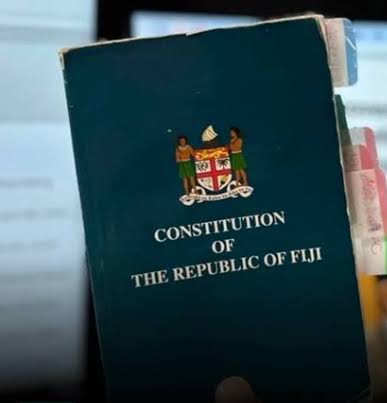
Meanwhile, Fiji’s Constitution Review Commission says that while a large number of submissions called for the complete removal of the 2013 Constitution, it was also urged not to discard provisions considered beneficial.
In its report, the Commission said strong views about the validity of the Constitution emerged during consultations, which it linked to Fiji’s constitutional history and what it described as the “obscure origins” of the 2013 Constitution.
“A large volume of submissions called for the full removal of the 2013 Constitution,” the Commission states.
However, it said other submissions cautioned that addressing what they regarded as the Constitution’s “democratic deficit” should not result in provisions considered beneficial being abandoned.
“We also heard from submitters that in addressing the democratic deficit of the 2013 Constitution, we would do well not to disregard its beneficial aspects,” the report states.
The Commission said it therefore adopted a selective approach to reform, recommending changes where they were considered necessary, supported by public submissions and reasonably justified in strengthening democracy, nation-building and the rule of law.
Where existing provisions were supported or had not attracted significant concerns, the Commission said it had generally avoided changing them.
The report also acknowledges that some proposed solutions draw on Fiji’s previous constitutional arrangements, but says simply returning to earlier systems would not necessarily address contemporary circumstances.
“People have told us they want a lasting constitution that provides the stability to move the country forward, while being responsive to citizens’ aspirations,” the Commission states.
It said Fiji’s social, political and economic circumstances had changed considerably and any constitutional framework needed to address present concerns while remaining forward-looking.
The Commission also cautioned against allowing immediate grievances arising from Fiji’s political history to determine the country’s long-term constitutional direction.
“A constitution must ultimately reflect actionable aspirations, not merely be centred on retribution,” the report states.
It said constitutional decisions could have consequences spanning generations and therefore needed to consider nation-building, good governance, the rule of law and protection of fundamental rights and freedoms.