
By Pita Ligaiula in Savusavu
Pacific governments need to build transparency, accountability and anti-corruption safeguards into disaster preparedness before emergencies strike, the United Nations Office on Drugs and Crime (UNODC) says.
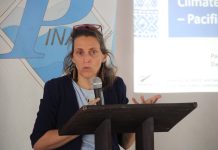
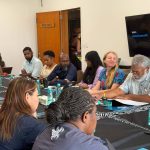
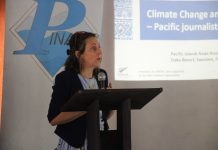
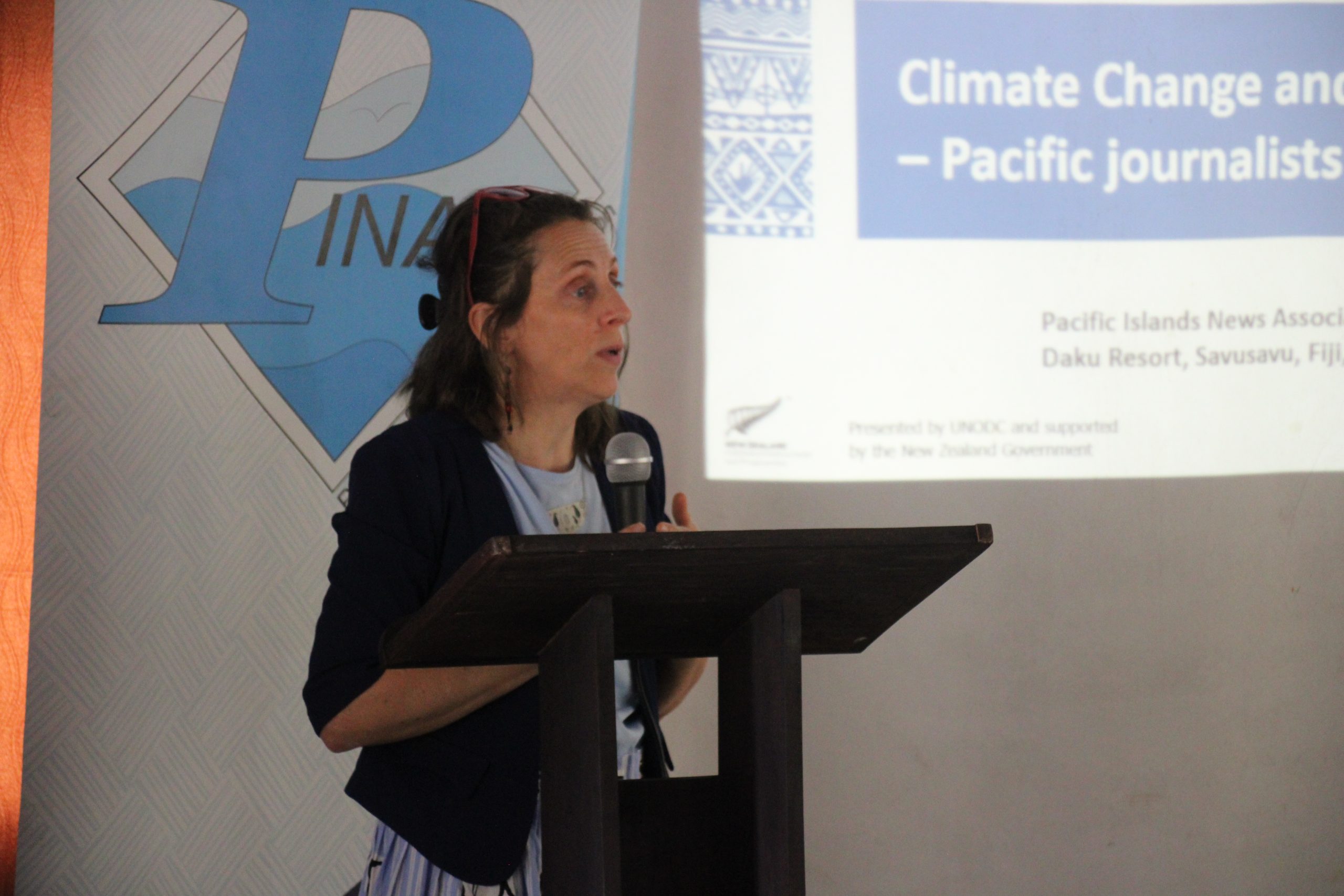
Speaking at a Pre-Pacific Media Summit workshop on Climate Change and Corruption in Savusavu, UNODC Pacific Regional Anti-Corruption Adviser Marie Pegie Cauchois said disaster preparedness was not only about food, equipment and response systems, but also about ensuring public funds and decisions were managed with integrity.
“Preparedness is really the key in terms of integrity and accountability, because without integrity and accountability in preparedness, it means that the communities that are needing it the most are more vulnerable when disaster hits,” Cauchois said.
She was discussing the new Pacific Integrity Toolkit for Disaster Planning, developed by UNODC to help national disaster management authorities integrate integrity and accountability measures into disaster preparedness.
Cauchois said the toolkit was being presented to disaster management authorities, with work now being explored specifically with Fiji.
She said the urgency was increasing as Pacific countries faced growing disaster risks, including climate-related events.
While earthquakes and tsunamis were not necessarily caused by climate change, Cauchois said the speed and pressure involved in disaster response created similar risks around funding, procurement and decision-making.
“Some of the elements between disaster and climate change funding, and the imperative for integrity and accountability, are really there,” she said.
Cauchois said journalists had an important role in examining how disaster funds were allocated, who received them and whether communities actually received the assistance intended for them.
She said this could include questions about contracts, tax waivers, the quality of materials and equipment purchased, and who was responsible for monitoring implementation.
“Who is receiving the money? What is the quality of the material being used? Who is reviewing the contract? Who is reviewing the implementation of the contract?” she asked.
A key issue highlighted by Cauchois was inclusivity, particularly whether women, people with disabilities and other communities at higher risk were included in disaster planning.
She said excluding communities from preparedness planning could leave them outside decision-making when a disaster struck.
“If they’re not part, there is no expectation that once the disaster hits and everybody has to respond very quickly, they will be part of the solution,” she said.
Cauchois also highlighted the importance of transparency within community groups established to respond to disasters.
She said if such groups were formed without clear accountability before a disaster, there was a risk that funding and assistance could be directed towards particular churches, families, ethnic groups or other interests once an emergency occurred.
“If already there, before the preparation, these groups are not transparent or don’t have all the elements of transparency, it’s impossible to think that once disaster hits, this group will be transparent,” she said.
The toolkit also promotes practical accountability measures, including access to information, maintaining a paper trail and exploring the use of real-time audits during disaster response.
Cauchois said traditional audits and parliamentary oversight could take too long to address concerns during an emergency.
She said real-time audits could help answer a basic question while assistance was being delivered: whether the communities meant to receive the money were actually receiving it.
She recalled a case in Tonga following the country’s triple crisis of a tsunami, COVID-19 and volcanic eruption, where a young woman repeatedly asked where disaster funds were going.
Cauchois said the woman faced criticism and was eventually discouraged from continuing to ask questions.
“She received so much pushback that she stopped asking, because people were always saying, ‘You’re the troublemaker, you’re always asking for that’,” she said.
Cauchois said media reporting could help change that perception by showing that demands for accountability were part of the public interest.
“When NGOs are saying, ‘OK, I’m not the only one, I’m not the only one to be a troublemaker. There are also the media that are doing this,’” she said.
She stressed that the toolkit was not designed specifically for journalists but could provide a way for the media to engage disaster management authorities on integrity issues.
“It’s perhaps also a document that might be a good door opener,” Cauchois said.
The workshop called on Pacific journalists to strengthen reporting on the links between climate change, disasters, public funding and corruption, while identifying practical steps for holding institutions accountable before, during and after disasters.
Cauchois said stronger media scrutiny could also encourage disaster management authorities to incorporate transparency, accountability and inclusion into preparedness systems before the next emergency.
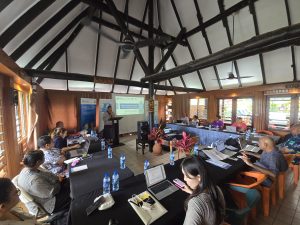
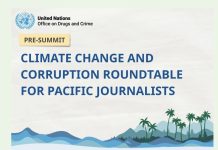
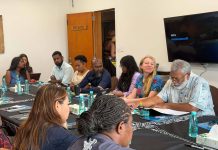
The Pre-Pacific Media Summit workshop brought together Pacific journalists to examine how corruption risks intersect with climate change, disaster response and climate finance.