
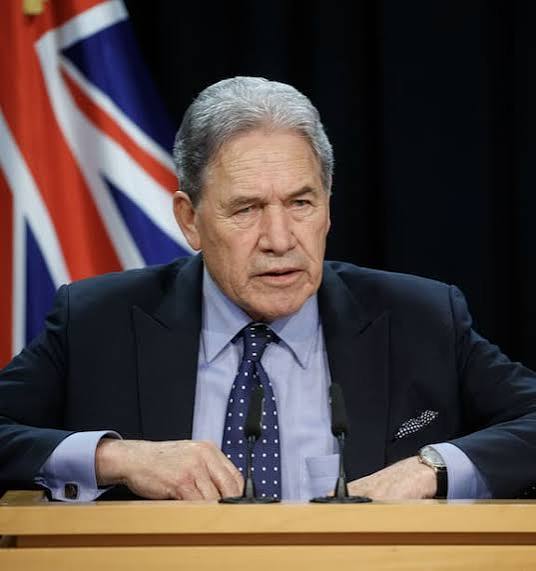
New Zealand Foreign Minister Winston Peters says New Zealand has undertaken the most intensive programme of Pacific diplomacy in its history, with the government using the region’s strategic importance to bring in new development partners and strengthen regional relationships.
Addressing the New Zealand Institute of International Affairs in Wellington, Peters said the Pacific had remained a core component of New Zealand’s foreign policy over the past three years.
“Working closely with Australia, New Zealand’s only formal ally, we have over the past three years undertaken the most intensive programme of Pacific diplomacy in New Zealand’s history,” Peters said.
He said New Zealand had set out to visit all 17 other Pacific Islands Forum members, completing the final visit to Kiribati in January 2026.
Peters said travelling across the Pacific had given the government a clearer understanding of the practical challenges posed by the region’s vast distances.
“The tyranny of distance is very real once you’ve experienced it,” he said.
He said the experience led New Zealand to provide Royal New Zealand Air Force transport to help Pacific leaders attend the Pacific Islands Forum Leaders Meeting.
At this year’s Forum in Palau, New Zealand transported 12 delegations.
Peters said the arrangement was a practical demonstration of New Zealand’s support for PIF centrality.
“It’s a small investment by us but one that directly responds to the challenges of distance they face as well as our fidelity to PIF centrality,” he said.
Peters said New Zealand had also encouraged countries outside the Pacific to travel to the region and gain a better understanding of its economic and security challenges.
He highlighted Denmark, Norway, the United Kingdom and the United Arab Emirates as new contributors to the Pacific Resilience Facility(PRF).
“We worked hard all term to entice new development partners into the Pacific,” Peters said.
He said New Zealand’s diplomatic efforts had been helped by the wider geopolitical disruption of recent years, which had increased recognition that developments in one part of the world could have consequences elsewhere.
“Events in one hemisphere create ripples in the other,” he said.
Peters also reflected on New Zealand’s engagement with New Caledonia following the violence that erupted there in May 2024.
He said New Zealand wanted to make clear to both the New Caledonian and French governments that it was prepared to support its Pacific neighbour.
“That was delicate diplomacy,” Peters said.
He said New Zealand was concerned about the collapse of New Caledonia’s economy while also recognising the need to address issues of institutional and democratic legitimacy.
Peters said New Zealand’s support included a study tour to Auckland in 2025 involving mainly young Kanak entrepreneurs and leaders seeking to learn about creating employment and economic opportunities.
“We stayed close to the New Caledonian Government throughout, and our enduring friendship with the French set the scene for the study tour,” he said.
Peters described the Cook Islands relationship as one of the most challenging foreign policy issues New Zealand had faced during the term.
He said the Defence and Security Declaration signed earlier this year reinforced the relationship between the two countries.
He also highlighted the agreement signed in Palau between New Zealand, the United States and Cook Islands to develop a port in Penrhyn.
“The Agreement … was a rare triple win in foreign policy terms,” Peters said.
“All partners to the agreement benefit, and it’s what we can achieve with valued partners.”
Peters welcomed renewed US engagement in the Pacific, including announcements made at the recent Pacific Islands Forum in Palau.
“The United States is a Pacific power, and we need an engaged America in the Pacific in support of regional prosperity and security,” he said.
He also said greater U.S capability in the region was needed to disrupt what he described as the “evil scourge of drugs” affecting Pacific countries.
Peters said 60 percent of New Zealand’s aid budget was directed towards the development needs of Pacific countries.
“The Pacific Reset and the diplomacy that flows from it sit at the heart of New Zealand’s foreign policy,” he said.
He said New Zealand’s foreign policy had also expanded its focus on South and Southeast Asia, arguing that developments across the Indo-Pacific were increasingly important to New Zealand’s interests.
“In some respects we are living in the Asian century,” Peters said.
“What happens across the Indo-Pacific matters hugely for the trajectory of world affairs and for New Zealand interests.”
Peters said New Zealand’s foreign policy response had also been shaped by what he described as a changing and increasingly unstable international order.
He said weaknesses in international and domestic institutions were contributing to difficulties in responding to global crises.