
Home Blog Page 1239

Highlighting the impact of COVID-19 on business in Tonga

0

A recent report by Pacific Trade Invest (PTI) focusing on the impacts of COVID-19 on Tonga’s private sector has found that less than a quarter of businesses in Tonga were fully operational over 2020, compared to 36% across the Pacific Islands.

The Pacific Business Monitor Tonga Focus 2020 Report aggregates results from respondents in Tonga across all the PTI Pacific Business Monitor surveys conducted in 2020. The report provides insight into the impact COVID-19 had on Tonga’s private sector last year, in comparison to businesses in the Pacific region.
The report found in line with fewer businesses in operation, the very negative impact on businesses in Tonga continued to be higher than the Pacific Islands across the course of last year. During November to December 2020, 85% of businesses in Tonga faced very negative impacts caused by COVID-19, compared to 58% overall across the Pacific Islands.

Similarly, the proportion of businesses reporting a negative impact on the local economy in Tonga was much higher than the rest of the Pacific Islands over the year. However, positively the end of 2020 saw a sharp 20% decline in perceived very negative impacts of COVID-19 upon the local Tongan economy.

The negative impact of COVID-19 on mental health is also significantly greater in Tonga, a pattern seen consistently throughout 2020. On average, 82% of business owners and leaders in Tonga reported COVID-19 as having negative effects on their mental health, in comparison to 63% across the Pacific Islands.

The timeframe of recovery is expected to be much later in Tonga with 85% expecting to return by 2022 or later and only 8% expecting to return by end of 2021.

By the end of 2020, the proportion of businesses receiving government support in Tonga was significantly higher at 85%, compared to 55% in the Pacific Islands overall.

Earlier this month at the panel discussion ‘How are businesses in the Pacific really doing?’ with PTI Australia and Griffith University Minoru Nishi, Managing Director of Nishi Trading Co in Tonga said export logistics during COVID-19 had negative impacts on the local economy.

“The majority of our businesses are in agriculture, so we have suffered a lot over 2020. What surprised us was our exports actually increased, there was demand from the market. So, while that was great for the farmers, the downside of it is that as the year went on we had so many logistic issues. Delays of borders, increased cost for freight, all because of COVID and that really impacted our bottom line. A lot of people in Tonga rely on export pathways for our fresh produce.”

PTI Australia’s Trade & Investment Commissioner, Caleb Jarvis, said the safe and sustainable return to fast and functioning international trade routes are imperative for the recovery the Tongan economy.

“The global pandemic has slowed many global supply chains and trade routes, right down to a halt. This makes business conditions for remote island nations like Tonga incredibly difficult. The effects of COVID-19 also compounded with also having to deal with effects of Cyclone Harold and Yasa last year. PTI Australia uses the results of the Pacific Business Monitor coupled with feedback from our in-country networks to communicate to regional governments, donors, and organisations the real and nuanced challenges Pacific countries are facing and also to tailor our response. There is not a one size fits all approach to charting a course to economic recovery in the Blue Pacific.”

SOURCE: PTI AUSTRALIA/PACNEWS

Cook Islands Superfund increases withdrawal limit from 15k to 45k

0

The Cook Islands National Superannuation Fund has adjusted the pension withdrawal limit, which loosens the criteria for those who want to exit the scheme.

Under the new rules the withdrawal limit is changing from $15,000(US$10,585 to $45,000(US$31,757) for all new pensioners.

This means those who upon retirement have less than $45,000 in contributions will be able to withdraw their balance.

The change will also affect existing pensioners who wish to claim their remaining balance.

CINSF chief executive officer Damien Beddoes said the change came about after it was determined that some pensioners with lower balances were receiving monthly payments that weren’t going a long way in providing income support during retirement.

“The CINSF completed a review of its objectives in late 2019, one of the outcomes of the review was to determine if the CINSF was providing a measured support to our people’s security in retirement,” Beddoes said.

“What we found was that taking into consideration the current high costs of living, small balance pensions and their relative payments, some as low as $87(US$61), were not making a material contribution to meet those monthly expenses.”

Beddoes said an additional factor was the cost to manage and administer small pension balances and for some pensioners, the costs of making international transfers.

With the change in the withdrawal limit to $45,000, Beddoes said Superfund monthly payments combined with Cook Islands Government old age security payments will provide pensioners within the scheme with a more secure income.

“Essentially pensioners would receive two payments of $250(US$171) from the Cook Islands Government, and another payment from CINSF for over $200 (US$141), and this would provide pensioners with three reasonable payments across the month to support their living.”

The new withdrawal limit will apply to approximately 170 pensioners, who hold a total balance of nearly $3.7 million(US$2.6 million) collectively within the fund, Beddoes added.

He said the CINSF expects the majority of those pensioners affected by the change will take the opportunity to cash out now, rather than receiving payments from the Superfund over the long term.

The change follows a decrease in pay out rates for new pensioners announced last month, which was prompted by lower forecasted investment returns for the fund.

Under those new rates, new pensioners will be receiving less money per month.

SOURCE: COOK ISLANDS NEWS/PACNEWS

Fukushima: Japan announces it will dump contaminated water into sea

Japan has announced it will release more than 1m tonnes of contaminated water from the wrecked Fukushima nuclear power plant into the sea, a decision that has angered neighbouring countries, including China, and local fishers.

Official confirmation of the move, which came more than a decade after the nuclear disaster, will deal a further blow to the fishing industry in Fukushima, which has opposed the measure for years.

The prime minister, Yoshihide Suga, told a meeting of ministers on Tuesday that the government had decided that releasing the water into the Pacific Ocean was the “most realistic” option, and “unavoidable in order to achieve Fukushima’s recovery”.

The plant’s operator, Tokyo Electric Power [Tepco], and government officials say tritium, a radioactive material that is not harmful in small amounts, cannot be removed from the water, but other radionuclides can be reduced to levels allowed for release.

“The Japanese government has compiled basic policies to release the processed water into the ocean, after ensuring the safety levels of the water … and while the government takes measures to prevent reputational damage,” Suga told reporters.

Work to release the diluted water will begin in about two years, the government said, with the entire process expected to take decades.

“On the premise of strict compliance with regulatory standards that have been established, we select oceanic release,” it said in a statement.

China denounced the plan as “extremely irresponsible”, and accused Japan of reaching the decision “without regard for domestic and foreign doubts and opposition”.

“This approach is extremely irresponsible and will seriously damage international public health and safety and the vital interests of the people of neighbouring countries,” the Chinese foreign ministry said in a statement on its website.

South Korea summoned Japan’s ambassador, Koichi Aiboshi, the broadcaster YTN reported, while a high-level government official said Seoul “firmly opposes” the move, a view also expressed by Taiwan’s Atomic Energy Council.

The U.S was supportive, describing Japan’s decision-making process as “transparent”.

“We thank Japan for its transparent efforts in its decision to dispose of the treated water from the Fukushima Daiichi site,” the secretary of state, Antony Blinken, tweeted.

The announcement drew swift condemnation from environmental groups.

Greenpeace Japan said it “strongly condemned” the water’s release, which “completely disregards the human rights and interests of the people in Fukushima, wider Japan and the Asia-Pacific region”.

“The Japanese government has once again failed the people of Fukushima,” said Kazue Suzuki, the group’s climate and energy campaigner.

“The government has taken the wholly unjustified decision to deliberately contaminate the Pacific Ocean with radioactive waste. It has discounted the radiation risks and turned its back on the clear evidence that sufficient storage capacity is available on the nuclear site as well as in surrounding districts.

The cabinet’s decision failed to protect the environment and neglected the large-scale opposition and concerns of the local Fukushima residents, as well as the neighbouring citizens around Japan.”

About 1.25m tonnes of water has accumulated at the site of the nuclear plant, which was crippled after going into meltdown following a tsunami in 2011.

It includes water used to cool the plant, as well as rain and groundwater that seeps in daily. The water needs to be filtered again to remove harmful isotopes and will be diluted to meet international standards before any release, the government said.

The radioactive water, which increases in quantity by about 140 tonnes a day, is now being stored in more than 1,000 tanks, and space at the site is expected to run out around next autumn. Tepco has argued that it will struggle to make progress on decommissioning the plant if it has to keep building more storage tanks at the site.

The International Atomic Energy Agency supports the decision, since radioactive elements, except tritium, will be removed from the water or reduced to safe levels before it is discharged. The IAEA has also pointed out that nuclear plants around the world use a similar process to dispose of wastewater.

Experts say tritium is only harmful to humans in large doses and with dilution the treated water poses no scientifically detectable risk.

“There is consensus among scientists that the impact on health is minuscule,” Michiaki Kai, an expert on radiation risk assessment at Japan’s Oita University of Nursing and Health Sciences, told Agence France-Presse before the decision was announced.

But local fishing communities say the water’s release will undo years of hard work to rebuild consumer confidence in their seafood.

“They told us that they wouldn’t release the water into the sea without the support of fishermen,” Kanji Tachiya, who heads a local fisheries cooperative in Fukushima, told public broadcaster NHK ahead of the announcement. “We can’t back this move to break that promise and release the water into the sea unilaterally.”

The decision comes about three months ahead of the postponed Olympic Games in Tokyo, with some events planned as close as 60km (35 miles) from the plant.

Japanese officials have objected to media descriptions of the water as “contaminated” or “radioactive”, insisting that it be described as “treated”.

Shaun Burnie, senior nuclear specialist with Greenpeace East Asia, said that claim was “clearly false”.

“If it was not contaminated or radioactive they would not need approval (to release the water) from Japan’s nuclear regulator,” he said. “The water in the tanks is indeed treated, but it is also contaminated with radioactivity. The Japanese government has been deliberately seeking to deceive over this issue, at home and abroad.”.

SOURCE: THE GUARDIAN/PACNEWS

First batch of 132,000 vaccines arrives in Port Moresby through COVAX facility

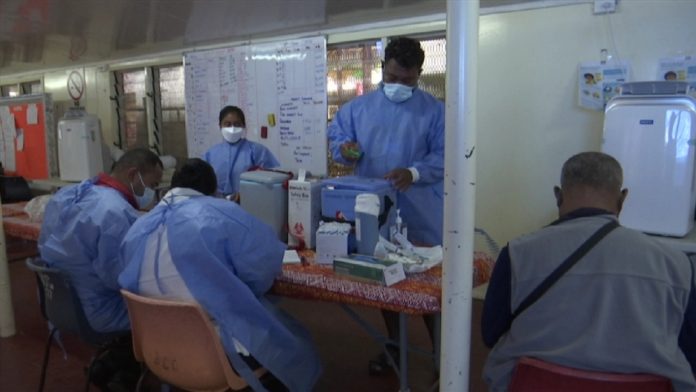
With over 1,500 essential workers already vaccinated in Port Moresby, Papua New Guinea Health Minister Jelta Wong is optimistic that the numbers will continue to increase as the demand around the country grows.

The first batch of 132,000 vaccines arrived Tuesday in Port Moresby through the COVAX facility in preparation for the Governments National Vaccine Roll-Out. This vaccine will be distributed to all provinces for the vaccination of health care workers and other front line essential workers. Through the COVAX facility, a total of 588,000 doses of the AstraZeneca vaccine will be made available to Papua New Guineans.

In response to the concerns about AstraZeneca Minister Wong advised, “To date over 200 million doses of AstraZeneca have been administered around the world. The European and UK regulatory authorities have reviewed and continue to review available data on reports of rare thromboembolic events in those who have been vaccinated in order to understand whether a plausal link can be established with the AZ vaccine.”

European and UK regulatory authorities have reviewed and continue to review available data on reports of rare thromboembolic events in those who have been vaccinated in order to understand whether a causal link can be established with the AZ vaccine.

They have concluded that the benefits of taking the AZ vaccine outweigh the known potential risks. If there is a link, the events are very rare and the risk is extremely low.

WHO advises countries should continue to vaccinate with the AZ vaccine, which has saved millions of lives and prevented serious illness.

The possible risk of vaccinating – as per the UK Regulatory Agency (MHRA) report on 31st of March 2021, a total of 79 cases of thromboembolic events with thrombocytopenia have been reported among 20.2 million doses of the COVID-19 Vaccine AstraZeneca administered in the UK. The overall risk of these blood clots is approximately 4 people in a million who receive the vaccine.

The risk of NOT vaccinating – as of 7 April 2021, 2.86 million people worldwide have died of COVID-19, and infections continue to rise. AZ vaccine has been shown to be highly effective in preventing the most severe forms of the COVID-19 and death caused by COVID-19. Persons above the age of 50 are at higher risk of severe disease and death from COVID-19 should they be infected. This risk increases with age.

They have concluded that the benefits of taking the AstraZeneca vaccine outweigh the known potential risks. If there is a link, the events are very rare and the risk is extremely low.

“The risk of severe disease, death or hospitalization as a result of COVID-19 infection is extremely serious. Vaccination is one of the key tools to preventing COVID-19 and to ending the pandemic. Serious side effects may occur from any vaccine but they are extremely rare. It is important to remember that we are witnessing the largest mass vaccination campaign in history, and some rare reactions are to be expected.

“Papua New Guinea’s infection rate continues to rise rapidly, and as a responsible Government – it is our duty to make vaccines available. I reiterate that taking the vaccine is not mandatory, but it is definitely encouraged.

“Our Prime Minister, Our Governor General and our Chief Justice have all taken the vaccine. That in itself is a strong statement from our country’s leadership,” said Minister Wong.

Meanwhile, the Commissioner of Police and Controller of the PNG COVID-19 National Pandemic Response David Manning has issued directions for air service providers permitting two groups of people to travel.

This includes students returning to their usual place of residence or returning to their education institution and persons returning to their usual places of residence. In both cases one-way tickets will be issued.

The direction comes into force Tuesday and continues in force during the period of the pandemic or as amended in writing by the Controller.

Manning said PNG’s total COVID-19 confirmed cases has reached 8,821 as of Monday 12 April, with the death toll at 69. He said more cases are expected today which will inevitably increase the country’s total COVID-19 cases.

Manning said that is why measures have been put in place to assist the country’s COVID-19 pandemic response.

He called upon all citizens to cooperate and work with the government in containing the further spread of the virus.

SOURCE: PNG GOVT/PACNEWS

Fiji leading the world in COVID-19 containment: PM Bainimarama

0

Fiji is leading the world in COVID-19 containment.

Prime Minister Voreqe Bainimarama said all the measures put in to protect Fiji against the pandemic has worked.

Speaking to Fiji National University students, Bainimarama highlighted that Fiji is about to mark a year since the last case of community transmission.

“I am not speaking to you through a mask and we are not meeting virtually because we defeated our outbreak of the coronavirus and have kept our people safe from the pandemic for more than 350 days. No nation on Earth has matched that record.”

The Prime Minister said Fiji now has a chance to join the world in defeating the pandemic for good.

This, he said can be achieved by registering for the COVID-19 vaccine and receiving the shot when the time comes.

Bainimarama also said local authorities have worked hard to bring the medical marvel to Fiji so that everyone can be protected.

“I have received my first dose. I’m feeling great health-wise, but not only that. I feel even better about the fact that I’ve done my duty to get us on the road to recovery.”

The government has set up a number of locations in communities to make it easier for people to register and be vaccinated.

Fijians are now becoming more eager to get the COVID-19 vaccine after the clearing up of misinformation associated with AstraZeneca jabs.

The Ministry of Health said they have also noted a change in peoples’ attitude towards vaccination with more Fijians now turning up to vaccination venues.

Head of Fiji’s vaccine task force, Dr Rachel Devi said misinformation about the AstraZeneca vaccine that was a hindrance in the vaccination process is clearing up.

“We’ve actually gotten some good responses, while some have asked for some leaders to get vaccinated then they’ll follow suit.”

UN Resident Coordinator, Sanaka Samarasinha said it is imperative for all Fijians to get vaccinated.

“It is important for this country and certainly for the health of its citizens but also for the health of the economy that we get as many people vaccinated so we can get the borders open and we can get people back to work.”

9,800 people have received the COVID jab from the second batch of vaccines.

Meanwhile, Fijians must pay the costs of their quarantine after they arrive in Fiji on repatriation flights.

Health Minister Dr Ifereimi Waqainabete says it’s a matter between the person quarantined and the facility where they stay during the mandatory two-week period.

The Minister’s comments follow cases where people say they did not know they had to pay their quarantine costs.

“That is a poor excuse, for nearly one year they came in because they actually indicated that they wanted to come back and they agreed to the airline and whoever brings them in.”

Fijians who are dual passport holders or permanent residents of another country planning to repatriate for personal reasons are required to pay the cost of their 14-day quarantine.

The charges are directly payable to the hotels or other quarantine facilities where they stay.

SOURCE: FBC NEWS/PACNEWS

Mountains of Hydro trouble

0

By Samisoni Pareti

Mountain tribes in Fiji are thwarting plans by the country’s power monopoly to build a multi-million hydro power plant.

The people of Nubu and Cawanisa say Energy Fiji Limited (EFL) only has itself to blame for the derailment of its hydro project because of the pitiful rental it has paid them in the past.

On hold is the Qaliwana Hydro Scheme, which EFL has earmarked as its fifth hydro power plant, in the centre of Viti Levu, Fiji’s main island.

Qaliwana is located in the same region as the main Monasavu Hydro Scheme, which was commissioned in 1983 and has an 80 MW capacity. Adjacent Wainisavulevu Weir was constructed in 1984, and another hydro plant, the Nadarivatu Hydro Scheme came online in September 2012. The fourth hydropower at Nagado has been shut down since 2016 due to “low water pressure.”

Landowners have refused to lease EFL the 2700 acres of land needed for the Qaliwana project. Instead, they have registered an independent power producer (IPP) company and told EFL that their IPP, with the support of international partners, intends to construct the hydro plant themselves.

They say EFL will then be invited to purchase the power from them.

The Fiji government is the majority owner of EFL, and while its CEO Hasmukh Patel is refusing to respond to written questions this magazine had sent to his office, Islands Business knows that the public utility is unimpressed with the landowners’ intentions.

Eyewitnesses in Nubu and Cawanisa tell the magazine that on at least two occasions, the Fiji Police’s Special Response Team, dressed in full riot gear, visited their villages to warn them against interfering with the EFL plans.

On their first visit in October last year, landowners claimed they saw weapons in the police vehicles. Photos sent to Islands Business showed four Police white four-wheel drive trucks plus a blue unmarked vehicle.

‘EFL brought 20 police officers with three guns to seize our land, claiming that they were sent by the Prime Minister. But when we asked Luke Vauvau and Etuate Mataitini from EFL whether they were indeed sent by the PM, they became afraid and said the PM didn’t send them, but it was their CEO, Hasmukh Patel,’ explains a post on the community’s social media page, showing photos of the police officers and their vehicles.

Verified with the Fiji Police Force headquarters, its media spokesperson Ana Naisoro confirmed the involvement of their Special Response Team but ignored our questions about whether the officers were armed.

“The visit was part of normal operations and visitations conducted by the Special Response team where they check on important infrastructure and at the same time conduct visitations to nearby villages,” was Naisoro’s one-line reply.

Documents made available to the magazine showed that the tribes have made representation to the office of Fiji’s Prime Minister Frank Bainimarama. They have a copy of Bainimarama’s response, in which he acknowledged and supported the move by the landowners to form their own power company.

A copy of the Prime Minister’s letter has been shown to government offices particularly on the west coast of Viti Levu, including the Commissioner Western and heads of Provincial Councils.

This letter was also shown to the two teams of police officers that had visited landowners in Monasavu and Nadarivatu.

In a video interview that was made available to Islands Business, a spokesman for the tribes of Nubu and Cawanisa, Peni Nagata revealed that they had secured the services of international law firm, Clyde & Co to represent them.

He said the three landowning units (mataqali) of Nabuto, Navinoti and Naqereqere have formed a private company and registered it by the name of Nubucokocoko Holdings Trust.

“Members of the mataqali have started their fundraising drive as we want to lease the hydro power plant site, and pay for a feasibility study,” said Nagata.

At least one of them, mataqali Navinoti is hoping to use the investment component of its Monasavu Hydro compensation money as equity in Nubucokocoko Holdings.

The magazine also saw number crunching done by Nubucokocoko Holdings about the viability of the proposed hydro power plant. Working on the electricity purchasing rate of 33 cents per KW that, according to the landowners’ company was once offered by EFL to buy power from the timber processing company Tropic Woods Ltd, they figure the Qaliwana Hydro could earn FJD$51.32m (USD$25.40m) annually.

“This numbers are very conservative, but they prove the point that the proposed hydro plant at Qaliwana is feasible,” said Ratu Semi Leiene, a landowner of Qaliwana.

The regulated domestic tariff set by the Commerce Commission is currently 34.01 cents/units.

Our questions emailed to Clyde & Co’s headquarters in London have yet to be answered. Documents sighted by Islands Business however revealed the landowners hope to approach Tokyo Electric Company and the European Investment Bank (EIB) to finance the project with the assistance of Clyde & Co.

In their brief response to our emailed questions, the media division of the EIB in Luxembourg said the Bank is managing funds from the Investment Facility for the Pacific (IFP) “for the purpose of conducting a technical and economic feasibility study for hydropower development on the Qaliwana and Upper Wailoa rivers.

“The objective is to assist the Government of Fiji (GoF) and Energy Fiji Limited (EFL) to determine the best way to meet their energy sector objectives and in particular their strategic renewable energy targets.

“The studies are ongoing, and no decisions about individual potential project/s nor structure or financing modalities have been taken yet, nor has any party (including EFL) officially requested financing from the EIB.

“In order for the EIB to consider participation in any financing, the project must fulfill our Environmental, Climate and Social Guidelines set out in the EIB’s objectives for investments in hydropower projects, and this fulfillment would be assessed during project appraisal.

“The EFL is fully informed of EIB’s guidelines on good practices for meaningful stakeholder engagement.”

EIB’s media division directed the magazine’s attention to their 60-pages manual titled ‘Guidance Note on Stakeholder Engagement in EIB Operations’.

Accessed on the bank’s website, the document has a separate chapter on ‘Special Requirements for Engaging with Indigenous Peoples.’

It states that the requirements are “to ensure that any communities of indigenous peoples affected by a project are fully informed about the project and its potential impacts, meaningfully consulted about the project, and given the chance to deliberate on whether they agree with the project.”

Free, Prior and Informed Consent is a key part of the EIB’s commitment to human rights, and the manual stressed that any “promoter who receives EIB finance for a project impacting indigenous peoples” must abide by the FPIC principles:

•No coercion, intimidation or manipulation.

•That consent has been sought well in advance of activities, and sufficient time is made for indigenous consultation and consensus processes

•Information is provided covering the nature, size, pace, reversibility and scope of any proposed project or activity; its purpose; the time involved; location of affected areas; the likely economic, social, cultural and environmental impact, including risks and benefit sharing; people likely to be involved, and other procedures.

Writing in EFL’s 2019 annual report which declared an after-tax profit of FJ$63.7m (USD31.15m), CEO Patel said an Italian consultancy firm, Studio Pietrangeli conducted a pre-feasibility study site visit of the proposed dam and weir sites in late March to early April 2019.

The consultant was hired by the EIB, said Patel.

A feasibility study followed, and a report should have been ready by now.
Before its website was taken down this month, Studio Pietrangeli said the proposed Qaliwana Hydropower project together with the upgrade of the existing Nadarivatu hydro scheme was its first project in Oceania.

It states Qaliwana will have a power capacity of 18 MW, featuring an arch gravity dam of 63 metres in height, penstocks and an outdoor powerhouse. “This plant will also receive flows from the Upper Wailoa catchment through weirs and several tunnels.”

The tunnels will run for about 13.5km.

Work on the Nadarivatu Hydro, Studio Pietrangeli adds, will include the installation of its third turbine that will raise the total power capacity of the plant to 60 MW.

Fiji has said it is working towards generating 100% of its energy through renewable sources by 2036. Infrastructure Minister Jone Usamate told the International Renewable Energy Agency earlier this year that this ambitious target will require financial support and expertise, as costs will be high.

Half of Fiji’s power needs are supplied through hydropower. Some 45% comes from fossil fuel generation and the remaining 5% from biomass and wind. EFL needs to generate 267 megawatts (MW) of power daily to service the 90% of Fijians connected to its grid. EFL recently signed a US$15 million solar project with the International Finance Corporation (part of the World Bank group). It will see a private sector partner deliver at least 15 MW to the national grid.

IFC will also assist EFL in exploring potential renewable energy sources in Vanua Levu

SOURCE: ISLANDS BUSINESS/PACNEWS

Six Samoan lawyers cross to become legislators

0

Six legal minds have successfully won their bid to become decision makers and legislators following Friday’s Samoa General Election, according to OEC preliminary results.

From the eight lawyers who contested the election, only two were unable to win enough votes, including the caretaker Minister of Justice, Fa’aolesa Katopau Ainu’u.

The other is Leota Suatele Manusegi who is a Tautua Samoa candidate for Safata No.2.

Fa’aolesa was toppled by his legal colleague and rival, Faualo Harry Schuster who won the Vaimauga No.4 seat by 1016 votes to 670 from the former Minister, during the provisional count.
The pair have battled head to head over the seat since 2016 when Faualo lost to Fa’aolesa; with the seat now appearing to have returned to him for the XVII Parliamentary term.

Three of the successful lawyers are flying the banner for the Human Rights Protection Party, two are from Fa’atuatua i le Atua Samoa ua Tasi and one Independent.

Gagaifomauga No.2 candidate and lawyer, Tuala Iosefo Ponifasio is the sole Independent who secured the seat in the unofficial first count, and holds the balance of power between H.R.P.P. and F.A.S.T. who are currently on 25 seats each in the 51 seat Parliament.

Dubbed as the kingmaker, Tuala has been running for election since 2006 and has a law firm with his wife Fuimaono Sarona Ponifasio.

Another veteran politician and lawyer by profession, Lauofo Fonotoe Nuafesili Pierre Meredith has returned to represent the Anoama’a No.2 constituency for the next parliamentary term.

A former Deputy Prime Minister in 2011 when he ran unopposed, Lauofo at first count is leading by 1087 votes, leaving behind four other opponents who were unable to keep up.

Lauofo first entered parliament in 2005 through by-election, and has held the Anoama’a seat for four consecutive terms.

Another former MP is Tuisa Tasi Patea (HRPP) who has unofficially returned to office under the newly formed Sagaga No.4 seat.

Tuisa lost the 2016 election to Minister of Education, Loau Keneti Sio and had returned to running his law firm after the defeat.

The only woman lawyer to have shrugged off her male counterparts, unofficially winning in her first attempt is Leota Tima Leavai flying the HRPP banner.

Leota won the Falealupo seat that was previously held by her father and veteran Parliamentarian, Aeau Peniamina Leavaise’eta.

She is the principal lawyer at the Leavai Law.

Lastly is Lio Taeu Masipau (FAST) from Fa’asaleleaga No.3 who is no stranger in the political arena.

A former Assistant Police Commissioner, Lio first entered Parliament under the Tautua Samoa banner in 2011.

He lost his seat in the 2016 election and switched to HRPP to contest a 2019 by-election for Fa’asaleleaga.

He was unsuccessful in that bid and again switched allegiances to the new FAST party, unofficially winning the Fa’asaleleaga No.3 seat at first count.

SOURCE: SAMOA OBSERVER/PACNEWS

Palau ‘would welcome British aircraft carrier’ to counter China’s reach in Pacific says president

-The Royal Navy’s carrier strike group would be welcome to visit Palau when it deploys to the Indo-Pacific this year, as the island attempts to counter growing Chinese intimidation.

In an interview with the Telegraph, Palau’s President Surangel Whipps said his country was facing a pressing need to shore up allies, as Beijing steps up its efforts to lay claim to territory and the energy rich waters of the Indo-Pacific.

The British carrier strike group could encounter a hostile reception from China during its deployment, as Beijing vies for economic and military dominance of the region.

“If they want to come, we’ll find a way to bring them here so they can have some shore leave and enjoy our beautiful island,” said Whipps.

His tiny island nation of 21,000 people was a key battleground between U.S and Japanese forces during the Second World War and the stage of the major Battle of Peleliu in 1944.

It is now emerging as a strategic outpost of the U.S-China great power competition in the Pacific.

Like other Pacific and Southeast Asian coastal nations, it is on the front line of China’s forceful moves as it asserts its claims to disputed reefs, islands and constructs facilities allegedly intended for military purposes.

Palau has faced Chinese opposition to its own claims to the continental shelf – a coveted spot for deep sea mining – and reported incursions by Chinese fishing fleets.

“We have had Chinese vessels come into our territory, not respect our borders, steal our resources and the response from the Chinese government has been ‘hands off’,” said Whipps.

As the most vocal China-sceptic of the Pacific leaders, he admits that Palau’s role in international efforts to counter Chinese regional hegemony “makes us a target.”

But he believes the deployment of partner country naval missions to the region, including the HMS Queen Elizabeth, the UK’s new aircraft carrier, and its accompanying battle ships, will help “promote peace and security.” He added: “We welcome the UK fleet.”

The choice of the Indo-Pacific for the maiden grand voyage of the carrier signals the growing focus of the UK and its allies on securing the patchwork of vital global trade routes that could be exploited for economic coercion.

During a visit to Indonesia this week, Dominic Raab, the Foreign Secretary, said the Indo-Pacific lay “at the heart of” British foreign and security policy.

“The Carrier Strike Group’s deployment marks the start of a new era of defence cooperation,” he added.

Although the fleet is believed to have no current plans to anchor near Palau on a voyage that focus on freedom of navigation operations in the South China Sea, the island features prominently in US defence priorities as Washington seeks to expand its own footprint.

The U.S Indo-Pacific Command in Hawaii has earmarked Palau for a US$200 million radar system to detect and track air and surface targets, as part of a new US$27.3 billion strategic regional plan.

Palau, like other nearby Pacific nations, has a 50-year defence agreement with the U.S known as the Compact of Free Association (COFA) that already grants the Pentagon virtually unrestricted military access in exchange for a security guarantee and benefits for Palauan citizens.

Whipps offered his unwavering support for the radar programme, stressing he was keen to see U.S military bases established on the island, and would also be open to ground-based – although not nuclear – missiles being stationed there as cooperation expanded.

“Whether it is our runways, or our seaports, they are available to the United States,” he said. “We definitely want to work with the United States on strengthening those facilities so that they are available and ready for use.”

The improvement of Palau’s three operational runways and deepening of port facilities to accommodate a fleet as large as a carrier strike group, could both serve strategic military purposes and make Palau’s economy less reliant on tourism, the president said.

“We continue to talk with the United States on these issues, but this is something that as a region – and all our global partners – we can look at together. The port facilities could be used by the French and the UK and Japan,” he said.

“The Palauan people are willing to do their part in promoting peace and security in the region.”

His stance will be viewed positively in Washington. Although there has been no public commitment to build new military bases in Palau, U.S forces are under Japanese pressure to shrink their massive bases in Okinawa and are looking to diversify their capabilities across the Pacific.

Situated east of the Philippines, a U.S treaty ally, Palau forms part of the “second island chain” that U.S military strategists view as a critical line of defence against Chinese advances across the Pacific.

“Palau during World War 2 was a strategic outpost for Japan and there’s a reason – you just look on a map and see our location and you know why,” said Whipps.

Palau’s importance was underscored by a visit last year by Mark Esper, the first ever U.S defence secretary to do so.

Heino Klinck, former deputy assistant secretary of defence for East Asia, who was on the trip, said the U.S strategy was focused on “places not bases” to respond to the growing Chinese military threat in the West Pacific and to complicate the People’s Liberation Army calculus.

“You complicate PLA calculus by ensuring the armed forces have flexibility in terms of the deployment locations,” he said, adding that improving Palau’s infrastructure was key to this plan.

In the face of more assertive and aggressive PLA actions, the presence of the Queen Elizabeth strike group would be significant in “ensuring that the global commons remain open to everyone,” said Klinck.

“I think writ large we value the presence of our allies and partners in the region, both from a diplomatic and messaging perspective that shows to the Chinese that this is not just a U.S-China issue, this is a China versus the world issue,” he said.

The increasing political alignment between the US and its allies in the Indo-Pacific and on issues relating to China also extends to Taiwan.

Beijing claims the democracy of 23 million as its own territory and has vowed to annex it – a move which would have huge regional security implications.

Palau is one of just 15 countries that have formal diplomatic ties with Taipei, which has exposed it to the chequebook diplomacy China has deployed across the Pacific.

Whipps said Beijing tried to buy his country’s allegiance with the promise that “the sky is the limit, just join us, cancel that relationship with Taiwan.”

He said no. “We shouldn’t be forced by anyone else to say that relationship should be severed,” he said, adding that while Palau sought friendly ties with China, “we should respect each other’s choices, we should respect each other’s borders.”

Palau suffered to the point of near extinction during the Second World War.

“We don’t want to ever have a war and we are a peaceful nation, but at the same time you have to do all you can to prevent a war,” said the president.

“Having partnership between nations provides stability and also helps in the prevention of those kinds of activities that may escalate to the point where we cannot maintain the peace and stability that we have,” he said.

SOURCE: THE TELEGRAPH/PACNEWS

COVID ‘long way from over’ as cases and deaths surge – WHO

The COVID-19 pandemic is “a long way from over” but there are many reasons to be optimistic and it’s possible the pandemic can be brought under control “within months”, the head of the UN health agency said on Monday.

Although January and February saw six consecutive weeks of plummeting COVID-19 cases, the World Health Organisation (WHO) chief said that had gone into reverse, with last week yielding “the fourth-highest number of cases in a single week so far”.

“We have now seen seven consecutive weeks of increasing cases, and four weeks of increasing deaths”, Tedros Adhanom Ghebreyesus told journalists at a regular media briefing.

More than 780 million doses of vaccine have now been administered globally, but several Asian and Middle Eastern countries have seen large increases in infections, he said.

While acknowledging that vaccines are “vital and powerful” instruments, the WHO chief reiterated that they are not the only tools needed to defeat the coronavirus.

“Physical distancing works. Masks work. Hand hygiene works. Ventilation works. Surveillance, testing, contact tracing, isolation, supportive quarantine and compassionate care – they all work to stop infections and save lives”, Tedros underscored.

While stressing the need for “a consistent, coordinated and comprehensive approach” in battling the virus, he said that “confusion, complacency and inconsistency in public health measures and their application, are driving transmission and costing lives”.

WHO wants to see societies and economies reopening, and travel and trade resuming, instead it is witnessing intensive care units overflowing and people dying, which Tedros maintained “is totally avoidable”.

He said proven public health measures and strong systems that have enabled countries to respond rapidly and consistently, illustrate that COVID “can be stopped and contained”, adding that those nations are now able to enjoy sporting events, concerts, restaurants and seeing their family and friends safely.

Currently, global manufacturing is insufficient to deliver quick, equitable vaccines and other essential health products, according to the WHO official.

Early in the pandemic, African countries agreed on a coordinated continental approach, “and now they’re coming together for a coordinated approach to scaling up manufacturing”, he said.

Tedros stressed the importance of investing in “sustainable and secure domestic manufacturing capacity and national regulatory authorities”, asserted that “what can be done today, should be done today”.

Noting that WHO and its partners have established a COVAX manufacturing taskforce, to increase supply and build a sustainable vaccine manufacturing platform, he offered the UN agency’s technical assistance in assessing the feasibility of local production and to access technology and know-how.

Despite continuing transmissions, some countries are re-opening restaurants, night clubs and indoor markets, with too few people taking precautions.

Moreover, the UN health chief observed that some young people appear to feel that it doesn’t matter if they get COVID-19.

“Young, healthy people have died. And we still don’t fully understand the long-term consequences of infection for those who survive”, he reminded, echoing reports of some mild cases that have left long-term symptoms, including fatigue, weakness and anxiety.

While the pandemic is “a long way from over”, Tedros said there were numerous reasons to be optimistic.

He pointed to the decline in cases and deaths during the first two months of the year as evidence that the virus and its variants can be stopped.

“With a concerted effort to apply public health measures alongside equitable vaccination, we could bring this pandemic under control in a matter of months”, he attested.

However, the WHO chief added that this hinges on the decisions and actions that governments and individuals make every day, spelling out: “The choice is ours”…..

SOURCE: WHO/PACNEWS

Samoa election result hailed as win for women

Samoa’s cliff-hanger general election is a victory for under-represented women in Pacific island politics, regardless of the final outcome, FAST leader Fiame Naomi Mata’afa said.

Her Faatuatua i le Atua Samoa ua Tasi (FAST) party is on the cusp of a major upset after Friday’s vote, leaving Samoan Prime Minister Tuilaepa Sailele Malielegaoi fighting for his political life after 22 years in office.

The result is even more extraordinary because FAST has managed to challenge one of the world’s longest-serving democratically elected leaders just nine months after the party was formed.

Mataafa said that she was feeling “very thankful” for the support FAST has received, with preliminary results showing it deadlocked with the ruling Human Rights Protection Party at 25 seats apiece in the 51-seat Legislative Assembly.

That leaves lone independent candidate Tuala Tevaga Iosefo Ponifasio holding the balance of power, with the ability to choose Samoa’s next leader.

Mataafa said she would open discussions with Ponifasio yesterday, but it could be weeks before an outcome is known, as a result would likely face legal challenges.

She said even if FAST fails to win government, the level of support for a female-led party was a game-changer for women.

“I don’t think it’s just [becoming] prime minister, it’s in any field where women have trail-blazed,” she told New Zealand broadcaster TVNZ. “I’ve always been conscious of the fact that I’m a role model, and of course I’ve been a very strong advocate of women’s participation in politics.”

Politics has traditionally been a male preserve in the Pacific islands, with Hilda Heine of the Marshall Islands still the only woman to lead an island nation when she was president from 2016 to last year.

“Women’s representation [globally] is the lowest in the Pacific island states as women hold 6 percent of seats, and they are not represented in parliaments in three countries,” UN Women said in an assessment released in January.

However, Mataafa, 64, is perhaps uniquely placed to challenge such gender restrictions. Her father was Samoa’s first prime minister when it gained independence in 1962. After entering parliament in 1985, she became the country’s first female cabinet minister, then deputy prime minister in 2016 until she quit last year when Malielegaoi introduced laws that she believed undermined the constitution….

SOURCE: AFP/PACNEWS

Stay connected

529FansLike
172FollowersFollow
156SubscribersSubscribe
- Advertisement -