This statement was originally published on freedomforum.org.np on 17 April 2021.
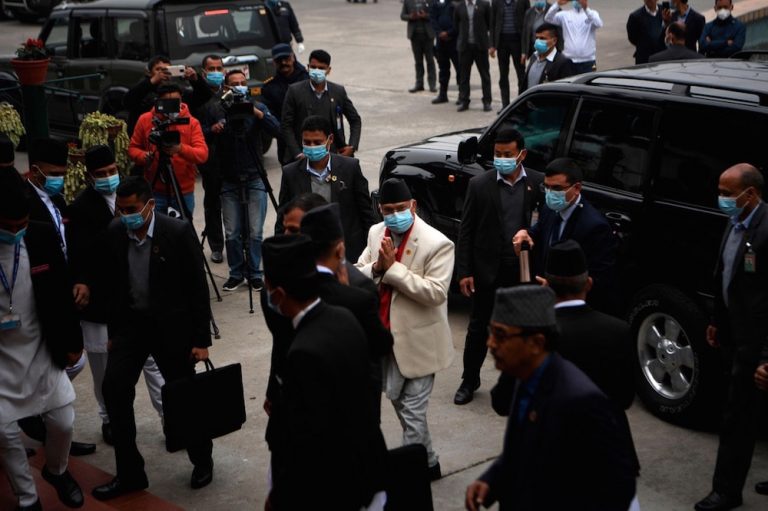
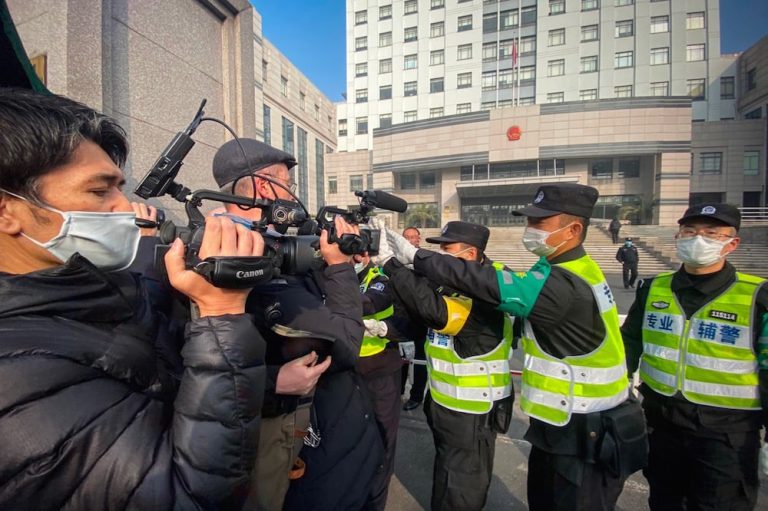
Freedom Forum is alarmed over the harassment of journalists who have been reporting about a secret agreement between a foreign official and the prime minister.
Security forces raided the residence of journalist Babin Sharma and his office for sharing a news story originally published by the Ujyaalo News Network on April 16. Sharma is associated with the online news portal. Reporters at Ujyaalo News Network were also harassed and threatened over the news, which was dismissed by authorities as “fake news”.
With the growing penetration of the internet, social media have become a popular digital public sphere in Nepal of late. As a result, the dissemination of critical news and the debate over whether it is “fake news” or not and the harassment mounted against journalists have amplified accordingly.
Freedom Forum is always in support of journalists’ right to free reporting and freedom of expression, in the interest of providing information to the people without any obstruction. Journalists must not be harassed and their homes and offices raided. FF vehemently condemns the raid.
There is already an institution tasked with looking after news content, Nepal’s Press Council. So the concerned parties can approach the Council in case they are dissatisfied with any news content, rather than attempting to treat a journalist as a criminal.
To this, Freedom Forum Executive Chief Taranath Dahal said, “Although the debate whether the news was ‘fake news’ is a good trend in order to challenge misinformation/disinformation from the news that is produced by the journalistic profession, the intimidation of journalists merely for news publication and dissemination is unacceptable. It is not security persons or the government who will determine the ‘fake news’ but the independent and professional fact-checkers. So, the government must stop intimidating journalists, but take rightful measures to identify ‘fake news’ and respect freedom of expression.”
This statement was originally published on rsf.org on 20 April 2021.
The 2021 World Press Freedom Index compiled by Reporters Without Borders (RSF) shows that journalism, the main vaccine against disinformation, is completely or partly blocked in 73% of the 180 countries ranked by the organisation.
This year’s Index, which evaluates the press freedom situation in 180 countries and territories annually, shows that journalism, which is arguably the best vaccine against the virus of disinformation, is totally blocked or seriously impeded in 73 countries and constrained in 59 others, which together represent 73% of the countries evaluated. These countries are classified as having “very bad,” “bad” or “problematic” environments for press freedom, and are identified accordingly in black, red or orange on the World Press Freedom map.
The Index data reflect a dramatic deterioration in people’s access to information and an increase in obstacles to news coverage. The coronavirus pandemic has been used as grounds to block journalists’ access to information sources and reporting in the field. Will this access be restored when the pandemic is over? The data shows that journalists are finding it increasingly hard to investigate and report sensitive stories, especially in Asia, the Middle East and Europe.
The 2021 Edelman Trust barometer reveals a disturbing level of public mistrust of journalists, with 59% of respondents in 28 countries saying that journalists deliberately try to mislead the public by reporting information they know to be false. In reality, journalistic pluralism and rigorous reporting serve to combat disinformation and “infodemics”, including false and misleading information.
“Journalism is the best vaccine against disinformation,” RSF secretary-general Christophe Deloire said. “Unfortunately, its production and distribution are too often blocked by political, economic, technological and, sometimes, even cultural factors. In response to the virality of disinformation across borders, on digital platforms and via social media, journalism provides the most effective means of ensuring that public debate is based on a diverse range of established facts.”
For example, President Jair Bolsonaro of Brazil (down 4 at 111th) and President Nicolás Maduro of Venezuela (down 1 at 148th) promoted medically unproven Covid-19 remedies. Their false claims were debunked by investigative journalists at media outlets such as Brazil’s Agência Pública and in-depth reporting by Venezuela’s few remaining independent publications. In Iran (down 1 at 174th), the authorities tightened their control over news coverage and stepped up trials of journalists in order to weaken the media’s ability to scrutinise the country’s Covid-19 death toll. In Egypt (166th), President Abdel Fattah Al-Sisi’s government simply banned the publication of any pandemic statistics that didn’t come from the Ministry of Health. In Zimbabwe (down 4 at 130th), the investigative reporter Hopewell Chin’ono was arrested shortly after helping to expose the overbilling practices of a medical equipment supply company.
Biggest movements in the Index
Norway is ranked first in the Index for the fifth year running even though its media have complained of a lack of access to state-held information about the pandemic. Finland maintained its position in second place while Sweden (up 1 at 3rd) recovered its third place ranking, which it had yielded to Denmark (down 1 at 4th) last year. The 2021 Index demonstrates the success of these Nordic nations’ approach towards upholding press freedom.
The World Press Freedom map has not had so few countries coloured white – indicating a country situation that is at least good if not optimal – since 2013, when the current evaluation method was adopted. This year, only 12 of the Index’s 180 countries (7%) can claim to offer a favourable environment for journalism, as opposed to 13 countries (8%) last year. The country to have been stripped of its “good” classification is Germany (down 2 at 13th). Dozens of its journalists were attacked by supporters of extremist and conspiracy theory believers during protests against pandemic restrictions.
The press freedom situation in Germany is nonetheless still classified as “fairly good,” as is the case in the United States (down 1 at 44th), despite the fact that Donald Trump’s final year in the White House was marked by a record number of assaults against journalists (around 400) and arrests of members of the media (130), according to the US Press Freedom Tracker, of which RSF is a partner. As a result of falling four places, Brazil joined the countries coloured red, indicating that the press freedom situation there is classified as “bad”. The vilification and orchestrated public humiliation of journalists have become trademarks of President Bolsonaro, along with his family and closest allies. Brazil shares the “bad” classification with India (142nd), Mexico (143rd) and Russia (down 1 at 150th), which deployed its repressive apparatus to limit media coverage of protests in support of Kremlin opponent, Alexei Navalny.
China (177th), which continues to take Internet censorship, surveillance and propaganda to unprecedented levels, is still firmly anchored among the Index’s worst countries, which are indicated in black on the World Press Freedom map. Right below China is the same trio of totalitarian countries that have historically occupied the bottom three places. Two are Asian: Turkmenistan (up 1 at 178th) and North Korea (up 1 at 179th). The third is African: Eritrea (down 2 at 180th). Regardless of their continent, these countries maintain absolute control over all news and information, enabling the first two to claim they had no Covid-19 cases and the third to maintain complete silence about the fate of 11 journalists who were arrested 20 years ago, some of whom have allegedly been held in metal containers in the middle of a desert.
The country that fell the furthest in 2021 was Malaysia (down 18 at 119th), where the problems include a recent “anti-fake news” decree allowing the government to impose its own version of the truth. Big descents were also registered by Comoros (down 9 at 84th) and El Salvador (down 8 at 82nd), where journalists have struggled to obtain state-held information about the government’s handling of the pandemic. Most of the 2021 Index’s biggest gains are in Africa. Burundi (up 13 at 147th), Sierra Leone (up 10 at 75th) and Mali (up 9 at 99th) have all seen significant improvements, including the release of four journalists with the independent Burundian media Iwacu, the repeal of a law criminalising press offences in Sierra Leone and a fall in the number of abuses in Mali.
2021 Regional rank
Europe and the Americas (North, Central and South) continue to be the most favourable continents for press freedom, even though the Americas registered the biggest deterioration in its regional violations score (up 2.5%). Europe registered a sizeable deterioration in its “Abuses” indicator, with acts of violence more than doubling in the European Union and Balkans, compared with a 17% deterioration worldwide. Attacks against journalists and arbitrary arrests increased in Germany (13th), France (34th), Italy (41st), Poland (down 2 at 64th), Greece (down 5 at 70th), Serbia (93rd) and Bulgaria (down 1 at 112th).
Although there was less deterioration in Africa’s “Abuses” score, it continues to be the most violent continent for journalists, and the Covid-19 pandemic fuelled the use of force to prevent journalists from working. In Tanzania (124th), President John Magufuli called the virus a “western conspiracy,” suggesting that Tanzania had kept it at bay “by force of prayer.” He imposed an information blackout on the pandemic before his death in March 2021.
In the Asia-Pacific region, the “censorship virus” spread beyond China, in particular to Hong Kong (80th), where the National security law imposed by Beijing seriously threatens journalists. Australia (up 1 at 25th), experienced a disturbing variant: in response to proposed Australian legislation requiring tech companies to reimburse the media for content posted on their social media platforms, Facebook decided to ban Australian media from publishing or sharing journalistic content on their Facebook pages.
The Eastern Europe and Central Asia (EECA) region held onto its second-to-last position in the regional rankings, in part because of events in Belarus (down 5 at 158th), where journalists were subjected to an unprecedented crackdown in an attempt to cover up the massive street protests in response to the contested presidential election result.
There has been no significant change in the Middle East & North Africa (MENA) region, which maintained last place in the regional rankings. In Algeria (146th) and Morocco (down 3 at 136th), the judicial system is being used to help silence journalists, while the Middle East’s most authoritarian countries – Saudi Arabia (170th), Egypt (166th) and Syria (up 1 at 173rd) – have taken advantage of the Covid-19 pandemic to reinforce their methods for gagging the media and to reaffirm their monopoly on news and information. In this region, still the toughest and most dangerous for journalists, the pandemic has exacerbated the problems that have long plagued the press, which was already in its death throes.
RSF’s global indicator – its measure of the level of media freedom worldwide – is only 0.3% lower in the 2021 Index than it was in 2020. However, the past year’s relative stability should not divert attention from the fact that it has deteriorated by 12% since this indicator was created in 2013.
Super Rugby is about to get a Pacific injection with Moana Pasifika and Fijian Drua officially confirmed as entrants in a new competition next year.
New Zealand Rugby confirmed the addition of the two Pacific franchises in a new competition for 2022 at a media conference this afternoon after months of rumours swirling around their involvement.
“In a significant step forward for Pacific Island rugby, Moana Pasifika and the Fijian Drua have been granted conditional licences to join a planned new professional competition next year, New Zealand Rugby (NZR) announced today,” NZR said in a statement.
“The NZR Board’s decision to approve licences is a major step toward the two Pasifika teams joining NZR’s existing five Super Rugby Aotearoa clubs and Rugby Australia’s (RA) five Super Rugby AU teams in a new tournament being planned for 2022 and is conditional on their final business plans and RA’s support.”
NZR Board Member and former Manu Samoa and All Blacks legend Sir Michael Jones said the announcement was a significant milestone.
“We are now on the cusp of realising a long-held desire to include Pasifika in our professional game and the opportunity to embrace all that comes with that.
“With the approval of licences, Moana Pasifika and the Fijian Drua can now forge ahead with the final stages of their business plans and crucially start to lock in their playing and coaching rosters for next season. It’s an exciting time for rugby.”
Moana Pasifika – who showed early signs of promise last year in a 28-21 loss to the Māori All Blacks – is a combined Samoa and Tonga side likely to be based in South Auckland.
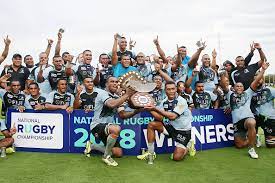
Fiji Drua could be based in Suva after building a formidable reputation playing in the Australian National Rugby Championship since their formation in 2017.
In November, Fijian Drua and Moana Pasifika were announced as New Zealand Rugby’s preferred partners to join an expanded 12-team competition subject to a range of conditions, mostly financial, to show that they were capable of funding each franchise to the tune of $10 million(US$7 million) a year.
NZR CEO Mark Robinson said they were confident both franchises could deliver.
“We are moving into the final phase of planning for 2022 and beyond, and we have confidence that Moana Pasifika and the Fijian Drua will be able to meet the conditions of the licence, which includes final sign off on a sustainable business plan by 30 June.
“In the next two months we will be working with Rugby Australia and the two Pasifika teams to formalise their place in the new competition for what we believe will kick off an exciting, new era for the professional game.”
World Rugby last month committed $7 million(US$4.4 million) in funding over the next three years to help fund the two Pacific Islands teams.
he Fiji Rugby Union (FRU) today welcomed New Zealand Rugby’s announcement that it would award a conditional license to the Fijian Drua to participate in the Super rugby competition from 2022 onwards.
Although still subject to finalisation of private capital funding, FRU is in advanced stages of discussions and remains confident that it will finalise funding from one of those parties in coming weeks.
The operations of the Fijian Drua will be conducted through a separate company, which will be majority owned by private investors, although it will work closely with the FRU in many areas.
FRU Chairman, Conway Beg said “This is one of the most exciting developments in the history of Fiji Rugby. To be able to field a team in Super Rugby is a dream come true for our Union, our country, and our players. It will be a transformational moment in our history, allowing us to bring many of our best players’ home, and to retain our best talent in Fiji, so that those players can play elite professional rugby in their homeland”.
Beg added “Although we still have some work to do in finalising our funding, we are well progressed in not only those discussions but more broadly with other commercial partners, and we look forward to closing our discussions and moving ahead”.
The CEO of Fiji Rugby, John O’Connor said “Today is another historical day of Fiji Rugby, Fiji and for Fiji wherever they live in the World. I want to acknowledge and honor the Almighty for this great achievement. Fiji Rugby has been through thick and thin, good and bad, lows and highs but through all of this, one thing that remain consistent throughout of journey, has been the love of this great God and I honor Him, first and foremost this afternoon. I also know that we have a lot of hard work ahead of us, but with God, nothing is impossible.
We are so grateful to New Zealand Rugby in particular, who have championed our inclusion in the Super Rugby competition. We extend our heartfelt thanks to NZR Chairman Brent Impey and his CEO, Mark Robinson and their Board and management colleagues for the faith they have shown in us to get to this point. We will not let them down”.
O’Connor noted that FRU’s inclusion in Rugby Australia’s National Rugby Championship from 2017 to 2019, had allowed it to showcase the depth of playing talent in Fiji and he also thanked Rugby Australia for their support in providing that opportunity. Over 20 of the Drua players who played in the NRC have gone on to become Flying Fijians and 26 had secured professional contracts overseas, demonstrating the value of playing week in, week out at a higher level.
O’Connor said “Having our best players turning out every week in the same team will really help develop combinations and together with the added caching, medical and strength & conditioning oversight, I’m sure we will be more than competitive, not only at Super Rugby level, but also flowing through to greater success for the national team.”
The Super Rugby games played in Suva between the Crusaders, Chiefs and Hurricanes from 2016 to 2019 were also hailed as pivotal milestones in demonstrating Fiji’s appetite to support rugby at the elite level, with bumper crowds, and successful staging also important evidence to convince NZR that Fiji is ready for high level Super Rugby matches in our country. From February 2022 onwards, FRU will play a minimum of five matches in Fiji, expected to be shared across venues in Suva and in the West.
Conway Beg also expressed FRU’s gratitude to World Rugby and thanked Chairman Sir Bill Beaumont for their leadership and funding support. He said “World Rugby’s support of the Fijian Drua’s participation in the NRC was pivotal in getting us to this point, and their commitment to funding for the next three years of over FJ$4million(US$2 million) is incredibly important to funding the team”.
Beg also noted that the Fiji Sports Commissions support for the Drua and the NRC should not be forgotten and foreshadowed that continuing support from the Fiji Government was expected.
He said “With the prospect of hosting matches against the likes of the Crusaders, Brumbies, Blues and Reds every year, we will not only attract huge crowds and attendance from local Fijians, but will also welcome hundreds of overseas fans who can combine following their team with a holiday at Fiji’s wonderful destination holiday resorts and islands. Beg said that the addition of the Drua will create over 65 new jobs, injecting in excess of FJD$6million in salaries alone to the economy. With other spending, and taxes, the economic impact is expected to exceed $15 million(US$7.5 million) annually.
O’Connor added that FRU’s General Manager Commercial, Brian Thorburn had worked tirelessly on the bid, and thanked him for his efforts.
Thorburn said “ The real work is just beginning, and once we finalise our equity partners, we then have a lot to do in the next nine months to make this happen”. Starting with appointment of coaches, contracting of players, locking in Venues and broadcasters, as well as securing commercial partners, Thorburn highlighted that there would be many opportunities for Fijian companies to get behind the team. “We’ll be looking for a number of Drua Sponsors from Team Naming rights to sleeve sponsors, and suppliers, plus we’ll be building a Hospitality programme to allow businesses of any size to get involved. In time, we hope to build membership packages also. And we’ll be making sure that there are plenty of affordable tickets for the everyday Fijian rugby fan to get behind the Drua and show their support at the turnstiles”.
Fiji Rugby will progressively make further announcements in coming weeks and months.
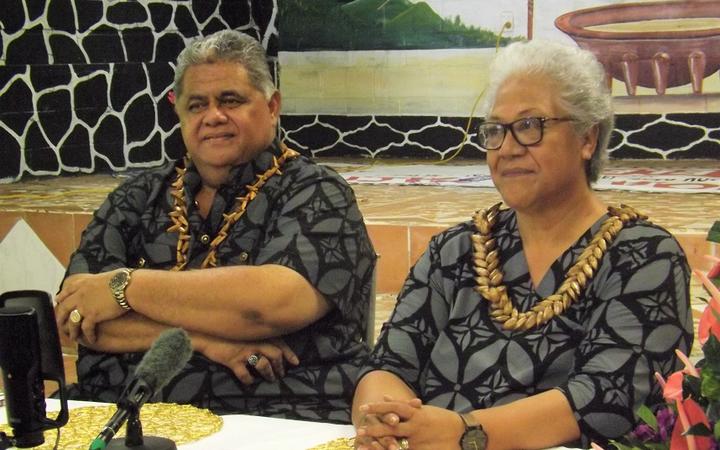
Samoa’s Electoral Commissioner, Faimalōmatumua Mathew Lemisio confirmed today that some voters voted twice in last weeks’ elections and they will face legal action.
Double voting surfaced during the official count for Sagaga 2 constituency that started yesterday and was put on hold as officials tried to sort out the double voting issue.
Faimalōmatumua could not give the actual number of those who voted twice but a scrutineer for Sagaga 2 told Talamua that they picked up 11 dual votes Tuesday.
It is suspected that those identified to have voted twice voted again in last Friday’s election after casting their vote in the pre-polls that ran from Monday to Thursday.
“After the official count, we will investigate it because it is an offence under the Electoral Act and we’ll initiate legal action if proven,” said Faimalōmatumua.
Coming into the third day of the official count, the Commissioner confirmed that the results from Friday remain even though there have been some minor changes to the results after the special votes were added.
Some informal votes have also been allowed and counted as good while others have been rejected.
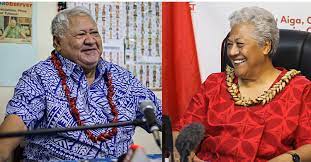
The provisional result from last Friday posted a tie of 25-25 between the main parties HRPP and FAST and one Independent.
The Commissioner is aware of the public pressure for the official results to be declared soon, but “we will not rush the count as we have to go through the process thoroughly before making any declaration.”
Today is the third day of the official count and he hopes to complete the count for Upolu today and start with the 18 constituencies of Savaii tomorrow.
The Commissioner is happy with the speed at which the counting is progressing and he hopes to release the results as soon as the official count is completed and the writ for the election results is signed by the Head of State.
“I urge the people to be patient as you will get your results,” he said.
As Samoa awaits the official declaration of its 2021 General Elections, results of special votes are eagerly anticipated by those constituencies for which the preliminary results had the first and second placed candidates in a close race.
One such Constituency is Faleata 1 – where the gap between incumbent Member of Parliament and former Associate Minister Salausa Dr. John Ah Ching is 51 votes behind unofficial winner, Manuleleua Paletasala Tovale of the FAST party. Through a transparent process attended by all candidates’ scrutineers, it has been confirmed that there are 125 Special Votes for Faleata 1.
Another Constituency where a swing from one party to the other is possible, is that of Salega 1, where Fepuleai Faasavalu Faimata Sua of FAST is currently the unofficial winner, however, he has HRPP’s Toomata Aki Tuipea only 13 votes behind, and Tautua Samoa’s Afualo Dr Wood Uti Salele trailing by 15 votes. The number of Special Votes is 40.
Then there are close preliminary wins which may switch the final winner, but not swing the pendulum between parties.
That is the case for Palauli 2 where unofficial winner Tiatia Laulu Mapesone Mapusua of FAST is a mere 2 votes ahead of fellow FAST member, Leota Laki Lamositele. There are 48 Special Votes and the final count could well switch the winning candidate, but still for the FAST party.
The same goes for two HRPP candidates at Aleipata Itupa i Lalo, where Fiugalu Eteuati Eteuati, currently the unofficial leader has Tafua Maluelue Tafua trailing by 29 votes. There are 46 Special Votes to tally, which may switch the winner but not the party.
There are also very close preliminary results for which the Special Votes may not have an impact. That is the case for Salega 2, where Olo Fiti Afoa Vaai of FAST is 27 votes ahead of Tapuai Faalogo Tupai Ve’e of HRPP; and there are only 24 Special Votes yet to count.
Special votes are those that were placed into the smaller ballot boxes from each polling booth. Officials such as OEC staff, police and those working at each booth cast their votes where they were stationed, for their respective constituencies.
Special votes also include the mobile booths that visited locations such as Mapuifagalele, Carmelite Sisters at Vailima and the SVSG Campus of Hope. There were also mobile booths for similar locations in Savaii.
The Faleata 1 count between Manuleleua and Salausa is underway
Pacific Games Council has approved the CNMI’s request to include three more sports—tennis, weightlifting, and va’a (outrigger canoe)—to the calendar of events for the 2022 Pacific Mini Games in the CNMI.
Andrew Minogue, Pacific Games Council chief executive officer, confirmed the council’s decision to approve the CNMI’s request following the local government’s financial commitment of US$4 million in the staging of the quadrennial event from July 17 to 25 next year.
“The Pacific Games Council is delighted to agree to the request of Gov. [Ralph DLG] Torres and [the Northern Marianas Sports Association] to add three sports back onto the program for the 2022 Pacific Mini Games in the CNMI. Tennis, va’a, and weightlifting were removed after the devastation of Super Typhoon Yutu when all efforts were made to keep the Games alive with a reduced sports program. PGC is very grateful to Gov. Torres for finding the additional funds that will enable these three sports to be hosted once more,” he said in an email to Saipan Tribune.
Minogue said there will be 24 nations expected to send athletes in the 11th staging of the Pacific Mini Games. This includes the 22 full members of the Pacific Games Council—American Samoa, Cook Islands, Federated States of Micronesia, Fiji, Guam, Kiribati, Marshall Islands, Nauru, Niue, Norfolk Island, New Caledonia, the CNMI, Palau, Papua New Guinea, Samoa, Solomon Islands, Tahiti, Tokelau, Tonga, Tuvalu, Vanuatu, and Wallis and Futuna—plus its two associate members—Australia and New Zealand.
The Pacific Games Council’s decision to reinstate tennis, weightlifting, and va’a to the calendar events of next year’s Mini Games was welcomed by all three sports federations.
Northern Marianas National Paddle Sports Federation president Justin Andrew said they are proud to be included in the CNMI’s first-ever hosting of the Mini Games.
“We are super excited about this and the NMNPSF has started the leg to ensure successful hosting of va’a in the Mini Games. It’s the CNMI’s first hosting of the Mini Games and we look forward to having regional athletes come and compete in our pristine lagoon. We are also excited about what the legacy of having va’a in the Mini Games will leave for us…the future of the sport in the CNMI can only be brighter with this,” he told Saipan Tribune.
He also extended NMNPSF’s gratitude to Torres and the Pacific Games Council for their decision to include va’a in the Mini Games sports calendar.
“We thank our governor and his leadership for making this happen. We also thank the Pacific Games Council and everyone else for this opportunity to showcase our local paddling athletes and to host our paddling sisters and brothers from the Pacific region….it will be a memorable time for us all…….and our federation looks forward to the work ahead to ensure hosting of va’a is successful,” said Andrew.
Northern Mariana Islands Tennis Federation president and many time CNMI National Tennis coach Jeff Race said he couldn’t be more delighted in seeing his sport participate in the 2022 Mini Games.
“That’s great to hear. We will put on a tennis event to remember. The core of our team from the 2019 Games will be returning and they should be even better than they were then. I believe that there are medals in the CNMI teams future at these Games,” he said.
CNMI Weightlifting president John Davis, for his part, said he’s happy to find out that his sport is finally back in the Mini Games following a two-year wait.
“We’re all smiles and giggles after learning of the decision that weightlifting is back in the sports calendar of the 2020 Pacific Mini Games… It really means a great deal to our federation especially in the heels of our suspension from the IWF (International Weightlifting Federation) being lifted…Now, we get to work and we will get it done to host a successful weightlifting event,” he said.
The CNMI originally backed out from hosting the then 2021 Pacific Mini Games following the onslaught of Super Typhoon Yutu in 2017. The CNMI was then persuaded to continue with its hosting duties following an agreement with the Pacific Games Council that it will be holding a scaled-down Mini Games instead with the budget decreasing from $8 million to $3 million.
Before the re-inclusion of tennis, weightlifting, and va’a, the events calendar for the 2022 Mini Games was made up of only athletics, baseball, badminton, beach volleyball, golf, and triathlon.
It’s now 101 days to the long-awaited Tokyo Olympics. The uncertainties and delay in staging of the 2020 Games, and the impact of the coronavirus pandemic on training, qualification processes and mobility, means that for Pacific islands athletes, just making it to Japan will be a feat in itself.
Globally, 61% of the athlete quota places have already been allocated. 25% will be assigned during the remaining qualification period, which will run until 29 June; and the final 14% of athletes will be selected through rankings as per the respective qualification system for each sport.
Samoa boxers Marion Faustino Ah Tong and Tupuola Ato Plodzicki-Faoagali are the most recent Pacific island qualifiers for Japan, joining athletes in rugby, weightlifting, canoeing, and wrestling amongst other sports. Qualification processes continue in other disciplines, including athletics, swimming, judo, archery, and beach volleyball, where Vanuatu’s women stand a chance of qualifying.
Once they get to Japan, the athletes’ experience will be very different from previous games, says Oceania National Olympic Committees (ONOC) President Dr Robin Mitchell.
For a start, there will be no international spectators although how this applies to many national dignitaries—heads of states and sports minister who traditionally attend the Olympics—is unclear. They booked years ago, and Dr Mitchell says the hefty deposits they paid at that time are non-refundable.
Olympics playbooks lay out requirements for travel and participation in Japan. They will continue to be refined as the Games near, but Dr Mitchell is confident Pacific island delegations will be compliant, as “it’s fairly close to what we are practicing in the Western Pacific,” and follows WHO advice, noting that the region is used to dealing with health outbreaks and natural disasters.
Athletes and officials in Japan will need to keep a diary of their movements, will have to use Games rather than public transport, and will follow an activation plan if they do test positive for COVID.
“Our training centre pre-games is Fukuoka and [it]has direct flights. But for Games time, they would prefer to fly to Tokyo because they have specified lanes to go through, straight into the bus, to the village,” Dr Mitchell says.
“Once you get to Tokyo, there’s quite a lot of changes in the sense that the Games Village will probably at the most only be up to a third full…You cannot go to a village until four days before your event. And then two days after you have to leave the village and Tokyo as well.”
“For us the big unknown is, how are we going to get there? And how do we get back again?” Dr Mitchell says. ONOC is looking at charter flights and one option is to use Nadi and Guam as staging points, where Pacific athletes can meet and then travel together.
ONOC has provided training and funding as part of the Olympics build-up, but also as part of sports and sports management/training development more broadly. This training series has been delivered online, from basic courses in meeting processes and book-keeping to Masters levels programs.
“We’re getting quite smart at doing webinars and stuff like that…and Oceania tends to pilot a lot of projects,” Dr Mitchell says.
In my capacity as Depositary of the South Pacific Nuclear Free Zone Treaty (Treaty of Rarotonga), as Pacific Ocean Commissioner, and on behalf of the Council of Regional Organisations in the Pacific: we note, with deep concern, the decision by the Government of Japan to discharge the Advanced Liquid Processing System (ALPS) Treated Water from the Fukushima Daiichi Nuclear Power Station into the Pacific Ocean, and wish to highlight and reiterate the position of the Pacific Islands Forum region in relation to this matter.
For decades, Forum Leaders have expressed strong concern regarding nuclear legacy issues. At their last meeting in 2019, Leaders expressed concern for the significance of the potential threat of nuclear contamination to the health and security of the Blue Pacific, her people and prospects. They acknowledged the importance of addressing the long-standing issues of nuclear testing legacy in the Pacific, and called for the operationalisation of the provisions of the Treaty of Rarotonga.
The Treaty of Rarotonga is determined to keep the region free of environmental pollution by radioactive wastes and other radioactive matter. At the Meeting of the States Parties to the Treaty of Rarotonga just four months ago on 15 December 2020, Forum Members “reaffirmed unity in our continued commitment to a nuclear free Pacific and a nuclear weapons free world, and further reaffirmed our determination for a region free of environmental pollution by radioactive wastes and other radioactive matter”.
In “acknowledging Japan’s efforts to date and its engagement with the International Atomic Energy Agency (IAEA)”, the States Parties also “recalled concerns of the environmental impact about the Fukushima Daiichi Nuclear Reactor accident in 2011, and urged Japan to take all steps necessary to address any potential harm to the Pacific”.
We are of the view that steps have not been sufficiently taken to address the potential harm to our Blue Pacific Continent, including possible environmental, health, and economic impacts. Our fisheries and oceans resources are critical to our Pacific livelihoods and must be protected.
As required under international law, and as highlighted by the States Parties in December 2020, Japan should take all appropriate measures within its territory, jurisdiction or control to prevent significant transboundary harm to the territories of our Blue Pacific Continent, including our South Pacific Nuclear Free Zone.
These obligations are reiterated under the 1986 Convention for the Protection of the Natural Resources and Environment of the South Pacific Region (Noumea Convention) and related Protocols, the 1995 Convention to Ban the Importation into Forum Island Countries of Hazardous and Radioactive Wastes and to Control the Transboundary Movement and Management of Hazardous Wastes within the South Pacific Region (Waigani Convention).
We therefore urgently call on the Government of Japan to hold off the conduct of the discharge of the ALPS Treated Water until further consultations are undertaken with Pacific Island Forum Members and an independent expert review is undertaken to the satisfaction of all our Members.
The International Atomic Energy Agency(IAEA), said on Tuesday that it will work closely with Japan which is preparing to release a million tonnes of contaminated seawater used to cool the stricken Fukushima nuclear power plant.
IAEA Director General Rafael Mariano Grossi said that Japan’s solution was both “technically feasible and in line with international practice” – and that the agency was also ready “to provide technical support in monitoring and reviewing the plan’s safe and transparent implementation”.
‘Unique and complex case’
Controlled water discharges into the sea are routine practice for operating nuclear power plants in the world after safety and environmental impact assessments, the IAEA chief explained.
“Today’s decision by the Government of Japan is a milestone that will help pave the way for continued progress in the decommissioning of the Fukushima Daiichi nuclear power plant,” Grossi said, while also underlining that “the large amount of water” at Fukushima made this a “unique and complex case”.
He added: “Tanks with the water occupy large areas of the site, and water management, including the disposal of the treated water in a safe and transparent manner involving all stakeholders, is of key importance for the sustainability of these decommissioning activities.”
Two-year wait
According to reports, Japan plans to start releasing the 1.25 million tonnes of contaminated seawater into the Pacific Ocean in two years, but only after it has been filtered and stripped of most radioactive material.
These include radioactive isotopes strontium and cesium but not tritium, which is linked to hydrogen and said to pose little health risk in low concentrations.
However, China and South Korea have publicly denounced the move, along with environmental group Greenpeace Japan, which described the Japanese Government’s decision as “wholly unjustified”. Greenpeace argues that radiation hazards would be better contained by storing and processing the water of the longer term.
Building confidence
Releasing all the contaminated seawater will take three decades.
It comes 11 years after a deadly tsunami flooded the reactors at the Fukushima Daiichi plant, leading to a number of explosions and forcing the evacuation of more than 60,000 people.
“We will work closely with Japan before, during and after the discharge of the water,” said IAEA Director General Grossi, who visited the Fukushima nuclear power plant last year.
“Our cooperation and our presence will help build confidence – in Japan and beyond – that the water disposal is carried out without an adverse impact on human health and the environment,” he said