Home Blog Page 1153

Propofol injection recalled in PNG

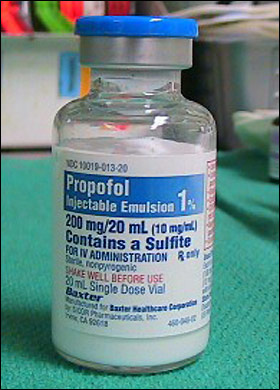
All provincial health authorities and private hospitals in Papua New Guinea have been warned of the use of Propofol Injection IP 10 Milligrams (mg) per Milliliter (mL) vial (1 per cent W/V).

This is according to a circular number 50 of 2021 that was issued on 17 August by Health Secretary, Dr Osborne Liko following the seven serious and fatal adverse incidents at the Port Moresby General Hospital Operation Theatre reported on 12 August caused by an anesthetic drug believed to be manufactured in India.

These cases included the death of four patients.

Last Friday, PMGH CEO Dr Paki Molumi confirmed that he is aware of this circular and responded last week by saying the death of the four patients after undergoing surgery in the middle of this month, August, was related to the administration of a batch of anesthetics.

Among them was a 14-year-old boy, whose death had come as a shock and disappointment to the families and the public. The boy died after undergoing an eye surgery at the hospital on 12 August.

Dr Molumi said investigation is still underway and PMGH will ensure that these investigations thorough and independent to assist and bring closure to these cases.

“The Health Department is taking this matter seriously and has requested for immediate identification and isolation of this batch of drugs from the entire procurement supply chain in both private and public hospitals,” Dr Liko said in the circular.

“All chief executive officers of PHAs, public, private and mission hospitals, all director medical services and clinical directors of public and private hospitals, all officers in charge (OIC), operating theatre managers of public and private operating theatres, all store technical advisers, pharmacy managers and OIC pharmacists in the hospitals pharmacies dispensaries, all pharmaceutical importers, wholesalers and distributors and manager country operations UNOPS and all other international health partners are urged to immediately identify and quarantine this batch from the entire procurement supply chain system both in public and private sectors in the country.”

As per the circular, the product name is Propofol Injection IP 10 mg/mL vial (1 per cent W/V). Manufacture is Cooper Pharma Limited, India. Batch/Lot Number LE21007, Manufacturing Date is 04/2021 and Expiry Date 03/2023.

Dr Liko said the Health Department through the Procurement and Regulatory team is conducting a preliminary and safety assessments to identify the cause of the serious and fatal adverse events during the use of the product.

“The Health Department is treating this as a very serious incident and full cooperation will be requested from all parties to fully establish the cause,” he said.

SOURCE: POST COURIER/PACNEWS

Fijian Drua included in Super Rugby Pacific competition

The world’s best provincial competition will reach new heights next year with Super Rugby Pacific set to kick off a new era, following agreement between Rugby Australia (RA) and New Zealand Rugby (NZR)

Set to kick-off on 18 February 2022, the new 12-team competition welcomes the introduction of Fijian Drua and Moana Pasifika who will join the five Australian and five New Zealand sides and will be delivered by the joint venture partnership between RA and NZR.

The Fijian Drua had previously competed in Australia’s National Rugby Championship, winning the title in 2018. Their inclusion was confirmed thanks to the support of Rugby Australia and New Zealand Rugby as well as that of the Australian Government’s PacificAus Sports programme.

Fiji Rugby Union will announce where Fijian Drua home matches will be played shortly, while Moana Pasifika will play their home fixtures primarily in New Zealand. Super Rugby Pacific’s two new entrants will play each other twice in the first two seasons with other examples where teams play twice to be determined by a seeding process based on 2021 results, with an emphasis on local derbies.

Rugby Australia CEO Andy Marinos said: “We’re thrilled to confirm the competition model for next year and beyond and want to thank NZR for their hard work and effort along with Fijian and Moana Pasifika for their patience, and the effort that has been put into their proposals.

“I want to thank Mike and Martin at Nine and Stan for their endorsement of the competition as well as Foreign Minister Marise Payne and the Australian Government for their terrific support.

“This is a game-changer for Rugby in the Pacific, and indeed, the rest of the Rugby world. We have seen the brilliant rugby that Fiji play in all formats of the game and their inclusion will make this new competition one of the toughest in the world,” Marinos said.

Stan Acting Chief Executive Officer Martin Kugeler said: “After a fantastic start for Rugby on Stan Sport, we are looking forward to showcasing the new Super Rugby competition format. We saw interest and viewership of Super Rugby significantly increase this year on Stan Sport and Nine, and we expect this new twelve team competition, with the addition of both Fijian Drua and Moana Pasifika, to resonate well with fans. Stan Sport as Australia’s home of rugby can’t wait to bring this new look Super Rugby competition to fans next year.”

RUPA Chief Executive Justin Harrison said: “It is pleasing to have a confirmed a new format to move into 2022, and to provide certainty for the participants and supporter base.

“Australian and New Zealand teams have a strong history of Pacific heritage representation; the inclusion of Fijian Drua and Moana Pasifika reflects the strength of the Pacific Island rugby talent participation. The addition of the Moana Pasifika and Fijian Drua sides are a celebration of our game, its people, and its future,” Harrison said.

Queensland Rugby Union CEO David Hanham said: “This is a significant step forward for Australian Super Rugby teams and the broader competition as we continue to navigate the post-pandemic world.

“The addition of two teams within our region competing in an 18-week tournament with seven home games will enable our clubs to further grow their supporter base and develop lifelong connections with their respective rugby communities.

“Having had the Drua in the National Rugby Championship and now being promoted to Super Rugby highlights that Australia has a strong professional pathway in place,” Hanham said.

Minister for Foreign Affairs and Minister for Women, Senator Marise Payne said DFAT’s partnership with Rugby Australia and the Fijian Drua will build careers for generations of talent and attract investment to support Fiji’s economic recovery from COVID-19.

“While the health security of our near neighbours remains a critical priority, sport helps facilitate the region’s cultural and economic recovery and keeps our countries connected,” Minister Payne said.

“As shown at the Tokyo Olympics, Fiji is one of the most talented rugby communities in the world and deserves to have this showcased on the world stage.”

Minister for International Development and the Pacific, Senator the Hon Zed Seselja said the partnership reinforces the strong bonds between Australia and Fiji.

“Australia and Fiji share a proud history of a friendly rivalry in rugby union stretching back 70 years. Supporting the Fiji Drua in Super Rugby is an exciting new chapter for rugby fans, and for our nations,” Minister Seselja said.

New Zealand Rugby General Manager Professional Rugby & High Performance Chris Lendrum said: “We are entering an incredibly exciting new phase for rugby in the Pacific region. The trans-Tasman rivalries are crucial to our sport in the Southern Hemisphere, and the existing Super Rugby clubs have built a wonderful history and legacy over 26 years.

“Moana Pasifika and the Fijian Drua will add an enormous amount of energy, skill and talent to the competition, not to mention a passionate support base. The Pasifika nations have added so much to world rugby over the years and this is an opportunity to enhance the standing of Pasifika rugby.

“Fans are going to see incredible skill and athleticism, and the regular season and finals series will undoubtedly unearth the best side in the tournament.”

All 91 matches will be ad-free, live and on demand on Stan Sport with the Saturday night match in each round also simulcast free-to-air on the Nine Network.

The competition structure for Super Rugby Pacific will be as follows:

*12 teams (alphabetical order) with Blues, Brumbies, Chiefs, Crusaders, Fijian Drua, Highlanders, Hurricanes, Melbourne Rebels, Moana Pasifika, NSW Waratahs, Queensland Reds, Western Force
*18-week competition window from 18 February to 18 June 2022 and 24 February to 24 June 2023
*91 matches in total
*Teams will play 14 regular season matches with each team to host seven matches
*Teams will play 8 teams once and 3 teams twice with a focus on derby matches
*One competition table with teams ranked 1 to 12 based on competition points
*Three-week playoff format involving the top eight teams on the overall competition table with quarters, semis and final as follows:
*Quarterfinals – 1 v 8, 2 v 7, 3 v 6 and 4 v 5 with the top ranked team hosting
*Semi-Finals – top ranked quarter-final winner hosts against lowest ranked quarter-final winner & 2nd highest ranked quarterfinal winner hosts 3rd highest ranked quarterfinal winner
* Final – top ranked semi-final winner hosts the other semi-final winner.

SOURCE: FRU/PACNEWS

Fiji PM promotes digital innovation as powerful driver of sustainable development at SIDS Forum

Fijian Prime Minister Voreqe Bainimarama says digital innovation can be a powerful driver of sustainable development sharing Fiji’s experience which has shown how the digital revolution can have an outsized benefit for Small Island Developing States (SIDS).

Using Fiji as an example, the Prime Minister added that Fiji has evolved over the years in terms of its demography, economic and social development, its institutions and governance.

Bainimarama also acknowledged Fiji’s increase in trade flows and investment levels whereby technological advancements have also been made on many front, and Fiji being digitally connected.

“We have no doubt that our economy will recapture its robust momentum once this pandemic is behind us.”

Bainimarama shared with the Forum Fiji’s improvements in terms of infrastructure and institutions, young people’s engagements and optimism and the extension of digital connectivity across Fiji’s many islands and rural communities.

While sharing Fiji’s achievements on the digital front, Bainimarama also acknowledged the brutal economic impact of the COVID-19 which has set back years of sustainable development progress. The Prime Minister added that Fiji is now resetting course to 2030 by readjusting the nation’s 5 Year & 20 Year National Development Plans – both of which has been formulated well before the pandemic – to strategically guide Fiji’s recovery.

“The Plan consists of two prongs or approaches: “Inclusive Socio-economic Development” and “Transformational Strategic Thrusts”. These prongs are mutually inclusive and reinforcing. I would like to focus now on the second approach – Transformational Strategic Thrusts. These are game-changing, forward-looking policy shifts to expand our development frontier and support the vision of transforming Fiji.”

The Prime Minister further stated that Fiji’s agriculture sector is focused on improving food and nutrition security by ensuring increased local production, raising farm efficiency and productivity, and developing more effective distribution systems. To achieve this, the Prime Minister said that new technology, mechanisation and better production practices are being adopted rapidly in Fiji’s agriculture sector to ensure that there are better systems to distribute agricultural information, effective market linkages and improved arrangement for effective public-sector market.

“We are also supporting commercial-scale production to achieve greater economies of scale, promote organic farming, encourage the production of traditional crops and help develop niche agricultural and fisheries products. To protect that progress, we are adopting climate-resilient varieties to ensure environmental sustainability.”

PM Bainimarama in his remarks at the SIDS Solution Forum also shared Fiji’s excitement about innovation in cloud computing, 3D printing, inter-networking of smart devices and other emerging technologies that hold the potential to improve efficiency and productivity across the Fijian economy. The Prime Minister added that for agriculture, government will further explore mechanised land preparation and harvesting, modern seed-breeding methods, and hydroponic and greenhouse farming techniques to address the issues of poor soil fertility, declining farm productivity and intermittent local supply.

“The digital revolution has been a godsend to us, as it has for many other nations. Digital technology allows us to connect people over huge distances and expanses of ocean in real time. It allows us to bring government services right to people’s homes and workplaces, no matter where they are. It gives every Fijian easy access to information available around the world.”

Bainimarama said that Fiji is digitising as many government services as possible and will continue to work on improving digital connectivity in the agricultural sector through universal access to high-speed internet networks and broadband – until all areas of Fiji are digitally connected

SOURCE: FIJI GOVT/PACNEWS

PNG’s ruling Pangu Party elects first woman president

Well-known former Papua New Guinea radio and tourism personality Erigere Singin has made history by being elected as the first woman national president of the ruling Pangu Pati at its 26th National Convention in Port Moresby last Friday.

Prime Minister and Pangu leader James Marape, announced the election of Singin and other party executives after the convention.

He also announced the election of Louisah Hosea as female vice-President, Sama Auro as male vice-President, and Joe Tep as Church Representative.

Singin, from Boana in Morobe, replaces Patrick Pundao.

Marape thanked Pundao for his service to Pangu over the last seven years.

“One of the key outcomes of today was the historical election of Erigere Singin as our National President of Pangu Pati,” he said.

“It is my distinguished pleasure to make this official announcement to the country.

“It is a historical milestone for Pangu Pati.

“In 1977, the first lady into Parliament was Pangu’s Nahau Rooney, and Pangu is breaking the frontier barrier again.

“It is not only men who can do the job, women can also do the job.”

Singin thanked Marape and said what happened Friday was a breakthrough for women in the country.

Meanwhile, deputy Prime Minister and parliamentary leader of the United Labour Party, Sam Basil has called on the Registrar of Political Parties to ensure that all 60-plus political parties in the country become visible throughout the country and not just lie in wait for election periods only.

Addressing hundreds of ULP supporters, delegates and villagers in Madang’s Sumkar district on the weekend, Basil said there are so many political parties in the country but a huge majority of them are invisible, or non-existent, and only come out to play during election periods.

He said this must stop. “I call on the Registrar of Political Parties to demand that these parties hold conventions and sell their policies and ideals to the people,” Basil said.

“A lot of times parties register and go into hiding until election time, when they put up candidates and campaign without strong policies.

“Political parties must not register as a business name and come out only during elections.

This is not good for political stability.”

He said the ULP believes in visible and transparent leadership, and would use the Sumkar convention to elect executives for the Madang branch of the party to lead the province into next year’s general election.

“The ULP will use this convention to elect the executives of ULP Madang branch.

This convention is important. We won’t go running around hand-picking executives in this and other provinces.

The people of Madang must vote your own executives to run the party in the province,” Basil said.

“These executives will be impartial and will play a big part in the nomination of ULP candidates in the upcoming elections.

“We will have strict criteria for nominating candidates for ULP in the upcoming elections, the Madang branch executives will have a big role in this process.

Our candidates will not be of questionable characters.

They must live in the electorate and must have a good standing in the community either in the church, private sector or public service.

“We have not done this properly in the past, and we don’t want to repeat the same mistake. We want good leaders who won’t tarnish the name and reputation of ULP.”

He was accompanied by MPs Koni Iguan, Peter Sapia and Chris Nangoi, various LLG presidents from all corners of the province and from Basil’s Bulolo district, as well as party executives.

SOURCE: POST COURIER/PACNEWS

Kava: The Pacific’s Economic ‘Diamond’ is being coveted by competitors

0


A tonic made from the roots of a plant endemic to the Pacific region has long been mired by foreign misconceptions. Now it has a new potential threat.

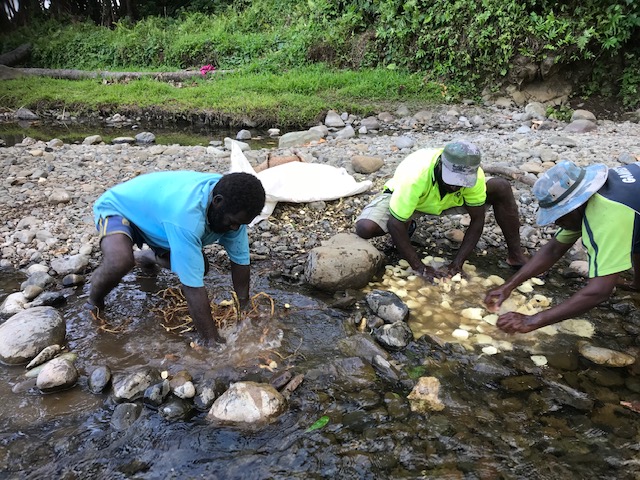
Nestled in the lush and steep climes of Penecost Island in Vanuatu, Anthony Tapi and his neighbours grow taro, cassava, and island cabbage. His community of about 20 people, in the northern village of Amatbobo, sits down to cups of kava each night to relax after a hard day’s work.

A majority of Tapi’s 7.5 acres is dedicated to piper methysticum, a plant native to Vanuatu. When the plant’s roots and rhizomes are peeled, crushed, steeped in water and extracted, the final product is kava — other names around the Pacific Islands include ‘awa, sakau, yaqona or malok.

Priced for anxiety, stress and pain-relieving qualities, the plant is rolled out for big community events — deaths, marriages, and pig killing ceremonies among them. Though kava is important culturally, it has become a product he and his Ni-Vanuatu countrymen have used to improve their livelihoods, Tapi says.

Passing around shells of kava is a centuries old tradition among Pacific Island communities, but increased international interest has steadily bolstered demand over the past decade. Almost solely grown in Pacific Island nations, kava is being exported globally, although kava experts fear the industry could be taken outside the Pacific.

Traditionally grown by small-holdings farmers alongside subsistence crops, it is now taking over as a cash crop. Despite the 3,000-year-old cultivar becoming a more recent economic boon for the Pacific, industry insiders are expressing concern over murmurs of kava farming taking place in Australia.

Tapi both farms and acts as a broker for fellow Pentecost farmers, selling 1.4 tons of kava to exporters and dealers in Vanuatu’s capital Port Vila. Michael Louze, director of South Sea Commodities, purchases kava from around the country, including Tapi’s.

“Kava has been a real success story,” says Louze from his Port Vila office. “Before independence in 1980, the economy was based only on what I call colonial crops: copra, cocoa, coffee.”

Those colonial crops were at the whim of global production, as they competed with other areas and global prices. In the ’90s with the kava industry beginning to export a unique product unable to be produced in other places, things changed.

Because of its associated relaxing benefits, demand for kava increased. Pharmaceutical companies were interested, and Ni-Vanuatu farmers found themselves making good money. In 2019, kava constituted 57% of Vanuatu’s export market, worth approximately US$48.4 million.

“Travel around the kava producing islands. All the development you will see around you, the Land Cruisers, the solar panels in households, all the ports, and school fees for the kids,” says Louze. “All of this would have been paid for with kava money — 95%, no loan. Where in the world do you find farmers buying Land Cruisers with cash money?”

An International Market

Vanuatu published its Kava Act in 2002, which dictated that all production would be organic, of certain varieties, while protecting local growers and ensuring stringent quality standards for export; other countries have since started drafting similar legislation.

Louze’s network of farmers cultivate and harvest before drying their kava, which is shipped to Port Vila and cleaned and processed again. From Port Vila, Louze ships kava to New Caledonia and the United States. Others ship to Europe, New Zealand and Australia.

Heightened shipping costs have affected Louze — one of approximately 20 registered exporters in Port Vila — though this year he has still shipped five containers containing three to four tons of kava to the U.S. and New Caledonia. Vanuatu also exports kava to Fiji and Kiribati.

Tarcisius Kabutaulaka, director of the University of Hawaii’s Centre for Pacific Islands Studies, sees kava as a “huge” opportunity for Fiji and Vanuatu in particular. Both countries have vibrant internal markets and have already benefited from outside demand. In 2020, Fiji exported just short of US$20.7 million worth of kava, to the United States, New Zealand, Marshall Islands and Nauru. Crop production has almost doubled to just over 13,000 tons since 2016 as well.

Fijian-Australian company Fiji Kava Ltd., which produces powdered kava and various therapeutics made with kava, listed on the Australian Stock Exchange in 2018. Its founder Zane Yoshida saw kava as a form of relief for the stressed masses, highlighted by the Covid-19 pandemic, and estimated the kava industry would be worth US$210 billion by 2026 — including therapeutic adaptations, aside from the beverage.

While kava bars around the U.S have closed, Fiji Kava’s growth increased 33% in the country, he says. Last year, the company signed a deal with a distributor in China, where the vitamin and supplement market is worth US$29 billion.

Fiji Kava now employs 40 people in Fiji and Australia, who work in the company’s tissue lab, its nucleus farm and in its offices, while it also has direct relationships with farmers around the country. Kabutaulaka says the increased interest — and volume cultivated, processed and exported — is already benefiting Pacific Islanders directly.

“Kava, because of the nature of the industry, because it’s produced in villages, the money directly goes to the village level,” he says.

Not a traditional consumer of kava, Kabutaulaka’s native Solomon Islands has also started growing the product for export. But Kabtaulaka is most concerned about kava being produced outside the Pacific.

Bundaberg Regional Council, in Australia’s Queensland, registered its interest in growing the plant with the country’s Department of Foreign Affairs and Trade, despite long-held restrictions on the product. If successful, production in Australia could have potentially devastating effects for the Pacific Island industry.

“Apart from the issues of incomes, it’s an issue of appropriation,” says Kabutaulaka.

Louze has worked with farmers such as Tapi in Vanuatu for more than 20 years, working with his own business for almost 12, and he finds the idea of Australian-grown kava insulting.

The country lists kava among its controlled substances, and has long had strict restrictions on its import. In 2019 Australian prime minister Scott Morrison announced that kava import rules would be eased by the end of 2020, though plans were delayed by the pandemic.

Given the country’s potential capacity for producing kava, Louze is alarmed.

“We will never, ever, ever, ever, be able to compete on any agricultural products,” he says. “We only have one product … which has high value for farmers.”

Yoshida suggested Australia divert its interest to further developing its kava-based programs throughout the Pacific, to help the countries where it could potentially make a difference.

“There certainly is that kind of support (already). They should be looking to ramp up,” says Yoshida, especially in light of potential legislative changes in Australia, and the potential domestic market there.

Now that kava has become more acceptable outside of the Pacific, used in specialty bars and lounges across the United States, Australia, New Zealand and Europe, concern over foreign kava crops has become a key question.

Dr Vincent Lebot, author of “Kava: The Pacific Elixir,” says Vanuatu’s Kava Act aims to promote kava in the same way Italy and France might promote their unique food products.

“Just like Scottish whisky, Darjeeling tea, Blue Mountain coffee from Jamaica, or Korean ginseng … we want to develop kava as something unique to the South Pacific, based on traditional knowledge,” says Lebot. “The problem is that we don’t have a product yet.”

To get such a product, consistency and quality is needed, he says, as well as a degree of standardization, which has not yet been achieved across the Pacific. It is far from impossible to achieve, he says, though it needs to be properly marketed too.

A Maligned Elixir

There are 120 different varieties of kava, which all share kavalactone compounds that give the plant its sedative quality. Kava took prominence in societal gatherings before colonization of the Pacific; it was offered to dignitaries, used to facilitate talanoa or constructive conversation, and the different varieties became known for their unique effects.

Pacific Island communities consume the tonic in different ways, to achieve different means. In Vanuatu, for instance, kava is generally a stronger post-conversation drink; in Fiji or Tonga, it is weaker and consumed four hours while people converse.

Lebot says that before colonization kava was the only way they could access “artificial paradise.”

The Frenchman moved to Vanuatu in 1981 as a young researcher, and became fascinated by the plant and the “licoricey” product prized by Ni-Vanuatu people. It was “under-researched and poorly documented” so he researched kava in the Pacific for his Ph.D, and began supposing direct connections between the islands.

“When you follow kava, you follow people. It has such a high cultural importance that people most likely couldn’t imagine settling somewhere without it,” says Lebot. “It was very important for kings and chiefs, and for running, I would say, society in general.”

When he started his research, collecting 300 samples from 35 Pacific islands, he found punitive colonial rule had almost destroyed traditional kava culture in some places, although he managed to find surviving plants deep in gulches and along creeks in places like Hawaii (which were strikingly similar to a variety found in The Marquesas Islands). Kava brought people together to discuss personal and community issues in their mother tongue.

“In other words, it was a threat to colonial power,” says Lebot.

More than colonialism, misconceptions about the effects of kava have long plagued its international success. German pharmaceutical companies attempted to isolate kavalactones for medicinal purposes in the late 1990s, prompting a spike in demand, but found the result unfit and dangerous. This led to Germany banning all kava in 2002, and other European nations following suit.

Lebot says kavalactones are not kava just as caffeine is not coffee. Germany’s ban was lifted in 2014, when a court decision deemed previous evidence insufficient. In 2020, the Food and Agriculture Organization and World Health Organization officially recognized kava as part of the Codex Alimentarius, essentially recognizing kava as food and publishing a best practice guide to kava production.

Kava has come to be used in cancer research, associated with relief for anxiety disorders, and has been considered a healthier alternative to alcohol. It is now being grown on islands where it had once virtually disappeared, including some varieties in Hawaii.

In Hawaii, the nonprofit Awa Development Council was started in 2005 to advocate for kava and its place in culture.

Jonathan Yee, a member of the council’s board of directors, says current demand outweighs supply in Hawaii. The associated costs of growing awa in Hawaii — utilities, labor, taxes — made it a more premium product, so value-added products were the best way to do business.

Yee says the product is particularly popular with those who value Hawaiian culture and young people, and there is a smattering of awa or kava bars across the islands.

Pu’u O Hoku Farm and Ranch is one of the largest awa producers in the state, on the eastern edge of Molokai. With 25 acres of awa, planted with native banana varieties, the ranch is likely the state’s only producer of frozen awa pulp. It supplies customers across the mainland, but its main market is in Hawaii.

Manager Rudy Hunke says demand is increasing, which he thinks could be partly due to cheaper powdered products from places like Vanuatu becoming harder to come by. The ranch is expanding its awa production in response, but he does not believe the ranch’s success should be measured in exports, sales or profits.

“Our main customers are Hawaiian native people. The feedback that we get from our customers is what motivates us,” Hunke says. “It’s not important how many bars there are, it’s important how heady we make our customers.”

The Kava Lounge

In New Zealand, in the urban center of Auckland, Four Shells Kava Lounge’s menu is almost exclusively kava. They are described as “fast acting,” “heady,” “uplifting,” or “deeply relaxing,” and the products hail from Tonga, Fiji and most commonly, Vanuatu. It is one of about seven outlets serving kava in the country.

Owners Anau and Todd Henry used Ni-Vanuatu kava first thanks to the quality assurance provided by the Kava Act, and later began offering Fijian and Tongan products once reliable sources were found.

Unlike many bars across the United States where kava is served in mixed cocktail-like drinks, the couple strictly serve kava traditionally, disassociating kava from alcohol and bar culture. In addition to hosting the Vanuatu, Fijian and Tongan diaspora, the couple spend a lot of time telling people how kava works, according to Todd Henry.

Each kava has provenance, Todd Henry says, as different cultivars give differing psychological effects.

“I find the best way to tell people about it is that we consider it the opposite to coffee … at the end of the day, we drink kava to unwind,” he says.

For the kava export industry to grow, quality needs to be assured. Todd Henry believes it’s inevitable kava will be grown outside the Pacific, though he does not want that to happen. He wants the island nations to reap the benefits of their culture and the cultivar, which one of his Ni-Vanuatu patrons calls the nation’s “diamond.”

“I almost feel like it’s a gift from their ancestors,” he says.

Thomas Heaton is a Li Center for Global Journalism Fellow. The position is supported by the Columbia University Graduate School of Journalism and the Institute for Nonprofit News. You can reach him by email at theaton@civilbeat.org or follow him on Twitter at @thomasheaton.

SOURCE: HONOLULU CIVIL BEAT/PACNEWS
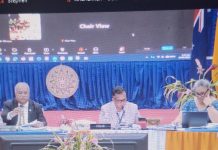
Peace by peaceful means has been the only answer -Bougainville President Toroama

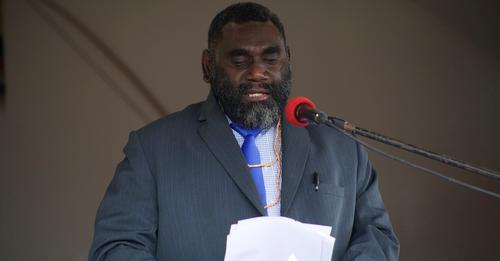
Bougainville today celebrated the 20th anniversary of the Bougainville Peace Agreement (BPA) that was signed between the people of Bougainville and the Government of Papua New Guinea on 30 August 2001.

The Bougainville Peace Agreement (BPA) formally ended the Bougainville crisis and signified the cessation of hostilities between the people of Bougainville and the Government of Papua New Guinea. It closed one of the darkest chapters of PNG and Bougainville’s history.

Bougainville President Ishmael Toroama said the BPA set the foundation for peace and opened the way for Bougainville to pursue their aspirations on self-determination.

“In the last twenty years our people, our leaders and the Autonomous Bougainville Government have shown great resilience in maintaining our commitment to the Bougainville Peace Agreement.

“Our endeavour to attain political independence for Bougainville has always been within the parametres of the Bougainville Peace Agreement. Our commitment has given credibility to the process espoused by the BPA by successfully implementing the requirements of the BPA’s three main pillars:

1.Autonomy
2.Weapons Disposal
3.Referendum

“We have achieved autonomy, we have achieved weapons disposal and we have successfully held a referendum with an overwhelming 97.7 percent of Bougainvilleans who have opted for an Independent Sovereign State of Bougainville,” President Toroama said in a statement.

The theme for the 20th Anniversary of the BPA “Celebrating the 20th Anniversary of the Bougainville Peace Agreement as the Cornerstone of our Independence Mission” is a testament to these achievements.

“It also a declaration by our government and our people of our resolve and the journey we have already begun.

“We have enjoyed twenty years of peace under the Bougainville Peace Agreement and the autonomous arrangements that created the ABG. The next five years are going to be critical as the ABG has declared its position to the National Government and we have set a timeline (2025 – 2027) for Bougainville’s final political settlement.

“I must thank the Prime Minister James Marape and the National Government for their continued commitment on the implementation of the BPA, we have come this far in the spirit of friendship and equal partnership. However, there are outstanding issues such as intergovernmental finance arrangements, drawdown of powers and the joint autonomy review. In light of this achievable challenges I recognise the Joint Supervisory Body as the appropriate medium to discuss these issues.

“In the face of adversity, we have shown courage by defending our land and our people against an oppressive regime and by the same spirit we have proved our valiance to accept peace. Our journey is not yet over, the next chapter in our history requires our people to unite and to continue to work hard to support our government,” said President Toroama.

He said history has taught them that peace by peaceful means has been the only answer to Bougainville’s progress.

“Hence we must embrace the values and principles that promote peace not only for our time but a peace for all time to come on Bougainville.

“As a signatory to the Bougainville Peace Agreement and moreover as President of Bougainville I am proud of the progress we have made despite the many challenges that came our way.

“I pay tribute to Bougainville’s past and present leadership for their immense contribution to making Bougainville realise its ultimate political future and that is independence. Happy 20th Bougainville Peace Agreement Anniversary Celebrations to you all,” said President Toroama.

SOURCE: ABG GOVT/PACNEWS

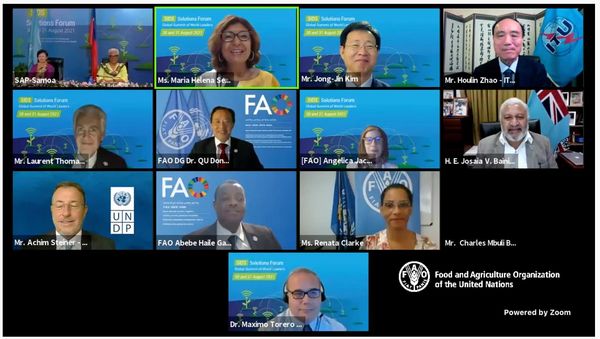
Fiji PM opens first ever virtual Small Islands Developing States Solution Forum

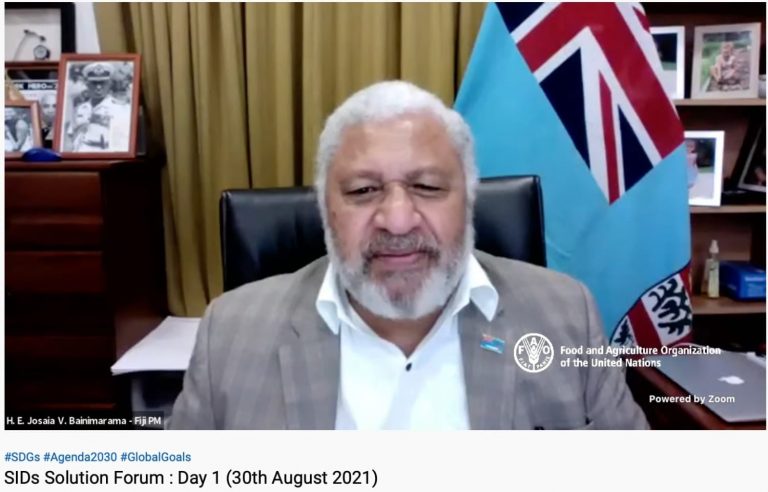
Fijian Prime Minister Voreqe Bainimarama today officially opened the first ever virtual SIDS Solutions Forum hosted by the Food and Agriculture Organisation (FAO) co-hosted by Fiji.

The Prime Minister expressed his deepest sympathies to the people of Haiti who have suffered the devastation of Tropical Storm Grace on the heels of a deadly earthquake and wished them the speediest possible recovery and urge solidarity from the international community in aiding the Haitian people.

With the theme “COVID-19 impacts on the economy and the potential of digitalisation and innovation to accelerate progress on resilient agri-food systems; improved nutrition and health; and strengthened climate resilience adaptation within the context of achieving the SDGs,” the two day event will be attended by Heads of States/Heads of Government, the FAO Director-General, and heads of other UN agencies, International Financial Institutions (IFIs), donors, private sector and civil society representatives.

While addressing the high-level gathering, PM Bainimarama acknowledged that advances in digital innovation has seen the vast oceans that separates SIDS members give way to vast possibilities, stating that together, SIDS are one connected continent bound by a spirit of innovative resilience.

“Our 39 states, from the South Pacific, to the Caribbean, to the Indian Ocean, are home to incredible minds, cutting edge innovation, and deep traditional knowledge. And it is past time we channeled all of our knowledge, ingenuity and passion behind solutions that can be scaled up for the benefit of our nearly 65 million citizens.”

The Prime Minister said food and nutrition security underpins every aspect of sustainable development and in the Pacific, decades of nutrition security have resulted in an epidemic of Non-Communicable Diseases (NCDs) – a challenge intensified by the pandemic. A challenge according to Prime Minister Bainimarama can be resolved through food systems which has the potential to help SIDS grow their way towards a COVID-19 recovery that sees their nations emerge stronger, more resilient, and more food and nutrition secure.

Prime Minister Bainimarama reiterated the need for SIDS to take note of the most recent IPCC report which states that without drastic cuts to emissions, low-lying SIDS member countries like Kiribati and Tuvalu will be faced with an existential threat over the coming decades.

“It means all of us must brace for storms and other climate impacts unlike anything we or our ancestors have ever endured. That is why, when we go to COP26 together, our rallying cry must be to keep 1.5 alive. It remains the only temperature threshold that guarantees the security of all SIDS citizens, and we must leverage every ounce of our power and moral authority to fight for it.”

Prime Minister Bainimarama added that these challenges can be met with innovation using Fiji’s launch of a micro insurance scheme for climate-vulnerable communities as an example.

“We are supporting local farmers with climate-resilient crops and funding adaption efforts through creative financial instruments. By harnessing the hope that such innovation offers, we can recoup the economic losses of the pandemic and reset course towards zero hunger, clean oceans, quality education, sustainable cities, and the other noble aims of the 2030 Agenda, towards more sustainable agri-food systems, and towards more resilient societies.”

The SIDS Solutions Forum scheduled from 30 – 31 August, 2021 intends to showcase examples of innovation and digitalisation for better agriculture, improved nutrition and health; strengthened adaptation to climate change and resilience – and aims to discuss ways and means for enhance knowledge sharing across SIDS globally and the investments and partnerships required.

Meanwhile the Prime Minister Bainimarama later today will also be delivering a High Level Leaders segment statement which will be attended by the Heads of Governments and Ministers as well as the Closing Remarks to conclude day one of the virtual SIDS Solutions Forum’s High Level segment.

SOURCE: FIJI GOVT/PACNEWS

Samoa urges U.S to commit to nuclear-free Pacific

Samoa’s former Ambassador to the United Nations, Ali’ioaiga Feturi Elisaia, has called on the United States to ratify a treaty declaring the South Pacific a Nuclear free zone.

The South Pacific Nuclear-Free Zone Treaty of Rarotonga has been signed by Samoa and is also referred to as the Rarotonga Treaty. The regional pact establishing the Pacific as a nuclear-weapons-free zone was first signed 33 years ago. But conspicuously absent from the countries to give the treaty legal effect is the America.

Russia, which along with America holds an estimated 90 percent of the world’s nuclear stockpile, has ratified the first two versions of the treaty but not the third. The United States is yet to ratify any version of the treaty.

Ali’ioaiga, who is currently Samoa’s High Commissioner to Fiji, made the comments during an online Blue Pacific Talanoa online meeting to mark the International Day against Nuclear testing last Friday. He was part of an expert panel that also included Fiji’s Prime Minister Voreqe Bainimarama and Pacific Islands Forum Secretary-General Henry Puma.

“Every journey has four distinct features. A point of reference, a starting line, sign posts, and a final destination,” Ali’ioaiga said.

“My point of reference for the Rarotonga Treaty was the establishment of the Pacific Islands Forum as a separate entity from the South Pacific Commission 50 years ago in August 1971.

“It was significant because it provided space for Pacific Leaders to discuss peace and security and political issues freely, which they couldn’t do within the South Pacific Commission because the metropolitan powers were present and some of the issues were sensitive and directly affected some of them.”

Issues like independence, decolonisation and nuclear testing became the Pacific Forum’s DNA, he said.

Ali’ioaiga then credited the Pacific Islands Forum for playing a critical role in the formulation of the treaty.

“I firmly believe that without the open and enabling environment that the Pacific Islands Forum offered, I doubt if the Rarotonga Treaty would ever become a reality, let alone discussed and considered,” he said.

“So that is the regional point-of-reference.

“My starting line was Tuvalu. I was a member of Samoa’s delegation at the Tuvalu Forum meeting in August 1984 where the decision was taken to appoint a working group of officials to prepare a draft of a Nuclear Free Zone Treaty for Leaders’ consideration at their next meeting.”

Looking back at the early days of the treaty’s formulation, Ali’ioaiga said Samoa was keen to be represented in the drafting team, and consequently became the country’s representative on the treaty’s drafting committee.

“I was not a nuclear scientist or an international lawyer – but Samoa was determined to have a seat at the drafting table to render legitimacy, inclusivity and ownership to our draft report. And the rest is history,” Ali’ioaiga said.

“The draft text of the proposed Treaty was endorsed by our Leaders at their Forum meeting in Rarotonga and opened for signature in August 1985. It came into force in record time a year later.”

Indicating that it was common knowledge that some Pacific island states were sites of nuclear testing at that time, Ali’ioaiga said said the scars of fear and mistrust – as a consequence of this experience as well as the impacted community’s vulnerability – gave the region a shared point-of-reference that shaped its perspective on nuclear disarmament.

“This helped unite us in our efforts to establish the Rarotonga Treaty,” said Ali’ioaiga.

Using Tuvalu as a starting point, Ali’ioaiga said the first signpost was in 2005, which marked 20 years after the adoption of the Rarotonga Treaty.

In 2005, there was a “Conference of States Parties and Signatories to Treaties” that established Nuclear Weapon Free Zones at Tlatelolco in Mexico, which was the namesake of the 1st Nuclear Free Zone Treaty for Latin America and the Caribbean Region in 1967.

Samoa was Chair of the Pacific Islands Forum Group in New York and it was invited to attend with New Zealand and Fiji also participating.

“Importantly, the different Pacific statements and interventions ensured that the spirit of the Rarotonga Treaty was alive, relevant and its presence felt on the global stage outside of its Pacific birthplace,” Ali’ioaiga said.

“The next signpost was in New York in 2015 during the Review Conference of the Non-Proliferation Treaty.

“We delivered a statement referencing our Rarotonga treaty’s contribution as the 2nd such Nuclear Free Zone Treaty stressing that the only guarantee against the use of nuclear weapons was through the total elimination of all nuclear weapons.”

The other signpost was in 2017 when Samoa was Pacific Islands Forum Chair again of the New York Group.

“And this was the year when the Treaty on the Prohibition of Nuclear Weapons was opened for signature. Samoa and five other Rarotonga Treaty members signed the treaty and we were amongst the first to ratify it, a year later,” he said.

When the Treaty entered into force in January of 2021 eight Pacific Island members were already states parties to the treaty.

And the last stop? Where else but Tuvalu when it hosted the 50th Forum Meeting in 2019 where regional leaders called for the operationalisation of the provisions of the Rarotonga Treaty.

It was at the Tuvalu Forum in 1984 when the decision was taken to start the drafting of a South Pacific Nuclear Free Zone Treaty, and it was at Tuvalu again that the call for the States Parties to operationalise the Treaty was made, said Ali’ioaiga.

Things have indeed come full circle, Ali’ioaiga added.

“Symbolically for me, things came full circle when I was back at home in Samoa. Last year on December 15 I was privileged to join virtually from Apia the first ever meeting of the States Parties to the Rarotonga Treaty, also marking the 35th anniversary of its adoption,” noted Ali’ioaiga.

“And the final destination? I guess the finishing line is still out of sight. Some powerful and influential people keep changing it.

“As for what is next, we don’t need to look far. The three Protocols of our own Rarotonga Treaty have yet to be ratified by the United States, despite some positive indications made earlier.

“And for us in the Pacific, is there appetite for the regionalisation of the Rarotonga Treaty to reflect the full Forum membership?

“And Japan’s announcement to discharge ALPS treated water into the Pacific Ocean has sounded the alarm bells again.

“We need independent and verifiable scientific assessment that this method of discharge is indeed safe-proof.

“We have a right to be reassured that this is the case. Nothing more, nothing less,” he said.

SOURCE: SAMOA OBSERVER/PACNEWS

Fiji records 396 new cases of COVID-19, six new cases on Malolo Island

Fiji has recorded 396 new cases of COVID-19 Sunday, increasing the total number of cases 45,957 and 477 death since the outbreak in April.

Fiji’s Permanent secretary for Health, Dr James Fong said 303 cases are from the Western division and 93 cases are from the Central division in Vitilevu, Fiji’s main island.

“Six new COVID-19 cases have been confirmed from Malolo Island. All these individuals have been isolated. There are now 29 active cases on Malolo Island.

“There have been 226 new recoveries reported since the last update, which means that there are now 19,300 active cases. 9,041 active cases are in the Central division, 10,090 active cases in the Western division, five active cases in the Northern division (Nabouwalu and Macuata), and 164 active cases in the Eastern division (all in Kadavu,” said Dr Fong.

He said there are currently 236 COVID-19 patients admitted to hospitals in Fiji.

“112 patients are admitted at the Lautoka Hospital, 22 patients are admitted at the FEMAT field hospital, and 102 are admitted at CWM hospital, St Giles, and Makoi. 24 patients are considered to be in severe condition, and 9 are in critical condition, said Dr Fong.

SOURCE: PACNEWS

Man arrested for threatening to assassinate Panuelo over vax mandate

Authorities have arrested a man who threatened to assassinate Federated States of Micronesia (FSM) President David Panuelo, in his social media posts.

The FSM government did not release the name of the suspect, who has been charged with “making threats of bodily harm” and “retaliation for official action.”

The case stemmed from a Facebook comment posted by an account user with the fictitious name “Jaylo David.”

“You gona need an army to protect you from now and on You will be assassinated for sure. Mark my word, President,” the comment read.

According to a statement from the FSM government, the national police investigators were able to link the defendant to the Facebook account, which appears to have been taken down.

“The investigators, in joint cooperation with the U.S Federal Bureau of Investigation et al., were able to reach out and secure critical pieces of information from Facebook, Google, and other relevant entities, regarding this matter,” the government said.

The “criminal” comment was posted under a government announcement mandating Covid -19 vaccination for all eligible FSM citizens.

FSM officials said citizens are encouraged “to freely express differing views on matters of public importance, to include the use of colorful and expressive language when one holds a particularly passionate view, as the freedom of expression is sacrosanct.”

FSM officials acknowledged that not every government decision, such as the Covid-19 vaccine mandate, will be popular.

“It is healthy, proper, and appropriate for citizens to engage in spirited debate (i.e. the exchange of views) and dialectic (i.e. the art of investigating or discussing the truth of opinions) on topics of public interest,” the government stated in a press release.

However, officials reminded the public that “making threats of bodily harm against any person, or any public official for that matter,” is a crime punishable with up to 10 years of imprisonment.

“The Panuelo-George administration promotes transparency and accountability in public service, but the law cannot, will not, and does not tolerate threats of physical harm to citizens and residents, including those directed against the head of state and head of government,” states the statement from the Office of the President.

After being confined in jail during the weekend, the man was released on probation pending trial.

SOURCE: FSM GOVT/PACNEWS

Stay connected

529FansLike
172FollowersFollow
156SubscribersSubscribe
- Advertisement -