
Home Blog Page 1147

Ambitious new sports diplomacy initiative aimed at deepening relations with Pacific island countries

0

An ambitious proposal for a new sports diplomacy mission dubbed ‘Team AusPac’ was tabled in the Australian Federal Parliament last Wednesday, aimed at deepening ties between Australia and Pacific island countries.

Chair of the Australian Parliament’s Trade Sub-Committee, MP Ted O’Brien, announced the proposal which forms part of a Parliamentary Inquiry report entitled ‘One Region, One Family, One Future’.

“Australia and Pacific island countries display an affinity for one another which goes well beyond our shared geography and common geostrategic and economic interests,” said O’Brien.

“It may not be at the pointy end of international affairs, but you should never underestimate the importance of people to people relations which is a great strength of Australia’s relationship with Pacific island countries,” he said.

‘And sport is one of the key ingredients.’

Team AusPac would be an initiative spearheaded by the Australian Government, in partnership with relevant sporting organisations, and include the creation a special programme for Pacific island athletes as part of the Australian Institute of Sport; an expansion of the number of sports to receive special focus under the PacificAus Sports programme beyond netball, football and rugby union and league; a capacity building programme for sporting coaches and trainers, and; support for a team from a Pacific island country to enter the National Rugby League (NRL) competition.

‘Team AusPac would also maximise opportunities for Pacific island countries to be closely associated with, and actively participate in, the 2032 Olympic and Paralympic Games in Australia,’ saidO’Brien who was Prime Minister Morrison’s personal representative on the bid team that recently secured the rights for Brisbane to host the 2032 Games.

In all, the Inquiry’s report made five recommendations proposing that the Australian Government:

*prioritises its support for the Pacific region to recover from COVID-19 by increasing development assistance, providing vaccine coverage, assisting in the event of COVID-19 outbreaks and assessing opportunities to restore international trade and travel

*prioritises activation of greater trade and investment by considering measures and reforms to the Pacific Agreement on Closer Economic Relations, making it easier for Pacific islanders to access the Australian market, supporting further research into trade and investment, supporting the establishment of National Standard Bodies, supporting the Pacific Quality Infrastructure Initiative, promoting pilot investor tours to Pacific island countries and expanding Australia’s kava commercial importation pilot

*improves travel and mobility between Australia and countries of the Pacific region by establishing a Pacific travel bubble subject to health advice and processes, investigates potential for improving infrastructure, introduces a Pacific Business Travel Card, and improves labour mobility arrangements

*works towards deepening people-to-people ties between Australia and countries of the Pacific region through sport, churches and media – for example, through a new programmme called ‘Team AusPac’

* maximises opportunities for Pacific island countries to be closely associated with, and actively participate in, the 2032 Olympic and Paralympic Games in Australia

*recognises the important role played by Australian states and territories in our relationship with Pacific island countries – in particular, the state of Queensland – and analyses the outcomes of this report within a Queensland context, undertakes a feasibility study on expanding the services of a Pacific-focused office of Department of Foreign Affairs, Defence and Trade in Queensland, and engages the Queensland Government and relevant local government authorities to work collaboratively on aspects of this report.

“After 56 submissions and eight public hearing and roundtables with the diplomatic representatives of the Pacific island nations, I am confident that this report helps answer our questions and that our five recommendations are worthy of adoption by the Government,” said O’Brien.

SOURCE: AUST GOVT/PACNEWS
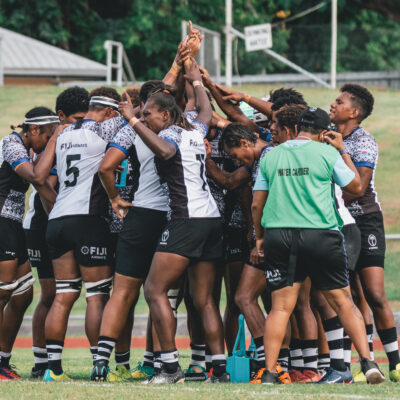
Fijiana Xv’s on track for 2022 Rugby World Cup

0

Fijiana XV’s have been pumping up preparation off the field leading up to the Rugby World Cup in New Zealand next year.

World Rugby made the decision to postpone the 2021 Rugby World Cup due to the uncertainty and the challenges of a global COVID-19 landscape.

Fijiana have not played a match together since they last played a year ago, the deferred of the RWC date has provided head coach Senirusi Seruvakula and his management teams the time to work closely with his squad in getting everything right.

Preparations has been well on track for the team but when Covid-19 surge the country around April, it brought everything to a halt.

However, the past 5 months of strict Covid restrictions has saw the Fijiana management team working around the clock to accommodate the players with the much-needed training programme to keep them on track.

Fijiana XV’s captain Sereima Leweniqila explained that their management team have been very active in keeping the players engaged.

“Our coaches n SNC team have been very active from the beginning. We have our training chat groups where our progamme is posted on a daily basis and players are tasked to send in daily videos and results,” said Leweniqila.

“It’s easy to just message our management individually if we are facing any difficulties and they are very understanding, and at times we would have our zoom meetings with our different coaches just to get everyone on the same page,” said Leweniqila.

LeweniqiIa emphasised how their journey to the RWC has been a roller coaster not just due to the current situation they’re “facing but with the postponement of the world cup as well.”

“We can’t do much with what the country is going through, for each player it’s a different story on the struggle we each face to try and keep the dream alive of playing in the world cup in these difficult times,” said Leweniqila.

“Some of us have lost loved ones, contracted COVID-19, loss of job/ hours cut etc, then theres trying to keep fit and improvising with whatever we can find at home to use it as training equipment,” she added.

“Not only the form of training that we had been undergoing we had found some to be new to us and also challenging, then we have a few stumbling blocks of smaller issues that we hit along the way,” she added.

However, these did not deter them from pushing through, and with the Fijiana 7’s success at the Olympics, it has definitely provided them with the urge to train hard, give it their best and aim for the top reward.

“Just an overall inspirational, motivational and just a proud moment for all women who play rugby, their win not only impacted the rugby fraternity but just women in General, winning an Olympic medal or just participating in the event is one of the highest forms of achievement in sport for any women,” said Leweniqila.

“As for the Fijiana 15s i think it’s given the players a sense of feeling and hope that anything is possible, we just have to work hard and work together,” added Leweniqila.

SOURCE: FRU/PACNEWS

U.S funding tapped for Pacific undersea cable after China rebuffed

0

The Federated States of Micronesia (FSM) will tap a U.S funding facility to construct a Pacific undersea communications cable, two sources told Reuters, after rejecting a Chinese company-led proposal that was deemed a security threat by U.S officials.

The United States has taken great interest in several plans in recent years to lay optic fibre cables across the Pacific, projects that would bring vastly improved communications to island nations.

The undersea cables have far greater data capacity than satellites, leading Washington to raise concerns that the involvement of Chinese firms would compromise regional security. Beijing has consistently denied any intent to use cable infrastructure for spying.

Two sources with knowledge of the plans said FSM would use U.S funds to construct a line between two of its four states, Kosrae to Pohnpei, replicating part of a route proposed under a previous US$72.6 million project backed by the World Bank and Asian Development Bank.

Reuters reported in June that project, which also encompassed Nauru and Kiribati, was scuppered after Washington raised concerns the contract would be awarded to Huawei Marine, now called HMN Technologies and majority owned by Shanghai-listed Hengtong Optic-Electric Co Ltd.

One source told Reuters that FSM would draw around US$14 million from the American Rescue Plan, a U.S facility created by President Joe Biden to distribute funds both at home and abroad to combat the health and economic impacts of the COVID-19 pandemic.

FSM said it was committed to providing fibre connectivity to the State of Kosrae, and onward connectivity to Kiribati and Nauru. It did not respond directly to questions about U.S funding.

The U.S State Department declined to comment.

The United States and FSM have a long geopolitical relationship, enshrined in the Compact of Free Association, a decades-old agreement between the United States and its former Pacific trust territories. Under that agreement, Washington is responsible for the island nation’s defence.

The second source said the U.S funded cable would likely connect to the HANTRU-1 undersea cable, a line primarily used by the U.S government that connects to the U.S Pacific territory of Guam.

Both sources spoke on condition of anonymity as they were not authorised to speak publicly.

The World Bank said in a statement it was working with FSM and Kiribati to map out their next steps after the original tender for the larger project concluded with no contract awarded.

Undersea cables represent one of the newest and most sensitive fronts in the rivalry between China and the U.S in the strategic waters of the Pacific.

While FSM has close ties to the United States, it also has long-standing diplomatic and trade relations with China.

Prominent U.S lawmakers have warned that Chinese companies could undermine competitive tenders by offering state-subsidised bids Reuters previously reported.

The U.S Commerce Department publicly lists Huawei Marine on its so-called “Entity List” – known as a blacklist – which restricts the sale of U.S goods and technology to the company. The Department told Reuters that Huawei’s new owner, HMN Tech, would also be captured under these restrictions.

China has strongly refuted the allegations. China’s Foreign Ministry said in a statement to Reuters that Chinese companies had a good record in cybersecurity.

“The so-called security threat [alleged] by the U.S is totally groundless, and has ulterior motives,” the statement said. “Who the ‘hacker empire’ really is – engaging in spying and stealing secrets – is plain to the world.”

Australia, a strong regional ally to the United States, has ramped up its presence in the Pacific through the creation of a AUD$2 billion (US$1.48 billion) infrastructure financing facility that island nations can potentially access for cable projects.

Nauru has been negotiating plans to tap into the Australian-backed Coral Sea Cable system, via Solomon Islands, sources told Reuters in June

SOURCE: REUTERS/PACNEWS

Fiji records 156 new cases of COVID-19

Fiji has recorded 156 new cases of COVID-19 Sunday, increasing the total number of cases in the island nation to 47,795 with 506 deaths since the outbreak in April.

Permanent secretary for Health, Dr James Fong said 79 cases are from the Western division, 73 cases are from the Central division in Vitilevu, Fiji’s main island and four cases are from the Eastern division on the island of Kadavu.

“There are four new COVID-19 positive cases in Kadavu and 13 new COVID-19 positive cases in Naviti, Yasawa Islands. All these individuals have been isolated.

“There have been 696 new recoveries to report since the last update, which means that there are now 15,997 active cases. 4,522 active cases are in the Central Division, 11,164 active cases in the Western division, four active cases in the Northern division (Macuata) and 307 active cases in the Eastern division (all in Kadavu).

“There have been 47,795 cases during the outbreak that started in April 2021. We have recorded a total of 47,865 cases in Fiji since the first case was reported in March 2020, with 31,041 recoveries,” said Dr Fong.

He said there are no new COVID deaths reported

“However, there are two deaths currently under investigation.

“here have now been 508 deaths due to COVID-19 in Fiji, with 506 of these deaths during the outbreak that started in April this year.

Therefore, as of 31 August, the national seven-day rolling average of COVID-19 deaths per day is four. The seven-day rolling average for COVID-19 deaths per day in the Central division is one and in the Western Division is three. We also have recorded 319 COVID-19 positive patients who died from the serious medical conditions that they had before they contracted COVID-19; these are not classified as COVID-19 deaths,” Dr Fong explained.

He said there are currently 204 COVID-19 patients admitted to hospitals in Fiji.

As of 04 September, 566,210 adults in Fiji have received their first dose of the vaccine and 299,943 have received their second doses. This means that 96.5 percent of the target population have received at least one dose and 51.1 percent are now fully vaccinated nationwide.

SOURCE: PACNEWS

West Sepik seeks help to manage COVID-19 and NCC responds promptly

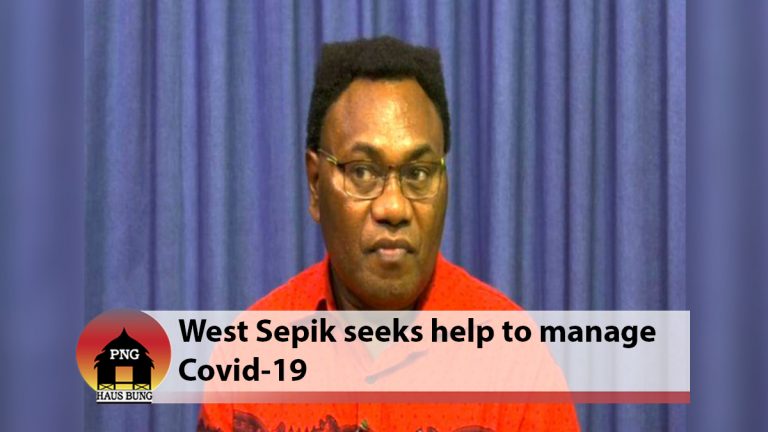
Health authorities in West Sepik in Papua New Guinea are seeking help to manage the COVID-19 pandemic as the number of cases rise.

They are also advocating for provincial lockdown or a partial lockdown to prevent a possible second surge of COVID-19 cases. It had a lock-down early this year when it had its first surge.

Director for WSP Public Health and Incident Manager Dr Trevor Kelebi said in a situation report submitted to the National Coordination Centre (NCC)that the six-bed isolation ward at the Sandaun Provincial Hospital was full throughout the month of August and is managed by one health extension officer and junior nursing staff and need added clinical manpower support.

“We are advocating for a provincial lock-down during Provincial Control Centre (PCC) or a partial lockdown with strict compliance to Niupela Pasin, vaccination and mandatory swabbing,’’ said Dr Kelebi.

He said West Sepik has so far confirmed a total of 594 positive cases of which seven died, including two in the month of August, and they are expecting a surge in the coming weeks

It is also difficult to know the real situation in the province now due to low testing, especially with swabbing hesitancy which poses a challenge to effective contact tracing. The other big challenges facing West Sepik’s response to COVID-19 lies in high hesitancy towards vaccination and lack of adherence to Niupela Pasin.

“A total of 490 vials (10 doses per vial) of AstraZeneca vaccines were received on 22 April 2021 which expired on the 29th of July, 2021 and additional 200 were received in early August which will expire on 30 September, 2021,’’ he said.

Furthermore, he said all health facilities and business houses’ attempts to strengthen the ‘no mask, no entry’ policy at all entry points remains a challenge due to so many social media critics having a big influence on the public.

Together with the Sandaun Provincial Inter-Agencies, the Provincial Health Authority has submitted the West Sepik Surge Plan on 04 August, 2021 to NCC and relevant government agencies.

With its close proximity to the border with Indonesia and the threat of current or future outbreaks of epidemics or pandemics, the WS PHA is also seeking a new isolation and quarantine site to be constructed on state land. Currently, they are renting a private property for quarantine and isolation for COVID-19 asymptomatic or mild cases with their contacts which the WSPHA says is not sustainable.

In response to the WS PHA request, the Deputy Controller for the National Pandemic Response, Dr Daoni Esorom, has confirmed receiving the WS PHA report at the National Coordination Centre and will be providing support to the PHA.

Dr Daoni confirmed that an Emergency Medical Team is now being put together with the clinical management and the Emergency Medical Team clusters at the NCC that will consist of an emergency specialist doctor, four clinical nurses and an Infection Prevention Control (IPC) nurse to support the PHA team respond to the surge.

He also confirmed that WHO has three staff already on the ground in Vanimo to support the PHA.

“We will support the WS PHA team to respond to the current surge. Some of the positive samples have been sent to Melbourne for genomesequencing which will confirm whether they are delta variant cases.

“I strongly urge all the PHAs to be prepared for any surges in the delta cases. This is the time that all PHAs must be preparing themselves for surges in the delta variant cases. I urge all the PHAs to increase the surveillance, testing, IPC and to have in place enough ICU beds to respond to any delta variant cases. All hospitals must have enough oxygen in the ICU and hospitals to respond to any increase in the number of cases,” Dr Daoni said.

SOURCE: PNG GOVT/PACNEWS

Kiribati starts rollout of Chinese-made COVID-19 vaccine

Kiribati started to rollout the Chinese-made Sinopharm COVID-19 vaccines on Friday.

Kiribati President Taneti Maamau, Minister of Health and Medical Services Dr Tinte Itinteang, Chinese Ambassador to Kiribati Tang Songgen and other officials attended the ceremony held in Tarawa, capital of Kiribati.

The vaccines, which arrived in the south Pacific island country on Wednesday, were donated by China to help the country better prevent an outbreak of the pandemic.

Tang said the international community should join hands to cope with the tough challenges brought by the pandemic, adding that China has always promoted greater access and affordability of COVID-19 vaccines in developing countries.

He said the Sinopharm vaccine, with good safety and effectiveness, has been approved by the World Health Organisation for emergency use. These vaccines will offer strong protection for Kiribati people against coronavirus, and provide support for the country’s economic and social development.

Itinteang thanked China for the donation. He said Kiribati, despite the current zero-case status, must be well prepared for any possible invasion of the coronavirus, and the vaccination is the key to reduce hospitalisation, death and severe cases.

The China-donated doses will help Kiribati vaccinate more residents, Itinteang said.

SOURCE: XINHUA/PACNEWS

Vaccines on horseback: Fiji doctors take long and muddy road to protect remote villages from Covid

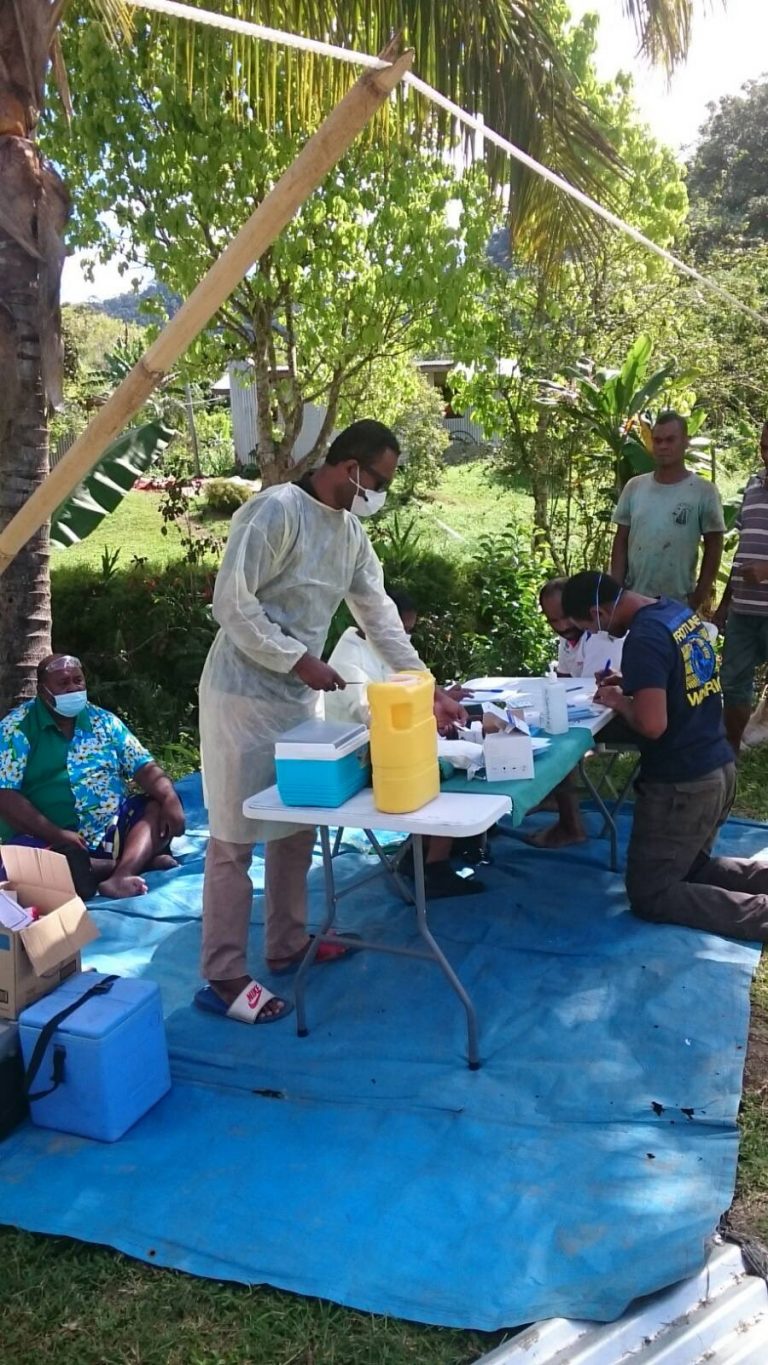
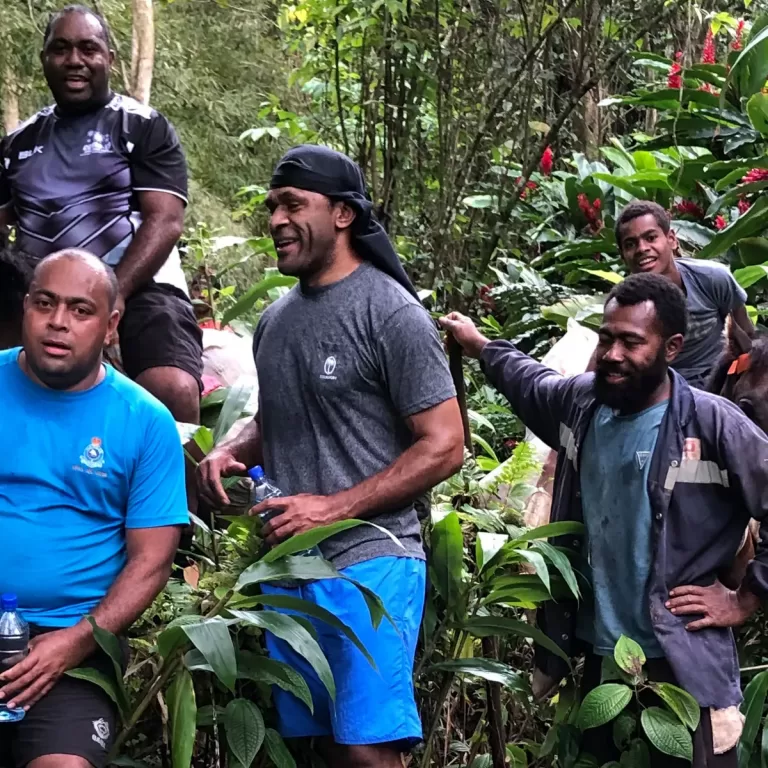
To reach Nakida village in the highlands of Fiji, Dr Losalini Tabakei and her colleagues hiked for hours, up and down mountains, through forests, down muddy slopes, across rivers and along treacherous ridges with steep slopes of bamboo forest on either side.

Their supplies – clothing, medical equipment and, crucially, the Covid-19 vaccines they were bringing to administer to the remote community of just 60 people – were sent separately on horseback; the vaccines in refrigerated boxes, the rest in bags wrapped in plastic. The horses took the longer but flatter route to the town along the river.

The team, made up of Tabakei, a junior surgical consultant at CWM hospital in Fiji’s capital of Suva, as well as other surgeons, nurses, consultants, registrars, a police officer, interns and a local health worker, made the trip as part of the Fiji government’s campaign to “leave no one behind”.

The country is grappling with a devastating Delta outbreak that has seen more than 500 people die and 47,000 cases – more than 5% of the country’s population of about 900,000 people. The Pacific nation has the dubious honour of having the highest per-capita rate of infection at times over the past month.

The trip, which Nakida locals had assured them would take a maximum of three hours, took the group five hours.

“No one was mentally or physically prepared,” she said laughing, a week later, on the phone from Suva, where she has just completed rounds at the hospital. “The guides, they are not allowed to tell us how far we have to go, because according to their belief that would make the trip longer. They’d answer ‘We’re almost there’ when we were about one-tenth of the journey.”

Their trip was not made easier by the fact that they accidentally left all their snacks for the trip in the bags that were put on the horses, meaning all they had was water – and one grapefruit, which one of their team spotted, climbed a tree to pick and shared with his colleagues.

Videos of the expedition – which show the team joking and teasing one another as they went, and chanting the catchphrase “Reaching the unreachable, leaving no one behind” – were shared by the country’s health minister, Dr Ifereimi Waqainabete, as a sign of Fiji’s collective effort to vaccinate its entire community from Covid-19. The drive seems to be bearing fruit, with 95 percent of all eligible people having received one dose of the vaccine, and about 51.1 percent having received both doses.

There were just 25 people at Nakida who needed vaccinating and Tabakei says the villagers were very pleased to see the group arrive.

“They were worried about us making it safely and they had prepared a lavish dinner for us,” she says. After showers and dinner, and despite their fatigue, the medical team delivered their awareness talk about Covid-19 and the vaccine.

“They were very receptive and they were very happy to see visitors and to see that we cared enough to make that trip and reach their village,” Tabakei says.

“In the question and answer sessions they mentioned that they had already started experiencing symptoms of Covid-19 weeks back, so even in these remote villages – and we saw this all over Naitasiri – despite being removed, where there’s a track this virus will find its way. It sort of reinforced our purpose going there to educate them, vaccinate them.”

Tabakei and the other health workers visited roughly 20 villages in Naitasiri that week. The format of their visits is the same: perform cultural ceremonies, give an awareness talk about the virus, particularly addressing conspiracy theories. Then the team swab people showing symptoms of Covid, provide vaccinations for those who want them, and attend to other health concerns.

The reception to the group, and attitude to the vaccine, is entirely dependent on the attitude of the village chief to vaccination, Tabakei says. In villages where the chief is positive, 90-95 percent of villagers will be vaccinated; in villages where the chief is sceptical, that number drops to 40-50 percent.

It helps that Tabakei, whose mother is from a village bordering Naitasiri province, speaks the local dialect.

“Especially the elderly, they tend to be very reserved. They don’t always have access to information, so when they see someone from province who comes into their village and says, ‘This is good for you, this will help you’ – and we saw a few very real examples of that, just after talking to them – [people are] saying, ‘OK, I’m going to get my jab now’ and they line up to get vaccinated,” she said.

SOURCE: THE GUARDIAN/PACNEWS

Japan donates US$10m for new tugboat at Port of Nuku’alofa

1

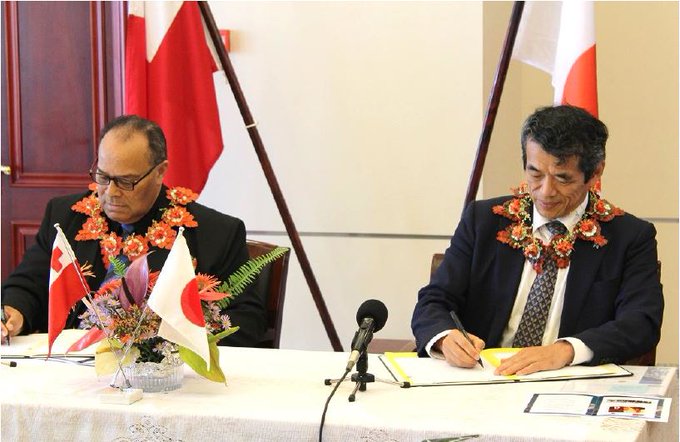
A multi-million dollar grant for the provision of a new tugboat for Tonga was signed by the Japanese Ambassador to Tonga Kensaku Munenaga and the Prime Minister, Dr Pohiva Tu’i’onetoa.

The agreement, worth approximately US$10 million from the Japanese Government under its Non-Project Grant Aid scheme, will be used for the provision of a new tugboat for the Port of Nuku’alofa.

“Without this new tug boat, the numbers and sizes of vessels calling on Tonga’s ports could be limited and will adversely affect the clearance of goods, which could ultimately put Tonga’s food security at risk,” said Ambassador Kensaku.

This is the ninth round of Non-Project Grant Aid NPGAs, totalling USD$17million, for Tonga since 2009, when Japan opened its embassy in Tonga.

“You could understand the significance of today’s grant as well as Japan’s priority,” he said.

This is the second tug boat to be donated by the Japanese Government to the Ministry of Public Enterprises and the Ports Authority. The first tug boat was the MV Hifofua in 1994, and is still in operation under the Port Authority. The life of the new tugboat will be around 27 years.

The Prime Minister, Dr Pohiva Tu’i’onetoa said the new tug boat was requested by Government to cater for the needs of the Ports Authority, and to comply with legal requirements and International Standards.

According to the Asian Development Bank, 80 percent of imports to Tonga arrive by cargo ships.

SOURCE: TONGA WIRES/PACNEWS

Micronesia continues dialogue with PIF, but position to leave the Forum has not changed

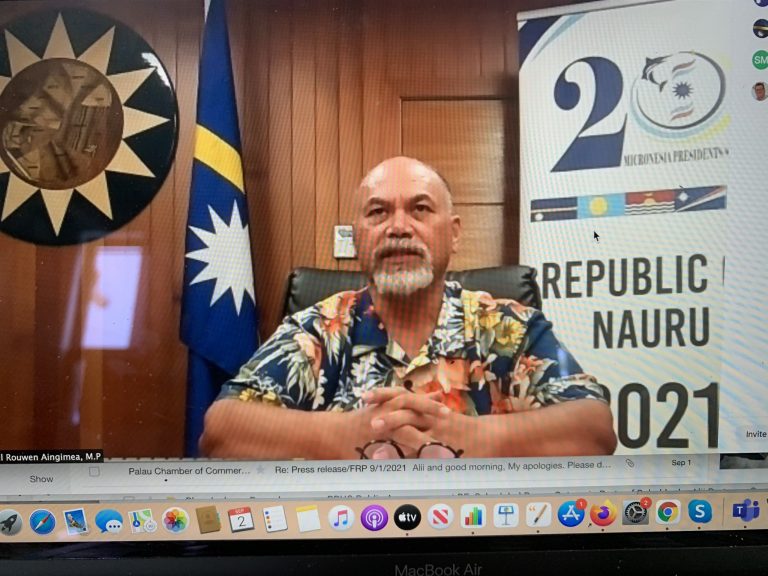
Nauru President Lionel Aingimea said Micronesian nations have not changed their position on leaving the Pacific Islands Forum (PIF) but that the sub-region is engaging with the other leaders to discuss the rift.

President Aingimea, in a virtual press conference at the 20th Micronesian Presidents’ Summit conclusion, told reporters that the issue of the fracture has been “discussed at length over the three days “during the summit.

“Now the position of Micronesia is still the Mekreos communique, we have not changed from that position. And that has been the position that we have taken and that’s the position that we have given to the Pacific Islands Forum,” he said.

However he said the four presidents of the Micronesian countries – President of Kiribati, Taneti Maamau; President of the Federated States of Micronesia, David Panuelo; President of the Republic of the Marshall Islands, David Kabua; and President of Palau, Surangel Whipps Jr, are engaging with the PIF leaders on the issue,

“Having said that, there are still ongoing discussions happening. Those discussions have yet to finish. And as those discussions go along, I am sure there will be other issues or things that will come about that could help maybe take things forward. We are of course Micronesia is always willing to engage. But again I reiterate that our position is the Mekreos communique and we stand by what we have said.”

In the Mekreos Communique’ signed in Palau in 2020, presidents of FSM, Kiribati, Marshall Islands, Nauru, and Palau insisted the Forum honor a long-standing unwritten gentleman’s agreement to rotate the secretary-general role by sub-region.

On Monday, the 20th MPS conducted virtually officially opened on the theme ‘Sustainable Transportation and Trade through the Micronesian Region.

President Aingimea said the topics discussed by the leaders were the issues of COVID-19, climate change, food security, high transportation costs, intrusive geopolitics, security issues, and withdrawal from the PIF.

SOURCE: ISLAND TIMES/PACNEWS

Nauru President: Palau travel bubble offers model for Micronesia

0

Micronesian countries look to Palau as leader of tourism bubble success, Nauru President Lionel Aingimea told reporters Thursday.

President Aingimea said transportation and people moving from one country to another is not the easiest task during the coronavirus pandemic.

“We not only have countries closing borders, but bigger countries like Australia having within their own states closing borders to the other states also.”

He said Palau’s travel bubbles could become a model for the other Micronesian nations to emulate for strategies in opening borders and bringing in visitors amid the COVID-19.

“The Republic of Palau has got a bubble with Taiwan. And I think they also have a bubble now with Guam. And we are learning from Palau how and how they’ve done their protocols regarding COVID. What happens when people do come to Palau? And what are the processes that they have to go through?”

A tourism-reliant nation, Palau has reopened its borders to Taiwan and Guam following its aggressive vaccination program and strict protocols implemented on incoming travelers.

Aingimea said Nauru, Kiribati, Federated States of Micronesia, and the Republic of the Marshall Islands can learn from Palau how to open up their borders.

Palau is taking the lead in the Micronesian countries and how they do things with tourism and with opening up these bubbles, we also would like to see how they’ve done things and for them to be able to teach us and to give us some lessons in how we can open…, “ he said.

President Aingimea was speaking to reporters after the virtual 20th Micronesian Presidents’ Summit (MPS, where the issue of transportation in the COVID -19 world was discussed.

Aingimea said it got the taste of the travel bubble when a mercy flight from Nauru to take people to Taiwan was allowed to land in Palau last week.

“And Polo opened its doors to allow that flight to land in Palau, either, because the Nauruans are all had been vaccinated, and coming from a COVID free country. And therefore, there was a quite nice of Palau and we commended the Palauan president for what he did.”

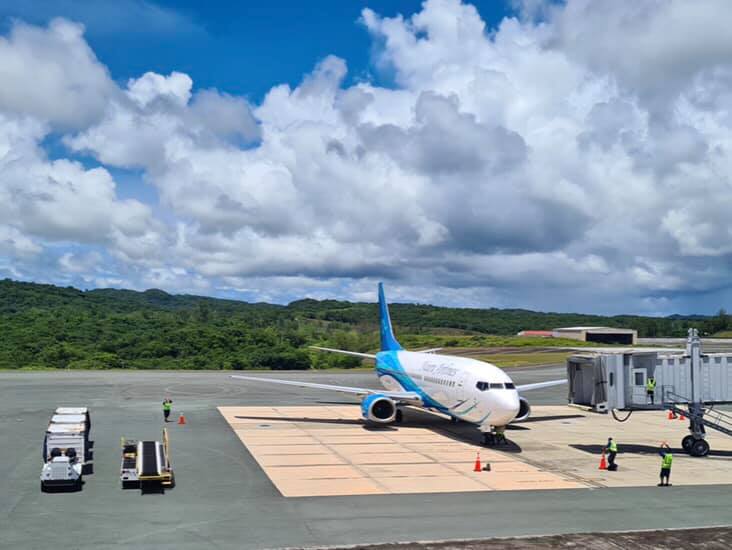
Palau has resumed the travel bubble with Taiwan in August with eased protocols and vaccination upon arrival.

The nation has also opened its border to a weekly flight from Guam. Travelers via Guam are required to be fully vaccinated and will have to show a negative COVID-19 test when entering the country.

ISLAND TIMES/PACNEWS

Stay connected

529FansLike
172FollowersFollow
156SubscribersSubscribe
- Advertisement -