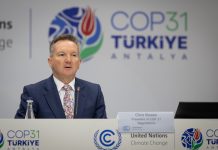
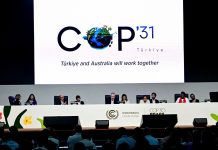
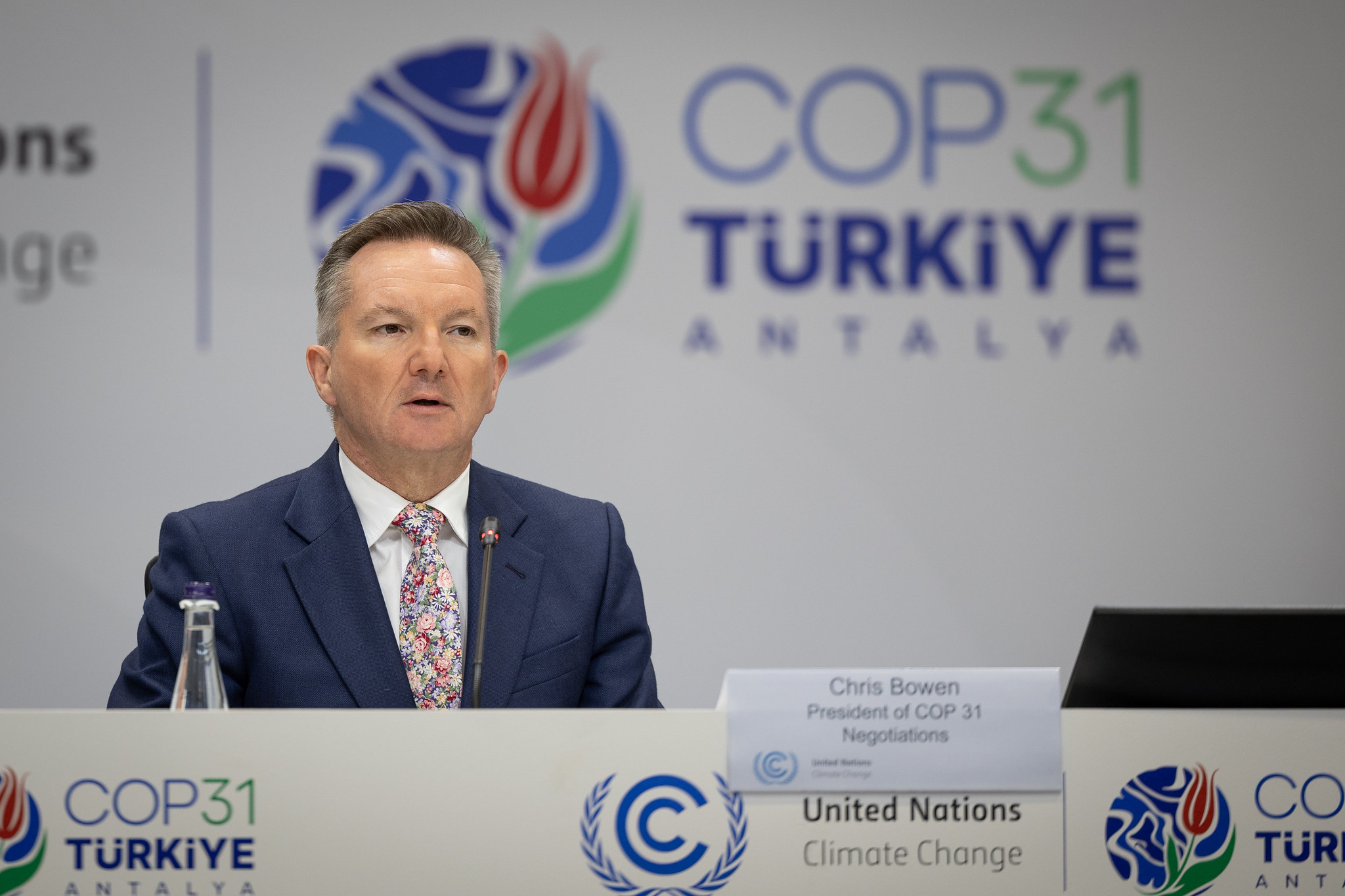
Australia has backed Pacific calls to keep the 1.5 degrees Celsius warming limit within reach, improve access to climate finance and strengthen regional resilience, as Climate Change and Energy Minister Chris Bowen outlined Australia’s clean energy transition at COP31.
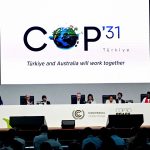
Delivering Australia’s national statement at COP31 in Antalya on Wednesday, Bowen said Australia was committed to turning its climate pledges into practical action while supporting Pacific-led solutions to climate change.
He said the Pre-COP meetings hosted by Fiji and Tuvalu had raised key Pacific priorities, including climate finance, resilience and ocean action.
“The Pre-COP in Fiji and Tuvalu powerfully elevated Pacific priorities: keeping 1.5 degrees within reach, improving access to climate finance, strengthening resilience and advancing ocean action,” Bowen said.
He said Australia was supporting regional efforts through a $100 million (US$67 million) investment in the Pacific Resilience Facility (PRF), the first Pacific-owned and Pacific-led fund dedicated to community resilience.
Australia had also invested $75 million (US$50.36 million) to support 14 renewable energy projects across seven Pacific countries.
Bowen said Australia recognised its shared future with Pacific Island countries.
“Australia is also a Pacific nation. We share an ocean, a region and a future with our Pacific family,” he said.
On domestic action, Bowen highlighted Australia’s rapid shift towards renewable energy, saying one in every three Australian homes now had rooftop solar, with the country’s rooftop solar capacity exceeding the combined capacity of its coal-fired power stations.
He said households had installed more than 600,000 batteries in the past 18 months through the government’s Cheaper Home Batteries programme.
Australia, with a population of 28 million, was now the world’s third-largest utility-scale battery market, behind China and the United States.
Bowen said renewable energy had also overtaken fossil fuels in electricity generation across Australia’s national grid in the final quarter of last year.
He said the transition was reducing emissions while improving energy security and reducing Australia’s exposure to global fuel price shocks.
“One home with solar and a battery does not transform an energy system. But millions of individual choices can,” he said.
Bowen said one in four new passenger vehicles sold in Australia this year was electric, compared with one in 50 five years ago.
Australia supported the 35 by 35 Global Electrification Pledge, which complements international efforts to triple renewable energy capacity and double the rate of energy efficiency improvements by 2030.
He also highlighted Australia’s international partnerships, including a new memorandum of understanding with South Korea on a joint decarbonisation pathway.
The partnership forms part of Australia’s Future Made in Australia plan, which targets investment in critical minerals, green metals, low-carbon fuels and advanced manufacturing.
Bowen said climate action could deliver economic benefits, including new jobs, investment and stronger energy security.
He said the Paris Agreement had helped change the world’s emissions trajectory, with projected global warming reduced from about four degrees Celsius before the agreement to around 2.6 degrees today.
However, he warned that the current projections remained far above the 1.5-degree target.
“Every fraction of a degree above 1.5 means greater costs and risks for communities, economies and ecosystems,” he said.
Bowen called on countries at COP31 to maintain their commitments, accelerate climate action and reach agreement on practical measures.
“Our task here in Antalya is to match that momentum: to deliver fairly and at scale, hold to our commitments, move faster, and find consensus.
“Australia is playing its part in building a clean, resilient and electrified future,” he said.