

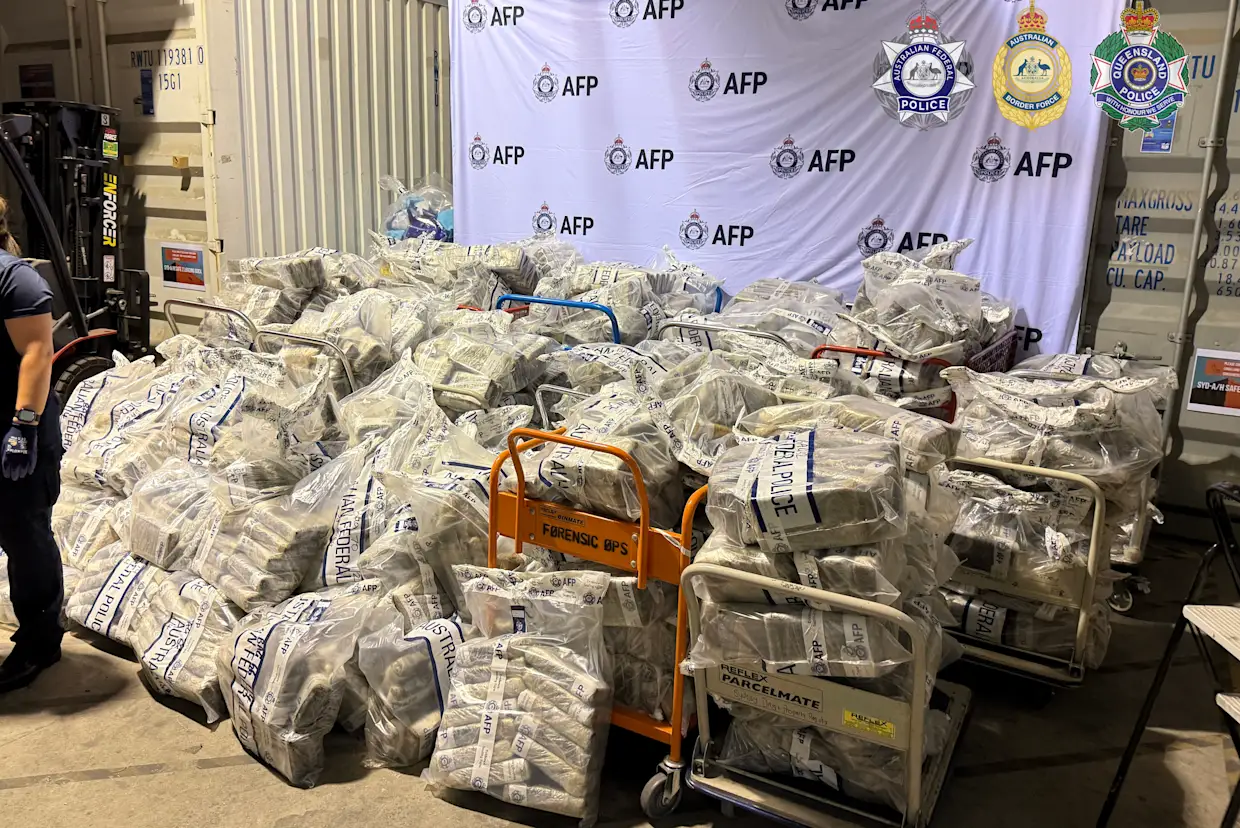
A surge in drug trafficking through the Pacific by transnational criminal syndicates has triggered fears China may exploit the crisis to expand its regional footprint, and added fresh urgency to the Albanese government’s push to become the region’s primary security partner.
More than 17 tonnes of illicit drugs – largely cocaine – have been seized by Australian and international law enforcement in the Pacific region this year, according to figures released by the Australian Federal Police(AFP), as drug cartels flood vulnerable island nations with illicit narcotics bound for Australia.
Security experts, diplomats and politicians say Australia and its partners must intensify joint efforts to combat the drugs surge or risk losing a bigger strategic battle as China continues to expand its economic, political and military reach.
“The Pacific cannot afford a fragmented response to a shared threat,” said Coalition foreign affairs spokesman Ted O’Brien, who recently returned from a visit to Fiji and Papua New Guinea, where he was inundated with reports about what he said was the “devastating consequences” of cocaine and methamphetamine use in local communities.
“Australia must work with our Pacific neighbours on a Pacific-led regional security agreement that strengthens our collective ability to confront transnational crime. If we passively stand by, we risk the emergence of a security vacuum that gets filled by others.”
Mike Hughes, director of the defence strategy programme at the Australian Strategic Policy Institute, said that although the government was intensifying efforts to tackle the problem, China was also seeking to leverage policing to shape the region around its own geopolitical interests.
“China absolutely uses its policing arm, the People’s Armed Police, and the Ministry of Public Security, as they are at the vanguard of advancing the Communist Party’s geostrategic interests in terms of mapping out and building a Sino-centric order that preferences the Communist Party’s interests as opposed to the Liberal Democratic order,” Hughes said.
He noted that despite any positive outcomes, China’s policing assistance remained intrinsically tied to Beijing’s promotion of an authoritarian worldview.
“There’s a fear in the Australian system that once a country adopts that style of policing, it’s basically putting a match to a tinderbox.”
Security experts such as José Sousa-Santos, associate professor at New Zealand’s University of Canterbury, pointed to the Trump administration’s lethal strikes on alleged drug-smuggling vessels in the Caribbean Sea and eastern Pacific Ocean as potentially contributing to increased trafficking in Australia’s neighbourhood.
“Interdiction in one theatre does not eliminate the trade – it squeezes the balloon and shifts pressure towards routes where surveillance and enforcement are weaker,” Sousa-Santos said.
“It is possible that intensified pressure in the Caribbean and eastern Pacific is contributing to route displacement, but it certainly did not create the Pacific drug highway.”
The main driver of the drug trade route remained the profitability of the Australian and New Zealand drug markets, which had increasingly become “cash cows for cartels and syndicates”, Sousa-Santos said.
“Criminal networks are exploiting the Pacific’s vast maritime geography, uneven surveillance coverage and limited enforcement capacity to move cocaine and methamphetamine into those markets.”
This year, reports of the discovery of at least seven semi-submersible vessels, also known as “narco subs”, indicated syndicates were increasingly using the covert craft to smuggle drugs shipments from South America.
In May, the AFP co-hosted an inaugural Pacific Transnational Crime Summit in Fiji and announced it would work with U.S, New Zealand, Mexican and Colombian law enforcement officers to disrupt some of the biggest drugs cartels on their home turf.
The latest Wastewater report by the Australian Criminal Intelligence Commission in April indicated Australians consumed about 26.8 tonnes of illicit drugs last year, with an estimated value of $14.3 billion(US$10.08 billion).
This represented a 21 percent combined increase from the previous year’s figures, said an AFP spokesperson.
O’Brien urged the government to develop a regional security pact in the Pacific.
“Australia cannot treat this solely as a problem occurring beyond our borders when demand on our shores is helping drive it,” he said.
“We have an obligation to strengthen maritime surveillance and support our Pacific neighbours in disrupting criminal networks operating across the region, and a Pacific-led regional security pact will be essential in supporting this outcome.” said O’Brien.