
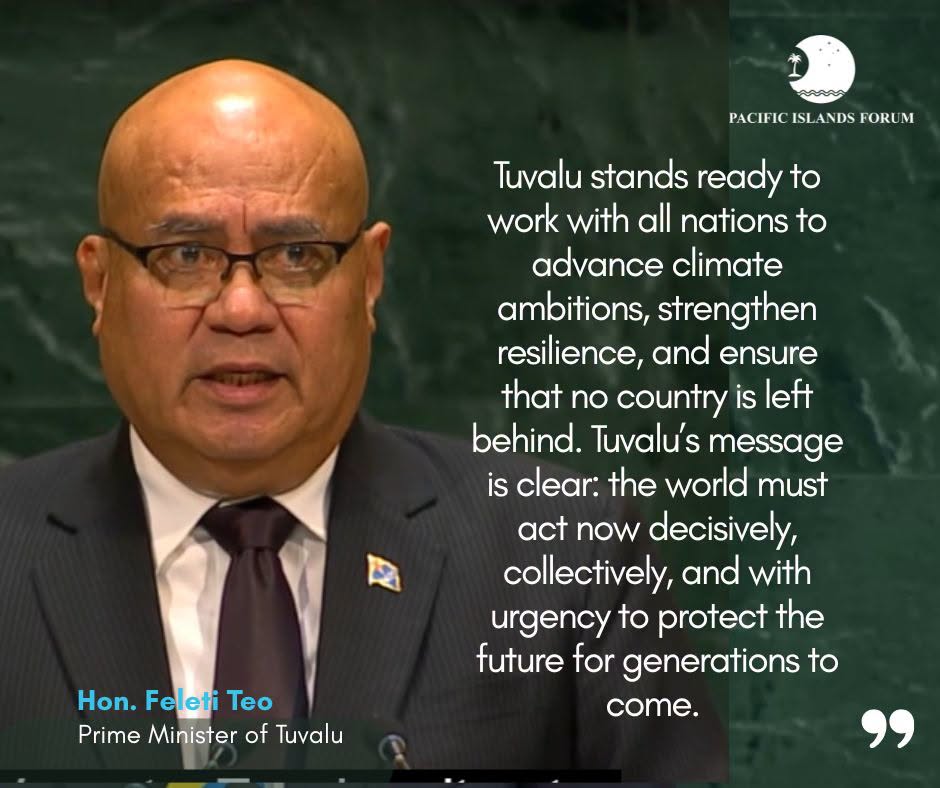
Tuvalu is reclaiming land above flood levels as it battles rising seas, with 15.3 hectares already created on the capital island of Funafuti and another 10 hectares under development.
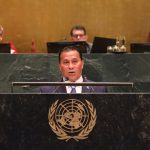
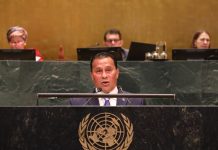
Prime Minister Feleti Teo said in his address at the United Nations General Assembly in New York, the project was a major adaptation effort for a country with only about 26 square kilometres of land.
“For Tuvalu, sea-level rise is not a future threat, it is a present reality,” Teo told the United Nations General Assembly.
He said the coastal adaptation project had already delivered 15.3 hectares of elevated, flood-free land, with a further 10 hectares being reclaimed.
Teo said Tuvalu was also using digital technologies to preserve its sovereignty, institutions, culture and historical heritage as climate change continued to reshape the country.
He welcomed the UN Political Declaration on Sea-Level Rise, describing its endorsement by member states as a “monumental and gratifying achievement”.
Teo highlighted the declaration’s recognition of the continuity of statehood and sovereignty despite sea-level rise, the permanence of maritime zones and rights established under the UN Convention on the Law of the Sea, and the protection of the dignity, culture, identity and heritage of affected peoples.
“The Declaration affirms that Tuvalu’s nationhood is not negotiable, that our maritime rights are not erasable, and that our people should never be forced to choose between their homeland and their future,” he said.
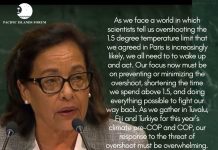
Teo warned that with a temporary overshoot of the 1.5°C global temperature target now inevitable, stronger action was needed to reduce greenhouse gas emissions and accelerate the transition away from fossil fuels.
Tuvalu is supporting Pacific-led initiatives including the Tassiriki Call for a Fossil Fuel Free Pacific and the Funafuti Call for Climate Justice and Climate Action.
Teo also welcomed the operationalisation of the Loss and Damage Fund, calling for adequate, predictable and timely financing to support countries facing unavoidable climate impacts.
“The world must act now decisively, collectively, and with urgency to protect the future for generations to come,” he said.
Teo said the ocean was central to Tuvalu’s development and security.
Although Tuvalu has only about 26 square kilometres of land, he said the country is responsible for some 750,000 square kilometres of ocean.
“We are custodians of some 750,000 square kilometres of ocean, which makes Tuvalu a large ocean State,” he said.
“Ocean governance is not simply an environmental policy. It is also an issue of economic security, food security and climate security.”
Teo urged greater international action on Sustainable Development Goal 14, Life Below Water, which he said remains among the least funded and least advanced of the SDGs despite its importance to Small Island Developing States.
He said Tuvalu was concerned that the world was not on track to achieve the SDGs and warned that failure would have severe consequences for SIDS.
Teo also reaffirmed Tuvalu’s commitment to the UN Charter, international law and multilateralism.
“This year also marks the historical and first deployment of Tuvalu police officers to serve in the UN mission in South Sudan,” he said.
He said the deployment demonstrated that even the smallest UN member states could make a meaningful contribution to international peace and security.
“The challenge is to manage transformation in a manner that protects people, preserves what is valuable, and gives every country the capacity to determine its own future,” Teo said.
He said Tuvalu’s experience showed that national leadership could drive adaptation and resilience, but stressed that the international community also had responsibilities.
“National leadership cannot substitute for global responsibility,” he said.