

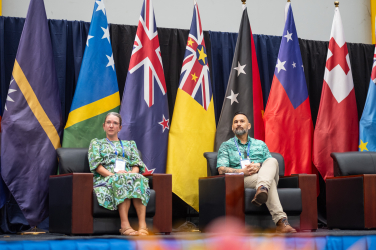
Australia and New Zealand have used a climate finance dialogue at the 5th Pacific Oceans Pacific Climate Change Conference (POPCCC), in Honiara, to emphasise that transformative climate finance must be shaped by Pacific priorities, strengthen local institutions and deliver changes that communities can see and feel in their everyday lives.
The session brought together representatives of two of the Pacific’s major bilateral development partners to discuss how climate finance is supporting resilience across the region, and what needs to change for investment to become genuinely transformative.
Prue Pickering, who leads Australia’s Climate Finance and Disaster Resilience bilateral programme in Solomon Islands, and Darren Paki, Deputy High Commissioner for New Zealand in Solomon Islands, emphasised that climate finance needs to go beyond delivering individual projects.
“Transformative climate finance is not defined by the size of the investment. It’s defined by what remains after the funding cycle ends,” said Paki.
He said infrastructure and practical adaptation measures remain important, but climate finance should also leave Pacific countries, communities and institutions better able to respond to future climate challenges. This includes strengthening Pacific organisations rather than establishing parallel systems, combining generations of Pacific knowledge with science and research, building local skills and creating livelihood opportunities alongside resilience.
A recurring theme throughout the session was the need to judge climate finance from the perspective of the communities it is intended to support.
Paki said investments in water security, coastal protection, transport, disaster preparedness, forests and oceans were already making a difference across the region but argued that success should ultimately be measured through people’s everyday experience.
“The most effective climate finance is financing that communities can see and feel in their daily lives,” he added.
He framed this through the practical questions communities face: whether they can access safe drinking water, continue to grow food and earn livelihoods, remain safe in their homes, protect the forests and oceans they depend upon, and maintain connections with places, traditions and identities for future generations.
This perspective also shaped New Zealand’s discussion of its support to provincial institutions in Solomon Islands.Through the LoCAL programme, climate finance is being used to strengthen provincial governments’ ability to understand climate risk, make investment decisions and manage finance for priorities such as water security, transport links, coastal protection and local infrastructure.
Paki said the value of this approach extended beyond individual investments.
“It’s not just about delivering a project, it’s about making sure the institutions that support communities are better able to work alongside them and respond to challenges ahead together.”
Australia similarly emphasised the importance of ensuring that climate finance responds to Pacific priorities and supports initiatives led and owned within the region.
Pickering noted that considerable climate programming is already underway, including investments in early warning systems and renewable energy. However, she said good projects need to be scaled up, particularly given the much larger pools of global climate finance available internationally.
The challenge, she said, is ensuring those resources actually reach the Pacific.
Australia has embedded climate finance advisers within Pacific governments to support access to international funding processes and proposal development.
In Solomon Islands, Australia is also supporting development of the country’s first National Adaptation Plan, including an investment pipeline intended to provide donors with a clearer picture of national adaptation priorities and practical investment opportunities.
Yet Pickering cautioned against donors defining transformational change on behalf of the people receiving that finance.
“We can’t answer the question of what transformative change look like alone, because it’s really up to the communities, beneficiaries of investments to tell us, ‘yes, this really helped… this changed, this fixed a problem.’”
She added: “Our job as donors is to work in close partnership, to listen to Pacific governments and communities on their priorities and then to respond to those priorities.”
Australia highlighted its AUD$100 million (US$71 million) contribution to the Pacific Resilience Facility (PRF) as one example of this approach. The PRF is designed as a Pacific-led and owned mechanism, governed within the region and focused on supporting community-level resilience investments.
Pickering said the significance of the Facility was not only in the projects it could finance, but also in demonstrating that climate finance managed within the Pacific can be managed effectively.
The discussion also went beyond financing mechanisms to consider who actually makes decisions about climate investments.
Paki challenged participants, including donor agencies themselves, to examine what is meant when projects describe themselves as “community-led”.
“We often talk about community-led approaches, but we should be honest enough to ask whether communities are actually shaping decisions, or whether we’ve become very good at consulting them.
“There’s a difference between asking communities what they think and genuinely sharing power over decisions. The best outcomes usually happen when solutions are designed with communities, not just delivered to them.”
The issue returned during audience discussion, when participants asked how authentic engagement could be achieved in communities experiencing repeated consultation.
Paki stressed the importance of returning to communities after engagement and explaining what had happened with the knowledge and ideas they shared.
Pickering similarly acknowledged the tension between meaningful engagement and the time pressures associated with project and funding cycles.
“We have to allow more time for engagement. It’s quicker to consult when you have just asked a direct question, and it takes a longer time to really speak, to understand and to listen.”
Both speakers also emphasised that Pacific communities have been adapting to environmental and social change for generations. Climate finance, Paki argued, should therefore reinforce rather than displace existing resilience.
“Climate finance should not replace this resilience. It should support it.”
Australia similarly highlighted the role of the Pacific Climate Change Centre in bringing together traditional knowledge with contemporary climate science to develop Pacific-led approaches to resilience.
The session also explored direct access to finance, budget support, youth participation and the role of research in shaping policy. Both Australia and New Zealand expressed support for strengthening the systems that allow funding to move more directly through Pacific governments and institutions while ensuring it ultimately reaches the communities it is intended to benefit.
The discussion reinforced a broader message emerging from POPCCC: the future of Pacific climate finance cannot be assessed only through dollars committed or projects delivered.
“This is not about projects or funding cycles, it’s about whether our children and grandchildren can drink clean water, earn a living, feel safe in their communities, and remain connected to the places, traditions and identities that make them who we are,” Paki said.
The session pointed towards a model of climate finance in which investment strengthens Pacific institutions, knowledge and decision-making, while ensuring communities have a greater role in defining what resilience and transformational change mean in their own contexts.