


By Pita Ligaiula
As Pacific leaders move to develop the region’s first AI governance framework, the creator of an independent Pacific-focused AI system says artificial intelligence must be able to show where its answers come from and know when it cannot verify information.
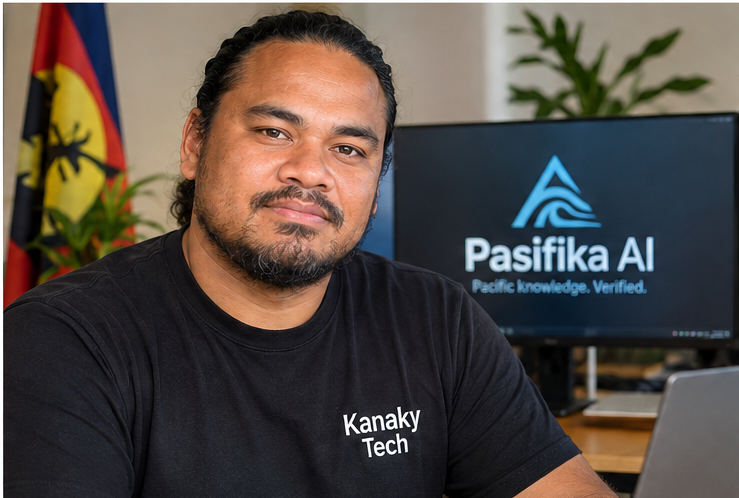
Kevyn Wahuzue, a Kanak from New Caledonia now living and working in Auckland, is the creator of Pasifika AI and founder of Kanaky Tech.
His interview with PACNEWS comes after Pacific Islands Forum Leaders endorsed the region’s first collective position on artificial intelligence, calling for AI to remain human-centred, safe and aligned with Pacific values.
In their 2026 Leaders’ Communiqué, leaders endorsed the Pacific Digital and Artificial Intelligence Technology Principles as the Pacific’s first collective regional position on AI and responsible digital technologies.
They agreed the Principles should guide the development of a Pacific AI Governance Framework for consideration in 2027.
Leaders said AI must remain “human-centred, inclusive and aligned with Pacific values” and stressed that technological advances should narrow, rather than widen, existing inequalities.
They also called for greater Pacific capacity, skills and digital sovereignty, while highlighting the need to protect Pacific languages, cultures and traditional knowledge as AI systems expand across the region.
The Principles also call for transparency, accountability, safety and meaningful human oversight in AI governance.
For Wahuzue, those principles address a problem he encountered personally while testing mainstream AI systems.
He said he repeatedly asked general-purpose AI assistants questions about his own languages and history and received fluent but incorrect answers.
“A fluent wrong answer about a Pacific word or a Pacific practice is not a neutral error. It circulates,” Wahuzue told PACNEWS.
He said the problem was not simply that mainstream AI systems lacked Pacific content, but that they often could not distinguish between information that was well documented and information where reliable material was limited or unavailable.
“They produce the same confident register for a well-documented topic and for one where the material simply does not exist in their training data.
“For a region whose knowledge is unevenly digitised, under-represented in the sources these models learned from, and in many cases deliberately not published, that failure mode is the whole problem,” he told PACNEWS
Wahuzue said Pasifika AI was built around a simple principle: users should be able to trace an answer to its source and see the limits of what can be verified.
The independent project covers Melanesia, Polynesia and Micronesia. Wahuzue designed and built it himself and funds it through his own resources, with small donations from readers.
“I wanted a tool where the route back to the source stays visible, and where the limits are part of what you see rather than something you discover after quoting it,” he said.
Wahuzue said Pasifika AI currently uses three key safeguards when dealing with culturally sensitive information.
The first is a retrieval boundary that limits web searches to a published list of institutional domains.
“It is not searching the open web, and it is not surfacing what somebody posted in a forum,” he said.
The second is vocabulary verification.
Wahuzue said terms used by the assistant are tied to the institution from which they came, with the reference shown with the answer.
“When a word cannot be traced back to a source the assistant says so instead of presenting it as established,” he said.
Where a dictionary is available, the check can also be automated.
For Kanak languages, Wahuzue said Kanaky Tech maintains a dictionary index containing 19,655 entries.
“Every Kanak word in an answer is compared with a 19,655-entry index and any word that is not in it is flagged to the reader,” he said.
He said the approach could be extended language by language with institutions that hold authoritative Pacific dictionaries and language resources.
But Wahuzue said technical safeguards could not determine whether knowledge was culturally restricted.
“Some knowledge belongs to a family, a clan, a lineage, particular custodians.
“Being able to ask a model a question does not create permission to receive that knowledge,” he told PACNEWS
He said that boundary was stated publicly in the Pasifika AI project statement rather than being treated solely as a technical issue.
Wahuzue also cautioned against presenting his safeguards as a complete solution.
“What I will not claim is that these safeguards are complete,” he said.
Wahuzue said restricting the system to institutional sources reduced the risk of repeating information that should not have been given to it, but did not make the AI capable of deciding what knowledge should remain restricted.
“No automated filter can be.
“That judgement belongs to communities,” he told PACNEWS
Wahuzue said this distinction would become increasingly important as Pacific countries develop regional rules for AI.
He said the objective was not simply to build a “Pacific AI”, but to create a system that treats Pacific peoples and knowledge with the same discipline.
“Name the source, keep each people distinct, say when something could not be verified,” Wahuzue said.