

By Pita Ligaiula
The creator of Pasifika AI says the biggest risk in developing Pacific-focused artificial intelligence without formal community ownership is that the technology could eventually become an unofficial authority on Pacific people and cultures without anyone having agreed to that role.
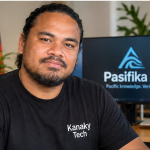
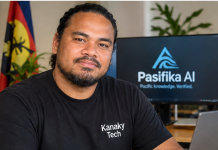
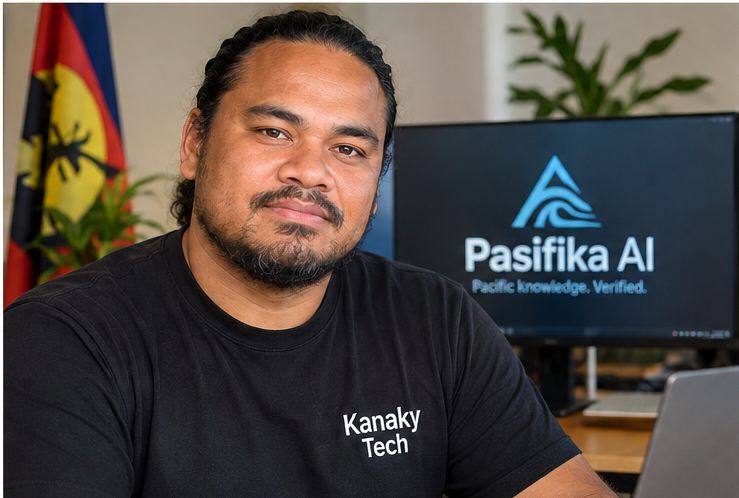
Kevyn Wahuzue, creator of Pasifika AI and founder of Kanaky Tech, said he has deliberately stated that the project has no institutional partner or community mandate because its availability alone could give it an authority it has not been granted.
“The risk is real and it is not hypothetical.
“A tool that speaks about a people without their mandate can become a de facto reference simply by being available and convenient.
“Convenience is authority’s cheapest route,” Wahuzue told PACNEWS.
Wahuzue said that over time, an AI interface could influence how people outside the Pacific understand the region, even though no Pacific community had agreed that the system should represent its knowledge or perspectives.
He said measures had been put in place to reduce that risk, including restricting the sources used by the system, publishing its limitations and making clear that Pasifika AI does not speak for Pacific communities.
Wahuzue also stressed that an AI-generated answer does not replace a speaker, teacher or knowledge custodian.
But he said these safeguards do not resolve the underlying issue of governance.
“What would resolve it is governance that I do not currently have a mandate that can constrain me, including the power to require that something be removed.
“I would rather say that openly than let the project’s existence imply an endorsement that nobody gave,” he told PACNEWS

Wahuzue said Pasifika AI also does not attempt to resolve differences between Pacific communities over cultural knowledge, languages, traditions or historical interpretation.
“I do not resolve them, and I do not think a system like this should try,” he said.
Where accounts differ, the system is designed to present the sources and allow those differences to remain visible rather than combine them into a single answer.
Wahuzue said averaging different accounts into one response could erase the disagreement and obscure who held a particular position.
“The averaging is where the damage happens, because it quietly erases the fact that there was a disagreement and who held which position,” he said.
Wahuzue said identifying the sources allows users to see which institution made a particular claim and follow the reference themselves.
The more difficult cases, he said, involve knowledge where the issue is not whether there is a published record but who has the standing or authority to tell a particular account.
“There the tool has nothing useful to contribute, and I would rather it point to references and stop than perform a judgement it has no basis for,” Wahuze told PACNEWS.
Wahuzue said Pasifika AI currently searches a finite list of 59 institutional domains rather than attempting to search the entire internet.
He said the approach was designed to make the system’s sourcing policy visible and open to challenge.
“Because a published, finite list can be argued with.
“A model that searches everything cannot be held to anything you cannot inspect it, you cannot contest an inclusion, you cannot notice an absence,” Wahuzue told PACNEWS.
The 59 domains include language academies, universities, museums, archives and regional organisations.
Wahuzue said the institutions were selected using deliberately conservative criteria, including whether they publish under their own name, maintain accountable material and can be cited.
However, he acknowledged that the initial list was created by him and therefore reflects his own judgement about what constitutes an authoritative source.
“That is a limitation I want stated plainly.
“It reflects one person’s judgement about what is authoritative, and it will carry the blind spots of that judgement,” he told PACNEWS
He also stressed that inclusion of an institution on the list does not mean the institution endorses Pasifika AI or has a relationship with him.
“The list is a sourcing policy, not a partnership claim,” he said.
Wahuzue said the list was also not a guarantee that every sentence generated by the system was correct, and users should still open and examine the references.
For questions involving Kanak languages, Wahuzue said Pasifika AI uses an index containing 19,655 dictionary entries across nine languages.
The dictionary material is retrieved before an answer is generated, rather than being used only to check the answer afterwards.
Kanak-language words produced in the response are then checked against the index.
When a word cannot be found, the intended behaviour is for the system to identify it as unverified rather than present it as an established word.
“The whole design is that an explicit gap is more useful than an invented answer that sounds complete,” Wahuzue said.
He cautioned, however, that an absent dictionary entry does not mean a word does not exist.
“It means our material does not cover it,” he said, adding that coverage is uneven across the nine languages.
Likewise, finding a word in the index does not establish that its translation is appropriate in every context.
“A dictionary is not a speaker,” he said.
Wahuzue said these limitations are central to how he wants Pasifika AI to be understood as a tool with defined sources and boundaries, rather than an authority on Pacific knowledge or culture.