
By Pita Ligaiula in Koror, Palau
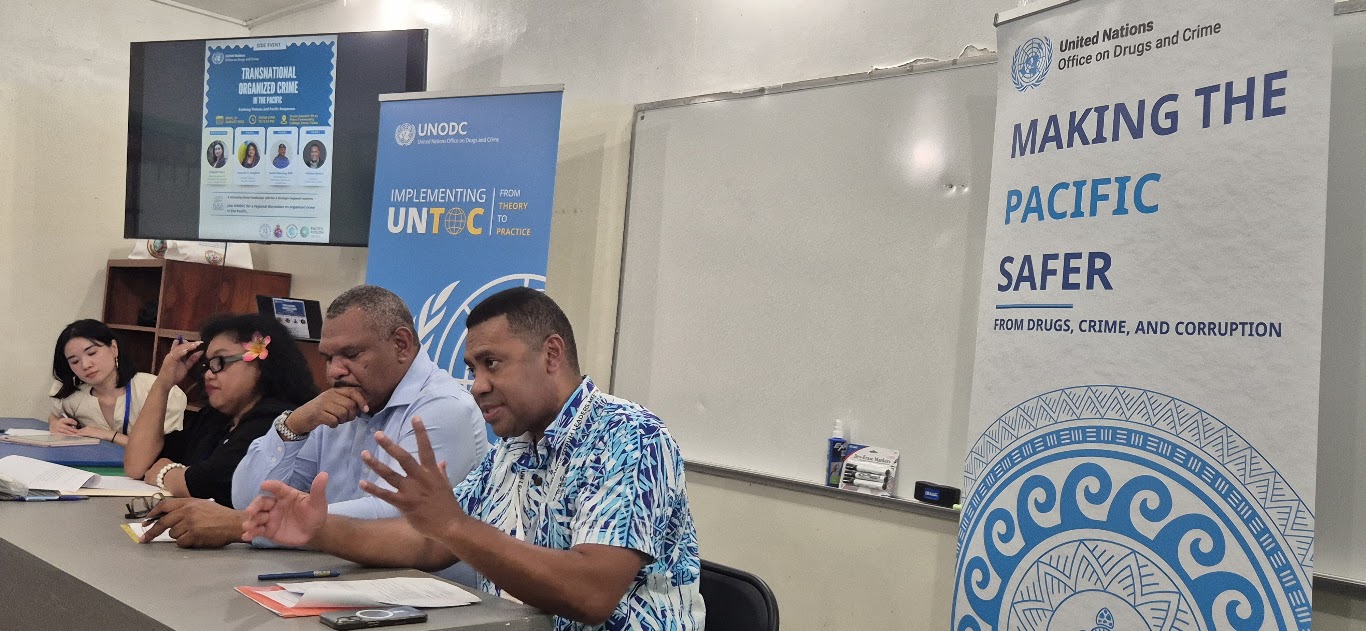
Pacific Fusion Centre Director, Viliame Bovoro has called on Pacific governments to target the money behind transnational organised crime, warning that criminal networks are increasingly treating the region as both a transit route and a destination market.
Speaking at a Pacific Islands Forum side event on “Transnational Organised Crime in the Pacific: Evolving Threats and Pacific Response,” Bovoro said governments must recognise that organised crime was driven primarily by profit.
“Make no mistake, transnational organised crime is a business proposition.
“They’re not doing it because they want to propagate drugs or create addicts. They’re doing it because of the financial reward,” Bovoro said at the side event.
He said the scale of the illicit drug trade demonstrated the financial incentive driving criminal networks, highlighting the Australian drug market, which he said was worth an estimated US$4.5 billion.
“That is a huge amount of money.
“We cannot build safe and resilient economies while organised crime continues to profit from our vulnerabilities,” Bovoro said
Bovoro said one of the Pacific’s main priorities must be to disrupt the financial incentives that allow organised crime to operate.
“Firstly, it’s really about removing the financial reward,” he said.
He called for stronger anti-money laundering and counter-financing compliance, better financial oversight and greater use of financial intelligence to identify and disrupt criminal activity.
Pacific countries also needed to protect critical sectors of their economies from criminal infiltration, he said.
Bovoro warned that criminal groups were increasingly exploiting legitimate businesses and supply chains to move drugs and other illicit commodities across borders.
“A lot of the gatekeepers are now being used in our cross-border business sector to facilitate the use of legitimate supply chains to move drugs across the region,” he said.
He said stronger regional information-sharing was needed to track illicit financial flows and drug trafficking networks.
Bovoro warned that the growing availability of illicit drugs in Pacific Island countries had changed the nature of the threat.
“We are no longer a transit route for drugs to get to other markets
“We are a destination market,” he said.
He said efforts to make it harder for criminal groups to move money through formal banking systems could have unintended consequences if criminal networks responded by selling drugs locally.
“They sell the drugs and leave a percentage behind to be sold locally to recover their financial costs.
“That is what’s driving addiction across the region,” Bovoro said.
Bovoro said the impact of organised crime should not be judged simply by the amount of drugs seized or the number of arrests made.
“The greatest impact of organised crime is not measured in the tonnes that are seized
“It is measured in the lives, the families and the communities that have been impacted and affected,” Bovoro said.
He highlighted the growing public health consequences of drug use and trafficking, including the HIV situation in Fiji.
“In Fiji right now, 1.6 per cent of our population is infected with HIV.
“That is a serious warning about what can happen when organised crime and drug markets become embedded in our communities,” he said.
Bovoro said the Pacific needed to strengthen prevention, rehabilitation and public health interventions, alongside law enforcement.
“It is not only about addiction and arrests.
“It needs to be a whole-of-society and whole-of-community response,” he said.
He called for better data collection on the social impacts of organised crime to support stronger policy responses.
Bovoro said Pacific law enforcement agencies must become more agile as criminal networks innovate and exploit weaknesses across jurisdictions.
“Criminal networks are innovating, so our responses must also be equally agile, intelligent and coordinated,” he said.
He called for stronger maritime surveillance and domain awareness, expanded intelligence-sharing, improved cyber resilience and stronger cybercrime capabilities.
Pacific countries also needed more coordinated operations across jurisdictions to disrupt criminal networks before illicit goods reached communities.
Bovoro said initiatives that combine information from regional agencies could be a major step forward.
He said intelligence from fisheries agencies, regional crime networks and the Pacific Fusion Centre could be brought together to provide operational information for authorities to intercept illicit activity at sea.
“It takes information from different agencies and fuses it for an operational and tactical response so that we can interdict drugs at sea,” he said.
Bovoro said recent seizures demonstrated both the scale of regional cooperation and the continuing challenge.
“Just looking at the 17 tonnes we seized, 31 tonnes of illegal drugs were detected in these waters.
“But there is still a whole heap of these illicit commodities moving through the region,” he said.
He said the figures reinforced the need for better integration of intelligence and maritime surveillance.
Bovoro also identified corruption as a growing threat to Pacific institutions and the regional response to organised crime.
“Corruption is a big insider threat.
“It is something that is really beginning to emerge,” he said.
He said corruption could undermine public institutions and damage public confidence.
“It is impacting on institutions. It is impacting on trust,” Bovoro said.
He called for stronger anti-corruption measures, harmonised legislation and expanded intelligence and information-sharing across the Pacific.
Bovoro said regional unity was critical because criminal networks operated across borders without regard for national jurisdictions.
“No Pacific nation can address this alone.
“Criminal networks operate seamlessly. They don’t know any borders, while we continue to be dictated by the borders that we have created,” he said
He said the Pacific response must therefore be collective and based on stronger cooperation between governments, law enforcement agencies and international partners.
As Pacific leaders meet under the Forum theme of Building Economies, Life, Action and Unity, Bovoro said addressing transnational organised crime was central to all four priorities.
“Organised crime threatens our prosperity. It harms our communities, exploits our vulnerabilities and undermines our institutions.
“A safer Pacific requires not only stronger enforcement, but a united regional effort to protect our economies, save our people and strengthen the resilience of our Blue Pacific for future generations,” he said
Bovoro said the message for Pacific governments was clear that follow the money, protect communities and strengthen regional cooperation.
“Transnational organised crime is a business.
“So holding the money is key,” he said.