
By Pita Ligaiula in Koror, Palau
Pacific Island countries could gain faster access to Green Climate Fund (GCF) financing under reforms that have cut project approval and accreditation processes from years to a target of nine months, GCF Executive Director Mafalda Duarte says.
In a PACNEWS exclusive interview on the margins of the Pacific Islands Forum Leaders’ Meeting in Koror, Duarte said the reforms were a direct response to repeated concerns from Pacific leaders and other developing countries that climate finance was too slow and difficult to access.
“One of the first things we did was actually to change a little bit the way we engage with the countries,” Duarte said.
She said the GCF began a reform agenda three years ago and has since reorganised its operations to provide countries with a more integrated service.
Previously, different GCF departments dealt separately with country engagement, project origination, project implementation and portfolio management.
The Fund has now brought those functions together under four regional departments, including Asia-Pacific.
“Everything from engagement with countries, with governments, to provision of technical assistance, to project preparation facility, all the way through investments, both development and implementation, is under one responsibility.
“That was so we can really come to the countries and engage more holistically and in a more integrated way across all of the services and instruments we have to support the countries,” Duarte told PACNEWS.
Duarte said one of the strongest complaints received by the GCF was the length of time it took to move projects from a concept note to approval by the GCF Board.
She said the process had previously taken more than two years on average.
“We reformed that process,” she said. “Since 2025, the commitment has been to do it up to nine months, and we are honouring that.”
The reform is expected to be particularly significant for Pacific Small Island Developing States (PSIDS), where limited government capacity has often slowed the preparation and processing of major climate projects.
Duarte said the GCF had also moved to simplify and speed up the accreditation process for institutions seeking authority to directly access and implement GCF funding.
Accreditation had previously taken more than four years in some cases.
“It was taking also more than four, four and a half years.
“We brought a reform to the Board mid last year, and so as of this year, we are committing to do it up to nine months,” Duarte told PACNEWS in Koror.
Duarte said the faster accreditation process could allow more Pacific institutions and governments to become directly accredited to the Fund.
She said capacity constraints and the previously lengthy accreditation process had discouraged some Pacific institutions from applying.
“With this reform now, we will see governments in the region, ministries of finance, that have an interest in being accredited and implementing directly,” she said.
The Cook Islands Ministry of Finance is already accredited by the GCF and has implemented its first project directly through the ministry.
Duarte said the Fund expects the reforms to broaden the network of Pacific institutions able to work directly with the GCF.
The Fund already works with the Pacific Community (SPC) and the Secretariat of the Pacific Regional Environment Programme (SPREP), which are key regional accredited entities.
“With those two, we already are working,” Duarte said. “But we will be able to have a broader network and really work also directly with governments.”
She said the GCF also wants to expand its engagement with the private sector.
Fiji Development Bank (FDB) is already among private sector entities accredited by the Fund, but Duarte said other Pacific institutions could also seek accreditation.
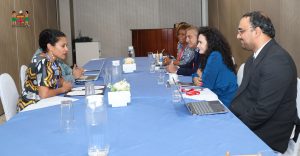
Duarte said Pacific leaders are increasingly calling for a greater role for private investment in climate action.
She referred to comments by Palau President Surangel Whipps Jr, who said earlier in the week that 97 percent of climate finance coming into the region was from the public sector, while only 3 percent came from private sources.
“The willingness and intent is to shift that and see much more investment with the private sector,” Duarte said.
She said increasing private investment would reduce pressure on governments with limited capacity while also supporting job creation.
“This is a heavy burden on the public sector with limited capacity,” she said. “But also, because the private sector, as we know, is critical to drive job creation.”
Duarte said the GCF has significant experience in mobilising private sector finance globally.
The Fund currently has approximately US$20.4 billion in GCF financing and around US$60 billion in co-financing, representing a total investment portfolio of approximately US$80 billion.
She said the GCF was already examining private sector projects in the Pacific that could soon be brought before its Board.
“They will be first of their kind in the region as well,” Duarte said.
Despite the reforms, Duarte acknowledged that some Pacific leaders have yet to experience the benefits because the changes are relatively new.
“I told some of the leaders that I met with, they are not yet feeling, many of them, the impacts of this reform because they are fairly recent.
“They haven’t yet experienced the new processes,” she said.
Duarte said the GCF was also considering whether additional dedicated access arrangements were needed for Small Island Developing States (SIDS) and other countries with severe capacity constraints.
“We are also very keen to continue to explore if we should have dedicated modalities for countries like SIDS or other highly capacity-constrained countries,” she said.