Marshall Islands President Hilda Heine called for stronger national security, climate adaptation and public-sector reform as parliament resumed, warning that geopolitical tensions, extreme weather and rising living costs were placing growing pressure on the Pacific Island nation.
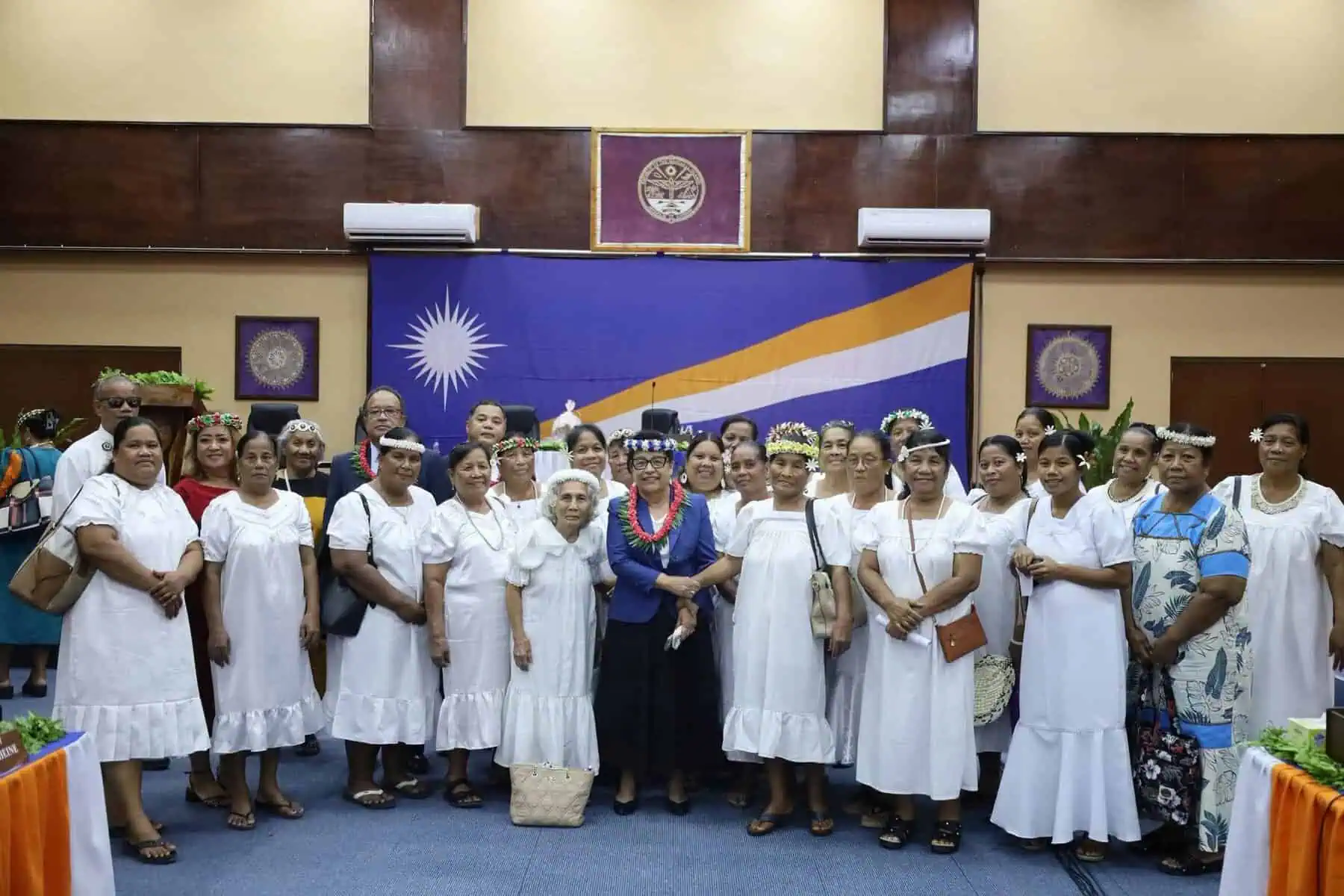
Addressing the Nitijela, the country’s parliament, Heine outlined a broad government programme that included maritime surveillance, drug-trafficking prevention, resilient infrastructure, healthcare reform, education and renewed efforts to document the legacy of U.S nuclear testing.
“The Marshall Islands is facing rapid global change, geopolitical tension, rising living costs, climate disruption and pressure on small island economies,” she said.
Security and maritime enforcement were central to the address. The government recently held its first National Security and Substance and Drug Summit, bringing together traditional leaders, churches, young people and government agencies to develop a national framework for preventing drug trafficking and limiting its effects on communities.
Heine also highlighted the arrival of RMIS Jelmae, a patrol vessel donated by Australia. The vessel is expected to support maritime surveillance, fisheries protection and enforcement across the Marshall Islands’ vast ocean territory.
Climate risks remain acute for the country’s widely dispersed atolls.
Heine urged residents to prepare for changing El Niño conditions, including possible drought in the northern islands and heavier rainfall in Majuro and the southern atolls.
The government has completed a national oil-spill contingency plan with assistance from the U.S Coast Guard and the National Oceanic and Atmospheric Administration.
Under an Adaptation Fund-backed water project, 161 climate-resilient storage units have been installed or are being prepared, creating about 2.7 million gallons of additional storage capacity.
More than 100 of the systems are already serving communities, providing about 1.4 million gallons of available storage.
The programme has reached nearly 1,000 households and about 4,700 people, while almost 3,000 residents have received training in water conservation, climate awareness and emergency preparedness.
Infrastructure plans include a new parliamentary chamber, a future national capital building, police headquarters, a correctional facility and projects under the Majuro Master Plan.
Heine said the government had approved the purchase of two Cessna 408 aircraft to improve emergency medical transport and links between Majuro and the outer islands.
The first aircraft has begun operating in Wotje, with services expected to expand as airport improvements are completed.
“Rising fuel, food and transport costs continued to weigh on households and public finances”
“The country has secured emergency assistance from the World Bank and is pursuing tax reforms supported by the International Monetary Fund (IMF), the World Bank and the Asian Development Bank (ADB).
“The Monetary Authority of the Marshall Islands is also being strengthened to improve financial regulation, payment systems and economic stability,” she said.
The government’s social assistance programmes have provided three months of support to 1,239 older people and people with disabilities.
More than 40,000 residents, over 95 percent of the population, received assistance in the first distribution under a national economic support programme.
Heine cited several education initiatives, including the relocation of Lukwon Elementary School on Mili Atoll, described as the country’s first school moved because of climate change.
The government has translated 128 reading books into Marshallese, introduced health and hygiene programmes in 86 public schools and established an early-childhood education diploma that incorporates climate resilience.
More than 100 students graduated from the University of the South Pacific, while 77 students supported by the Marshall Islands Scholarship, Grant and Loan Board completed their studies, the highest number recorded by the board.
Heine also recognised Makaira Silk Jibas, the first Marshallese student admitted to a Harvard University graduate programme in human development and education.
In healthcare, the government has introduced HPV screening, approved a national strategy on non-communicable diseases and established the country’s first national autism referral system.
But Heine acknowledged persistent problems in hospital management and said the government was examining reforms to improve administration, patient safety and medical services.
The president also emphasised the Marshall Islands’ role in international shipping and ocean governance. Its maritime registry now covers more than 217 million gross tonnes and about 6,500 vessels, making it one of the world’s largest ship registries. The country has retained recognition under the U.S Coast Guard’s QUALSHIP 21 programme for 22 years.
Nuclear justice remained a central issue in the president’s domestic and foreign-policy agenda.
The government has completed initial work on a national nuclear museum and research facility intended to preserve the history and experiences of communities affected by the United States’ nuclear testing programme in the Marshall Islands.
Heine also pointed to the country’s work at the United Nations Human Rights Council and at an 80th-anniversary Nuclear Legacy Summer Camp, where young people studied the nation’s nuclear history and its continuing campaign for justice.
She thanked the United States, Taiwan, Australia and Japan, as well as international financial institutions, Pacific organisations and UN agencies, for their support.
With a Constitutional Convention ahead, Heine urged national unity and continued public participation.
“Together, with commitment and determination, we will continue building the Marshall Islands according to our needs and for the benefit of our children and future generations.”