



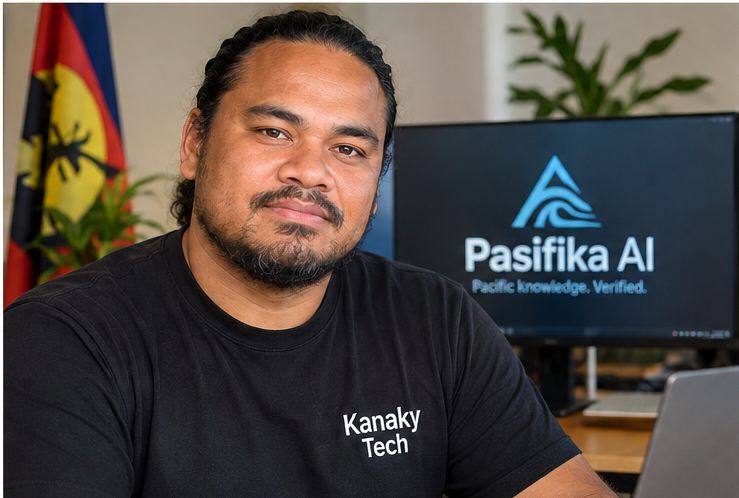
Artificial intelligence may change how news is produced, but it cannot replace the human relationships that give Pacific journalism its credibility, says Pasifika AI creator and Kanaky Tech founder Kevyn Wahuzue.
In a featured interview with PACNEWS Senior Journalist Pita Ligaiula, Wahuzue says Pacific journalists should use AI to handle work behind the story while keeping reporting, community relationships and editorial decisions firmly in human hands.
“Use AI for the work behind the story, never for the relationship in front of it,” Wahuzue said.
He says the value of a Pacific journalist comes from being present in the communities they cover, knowing the people involved and being accountable to them beyond a single story.
“Trust in Pacific journalism doesn’t come from speed,” Wahuzue said. “It comes from people knowing who you are, knowing you went there, and knowing you’ll be back next week to face them.”
The interview examines AI’s impact on Pacific journalism, including language and cultural risks, Indigenous knowledge and data, deepfakes, newsroom jobs, journalist training and editorial independence.
PACNEWS: With AI rapidly changing journalism, what is your message to Pacific media about using AI without losing the values, identity and trust that underpin Pacific journalism?
WAHUZUE: Trust in Pacific journalism doesn’t come from speed. It comes from people knowing who you are, knowing you went there, and knowing you’ll be back next week to face them. AI can’t give you any of that. But it can cost you all of it in one bad story.
So, my message is simple: use AI for the work behind the story, never for the relationship in front of it. Transcribing, a first draft of a translation, sorting documents, searching archives: fine.
Speaking for a community, deciding what matters, putting words in someone’s mouth: that stays with the journalist.
PACNEWS: How can Pacific media use AI to strengthen journalism without allowing technology to replace the journalist’s role in verifying facts and providing context?
WAHUZUE: Treat everything an AI gives you as a tip, not a fact. A tip from a source you don’t know, who has never been to the place, and who sounds confident about everything.
That’s how I built Pasifika AI. It only searches a published list of 66 institutional sources, and every answer shows its references so the reader can open them.
Even then, the site says clearly that a listed source doesn’t guarantee the sentence is right. If that’s the standard for a tool, it should be the minimum for a newsroom.
AI can find the documents faster. The journalist still reads them, calls the people, and explains what it means here.
PACNEWS: What risks does AI create for Pacific languages, cultures, traditional knowledge and Indigenous data?
WAHUZUE: The biggest risk isn’t silence. It’s fluent mistakes.
This month I tested several AI models in Pacific languages. Some went into loops, repeating the same phrase for a whole page. That’s the easy case: anyone can see it.
The dangerous one wrote smooth Samoan that was wrong. It described the pe’a, the traditional male tatau, as reaching the elbow. It reads well. A Samoan reader sees the mistake in a second. A student overseas won’t and will repeat it.
Then there’s knowledge that was never meant to be public. Some knowledge belongs to a family, a clan, specific custodians. Being able to ask a machine doesn’t give anyone permission to receive it.
And every archive, recording and story that goes online can be pulled into a model without anyone asking the community it came from.
PACNEWS: How do we make sure AI systems understand the Pacific rather than simply applying perspectives and assumptions developed outside the region?
WAHUZUE: To be honest, these models don’t “understand” anything. They reproduce what they were trained on, and very little of that was written by Pacific people, in Pacific languages.
The failure I see most is blending. In my tests, when I asked for an answer in Cook Islands Māori, some models wrote New Zealand Māori instead.
Related languages, different peoples. A model trained mostly outside the region treats the Pacific as one culture with one voice.
Three things help. Ground the answers in sources from the region: our institutions, academies, archives, not the open web.
Keep each people distinct and named. And let the people who hold the knowledge correct the system, with the power to have something taken down.
The rest, the region has to build itself. Te Hiku Media in Aotearoa showed it can be done they built their own te reo Māori speech technology and kept control of their data.
PACNEWS: Could AI become another form of information inequality for the Pacific if our newsrooms lack the infrastructure, skills and resources to use it?
WAHUZUE: Yes, it could. But not for the reason people think.
The tools are getting cheap. Pasifika AI runs on a daily budget of a few dollars.
The inequality is somewhere else: connectivity, training, the time a small newsroom has to learn, and above all language.
In my tests, most models could not write Samoan, Tongan or Tahitian correctly, and the weaker ones don’t tell you. A newsroom publishing in English gets a strong assistant. A newsroom publishing in a Pacific language gets a weak one, or a dangerous one.
The other inequality is who shapes the tools. If Pacific newsrooms only consume AI, the decisions about what these systems know about us get made somewhere else.
The region should pool it: shared training, shared rules, shared tools across newsrooms, the same way PACNEWS pools the news.
PACNEWS: As AI makes it easier to create convincing fake images, audio and video, how can Pacific journalists protect public trust?
WAHUZUE: Three habits.
First, verify the source, not just the file. Who sent it, where it came from, can you reach the person who recorded it. Detection tools help, but they lose the race: the fakes get better every month.
Second, show how you verified. Tell your audience “We reached the person who filmed this” or “we could not confirm this.” People trust a method they can see.
Third, never use AI to create an image of a real person or a real event and publish it as if it were real, not even as an illustration. Once a generated face sits next to a real name, it travels without the caption.
Pacific audiences have one advantage: small, connected communities. Someone always knows the person in the video. Use that network before you publish, not after.
PACNEWS: Who should be accountable when an AI-assisted story contains false or misleading information the journalist, the editor, the media organisation or the technology provider?
WAHUZUE: The newsroom. Always.
The journalist is responsible for what they file, the editor for what they approve, the organisation for what it publishes. That chain doesn’t change because a machine was involved.
“The AI got it wrong” is the new “the intern did it.” Readers won’t accept it, and they shouldn’t.
Tech providers should answer for what they promise. If they sell a tool as accurate or safe for news, that’s on them.
But the byline and the masthead carry the story. You can outsource a task. You can’t outsource the responsibility.
For my own tool, which means my contact is on every guide and corrections come to me. If Pasifika AI gets something wrong, it’s my name on it, not the model’s.
PACNEWS: Should Pacific newsrooms have clear rules on when journalists can and cannot use generative AI?
WAHUZUE: Yes. Short, written, public. One page, not a 40-page policy nobody reads.
Something like three colours.
Green, no need to ask transcription, a first-draft translation that a speaker then checks, summarising documents you have already read, searching your own archive.
Orange, the editor signs off and the audience is told AI-assisted translation published as is, AI-made graphics.
Red, never: invented quotes, generated images or voices of real people, AI-written stories on community or cultural matters with no reporter behind them, and pasting confidential material or a source’s identity into an outside AI tool.
That last one gets forgotten. Protecting your sources now includes where you paste their words.
And publish the rules. Readers trust a newsroom that tells them how it works.
PACNEWS: There is concern AI could replace some newsroom tasks and jobs. What should Pacific media organisations be doing now to ensure journalists are not left behind?
WAHUZUE: Train people now. Not a one-off workshop: practice, on real newsroom tasks, with someone who can say “this output is wrong, and here’s why.”
And be honest about which tasks will change. Transcription, routine first drafts, formatting, monitoring: those will shrink.
Use the time saved to put journalists back where machines can’t go in the village, at the court, at the council meeting, with the people.
If AI is only used to cut staff, the region loses reporters it cannot replace. If it’s used to free reporters, the region gets more journalism.
PACNEWS: What skills will Pacific journalists need to remain relevant as AI becomes part of everyday newsroom work?
WAHUZUE: Verification first: reading sources, checking claims, spotting a generated image or an invented quote. That was always the job. It’s now the most valuable part of it.
Second, knowing how these tools fail: they sound sure when they’re guessing, they’re weaker in our languages, they blend peoples together. You can’t catch a mistake you don’t know is possible.
Third, the human skills that don’t automate: building trust, talanoa, knowing who to ask and how to ask, being there.
And language. A journalist who writes and speaks a Pacific language well is becoming more valuable, not less, because that’s exactly where the machines are weakest.
PACNEWS: Who owns Pacific stories, images, archives and cultural knowledge when that material is used to train AI systems?
WAHUZUE: Legally, it’s unsettled, and it depends on the country. The rules were written for a world where copying took effort.
Ethically, it’s clearer. A photo belongs to the photographer or the newsroom. A story belongs to the outlet that published it. Cultural knowledge belongs to the people it comes from, even when someone else recorded it, even when it sits in a museum overseas.
Article 31 of the UN Declaration on the Rights of Indigenous Peoples already says Indigenous peoples have the right to control their cultural heritage and traditional knowledge. In Aotearoa, Te Mana Raraunga has set out what Māori data sovereignty looks like in practice.
For newsrooms, the practical step is simple: know what’s in your archive, decide who can use it and on what terms, and don’t let it be taken by default.
Your archive is the region’s memory. It shouldn’t be free training data for anyone who asks.
PACNEWS: How can Pacific media protect editorial independence when AI tools are largely developed and controlled by companies outside the region?
WAHUZUE: Start by being honest: almost every AI tool, including the models Pasifika AI runs on, is built outside the region. I don’t pretend otherwise. What you control is how dependent you become.
A few rules I follow. Never build on a single provider. This month alone I had to change the main model behind Pasifika AI because the one I used couldn’t write Pacific languages properly.
If a company changes its prices, its rules or its model tomorrow, you should still be able to publish.
Keep your archive, your data and your workflow on your side, not inside someone else’s product.
And never let a tool’s defaults become your editorial line: what it refuses to discuss, how it frames a story, which sources it trusts. Those are editorial decisions. They belong to editors.
PACNEWS: Is convenience becoming a risk for journalism where journalists use AI simply because it is faster, without asking whether it is appropriate?
WAHUZUE: Yes. It’s the quiet risk, because nobody decides to lower their standards. It happens one shortcut at a time.
The test I use: would I be comfortable telling my readers exactly how this was made? If the answer is no, don’t do it. If it’s yes, tell them.
And speed isn’t neutral in the Pacific. A wrong fact about a person, a clan or a custom doesn’t disappear. It gets shared, repeated, and it can hurt people who have to live with it in a small community.
Being first matters less than being right and being right still takes a phone call.
PACNEWS: If you could leave Pacific journalists with one rule for using AI, what would it be?
WAHUZUE: If you can’t show where it came from, don’t publish it.
Every fact, every quote, every image. That’s the rule I built Pasifika AI on the machine has to show its sources or say it doesn’t know.
Journalists should hold the machine to that standard, and themselves too.
PACNEWS: AI can make journalism faster, but can it make journalism better? What must Pacific journalists never outsource to a machine?
WAHUZUE: AI makes journalism better only if the time it saves goes back into journalism: more time in the field, more time checking, more time listening.
If the time saved just becomes more content, it makes journalism worse.
What you never outsource: the relationship with the people in the story. The judgement of what matters, and of what shouldn’t be published at all. The verification. The responsibility.
And the voice: the way a Pacific journalist tells a Pacific story, in the words of the people who live it.
A machine can help carry the story. It can’t be the one who was there.