

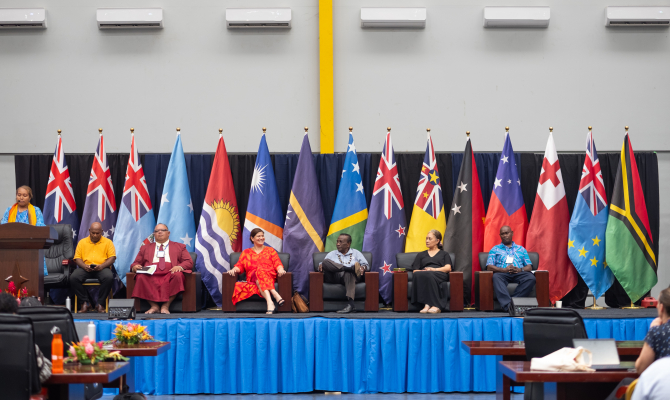
Four days of science, community knowledge, policy dialogue and cross-sectoral exchange at the Fifth Pacific Ocean Pacific Climate Change Conference (5POPCCC) culminated in a Talanoa on ten proposed conference takeaways, with participants calling for the outcomes to carry Pacific evidence, priorities and agency into regional and global climate processes.
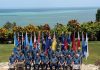
Held in Honiara from 14–18 September under the theme “Amplifying One Pacific Voice for Action on 1.5°C to Stay Alive”, the Pacific-owned and Pacific-led conference brought together researchers, governments, regional organisations, communities, development partners, students, civil society and practitioners from across disciplines.
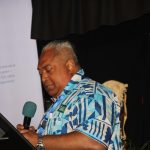
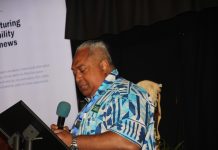
Presenting the proposed conclusions, 5POPCCC Committee Chair Dr Vaeno Wayne Vigulu emphasised that the ten takeaways were being put to participants for discussion rather than presented as a final conference statement.
“We now have a chart for our voyage ahead,” said Dr Vigulu.
“In the spirit of Pacific partnership, we have worked together to forge ten priorities that will navigate us on this journey. We selected these after presenting them to the conference for discussion. Together, we identified what needed to be corrected, what was missing, which messages should go forward and who will carry them next.”
The resulting priorities focus on Pacific agency and leadership; keeping 1.5°C alive; the depth of adaptation practice and scientific evidence already present in the region; responsible integration of Indigenous, traditional and scientific knowledge; the connections between oceans, health, food, communities and other systems; meaningful community authority; climate finance suited to Pacific realities; sustained investment in Pacific institutions and careers; stronger pathways for Pacific evidence into global decision-making; and the opportunity created by the level of agreement already present across the conference.
Across these themes, a consistent message emerged: the Pacific is already generating knowledge, testing solutions and practising adaptation. The region should not be defined through vulnerability alone. The conference showcased sophisticated scientific research alongside community-led approaches, Indigenous and traditional knowledge, locally developed tools and practical examples of resilience across sectors.
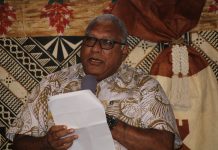
“From this conference we know where we can work together to strengthen key areas. Community engagement needs to translate into meaningful influence over decisions, and Pacific researchers, practitioners and knowledge holders need sustained career pathways, mentoring and institutional support,” said Tagaloa Cooper, Director of Climate Change Resilience at the Secretariat of the Pacific Regional Environment Programme (SPREP).
“The evidence generated across the region needs stronger pathways into policy, investment and international climate processes. We look forward to working together to make sure this happens.”
A central conclusion was that Pacific knowledge and evidence must be able to travel into the systems where decisions are made. Community experience needs pathways into national evidence; applied research needs to become visible and citable; and Pacific evidence needs to shape professional standards, indicators, investment pipelines, Intergovernmental Panel on Climate Change assessments and United Nations climate negotiations.
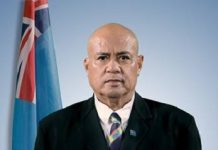
An earlier message from Solomon Islands Prime Minister Hon. Matthew Wale, highlighted again during the presentation of outcomes, captured this pathway:
“To the scientists and academics here, I say: produce knowledge that can travel beyond the journals and conference halls. To policymakers, I say: create pathways through which evidence changes laws, budgets and public investment.”
The newly launched Pacific Climate Change Journal provides one practical pathway for this work, supporting Pacific research and applied evidence to become peer-reviewed, visible and accessible to governments, communities and the international scientific community.
“Perhaps the most encouraging conclusion was the level of agreement already present in the room,” saidCooper.
“Political leaders, scientists, governments, communities, regional organisations, development partners and practitioners approached climate change from different perspectives but repeatedly converged around a shared direction: keep 1.5°C alive, strengthen Pacific leadership, build and protect the evidence base, give communities meaningful authority, improve access to finance and turn knowledge into implementation.”
The challenge after Honiara is now to carry that agency and alignment forward, translating the evidence, relationships and momentum built during 5POPCCC into measurable impact across Pacific communities and greater influence globally.
As Dr Vigulu challenged participants: “Our target must be action. What legacy are we going to leave for the generations that will come after us?”
The 6th POPCCC will be held in 2028, with Tonga National University and the National University of Vanuatu both committed to hosting.
The Fifth Pacific Ocean Pacific Climate Change Conference was hosted in Honiara, Solomon Islands.
The Fifth POPCCC is jointly organised by Solomon Islands National University, the Pacific Climate Change Centre of SPREP, the Solomon Islands Government’s Ministry of Environment, Climate Change, Disaster Management and Meteorology, Te Herenga Waka Victoria University of Wellington and the National University of Samoa, continuing a lineage of Pacific-led gatherings held in Wellington in 2016 and 2018, online in 2020 and in Apia in 2024.