By Pita Ligaiula in Koror, Palau
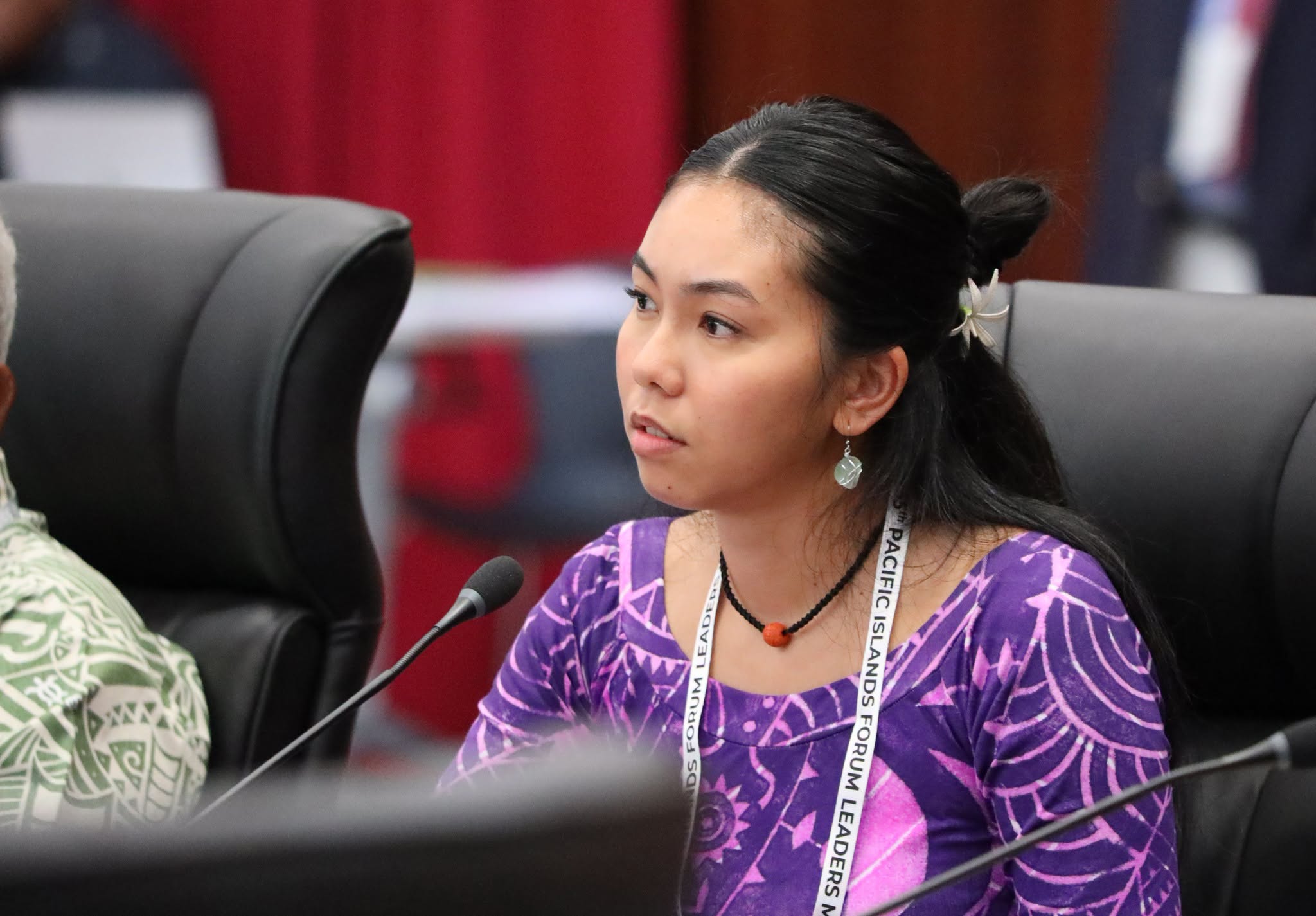
A Palau youth representative has told Pacific Islands Forum leaders that the region’s fuel crisis is not simply an energy problem but a wider crisis affecting food, livelihoods, social stability and Pacific sovereignty.
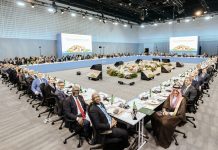
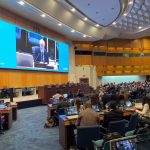
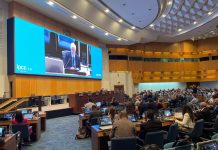
Speaking during the Forum Leaders’ Dialogue with Civil Society and the Private Sector, Shuri Chibana, Youth Coordinator at Palau’s Bureau of Behavioural Health under the Ministry of Health and Human Services, said Pacific communities were facing the consequences of deep dependence on imported fuel.
“I have been asked to speak about community impacts of the global fuel crisis
“But our communities do not live these impacts in isolation,
“For our communities, it is not a fuel crisis. It is a food crisis and a livelihood crisis, which happens to have arrived through the fuel pump, Chibana told leaders in Koror.
Chibana spoke on behalf of the Pacific Regional Non-Governmental Organisations Alliance(PRINGO), wider civil society networks and Pacific communities.
Chibana said rising fuel prices had direct consequences for Pacific households and essential services.
“Here in Palau, our outer islands faced the brunt of the hike in fuel costs, impacting community services and costs of goods,” she said.
She highlighted the wider impacts across the region, including government workers being sent home in Tuvalu and the declaration of a national economic emergency in the Marshall Islands.
“Behind each of those decisions sits a household, and the costs fall unevenly,” Chibana said.
She said women, persons with disabilities and young people were among those most affected.
“Women absorb the shock performing much of the unpaid labour. Persons with disabilities lose access before anyone else. Young people watch the cost rise and have to decide whether to leave or stay.”
Chibana also warned that economic hardship could create conditions that criminal networks exploit.
“Where legitimate income collapses, the illicit economy steps in,” she said.
“The methamphetamine trade in our region is not separate from this crisis. It is downstream of it.”
Chibana said the seriousness of the regional fuel crisis was demonstrated by the Pacific’s decision to invoke the Biketawa Declaration earlier this year.
“In April this region invoked the Biketawa Declaration — an instrument written for coups and conflict.
“We invoked it because of the price of imported fuel,” she said.
She said this demonstrated that the issue went beyond energy policy.
“This was never an energy policy question. It is a question of dependency, and dependency is a question of sovereignty.”
Chibana said the Regional Response Mechanism was important but could only manage the immediate effects of the crisis.
“The Regional Response Mechanism is sound, and we commend it.
“But it manages the shock. It does not remove the exposure,” she said.
Chibana said Pacific leaders needed to match their global climate advocacy with stronger action at home.
She noted that the Pacific was preparing to take its climate priorities into the Pre-COP process and COP31.
“Our region carries the moral authority of the world’s climate movement into Pre-COP and into COP31,” she said.
But she questioned why the Tassiriki Call for a Fossil Fuel Free Pacific had not yet been adopted by Forum leaders.
“The Tassiriki Call for a Fossil Fuel Free Pacific, launched in April by six of our Pacific governments, has still not been adopted at Leaders level,” she said.
“We can’t arrive at COP31 as the conscience of the world’s climate negotiations if we have not adopted our own declaration now.”
Chibana said Pacific resilience could not be based on dependence on imported fuel.
“Resilience cannot be built on a fuel tank we do not own, a price we do not set and a schedule we do not control,” she said.
The youth representative also linked energy dependence to the growing strategic competition in the Pacific.
She said Pacific countries were increasingly being offered infrastructure, energy and finance by outside partners, often at a time when their economic vulnerabilities were most exposed.
“Strategic competition is intensifying in our ocean precisely because our vulnerabilities are visible and our needs are urgent,” Chibana said.
She said the Pacific should view energy security and regional security as connected issues.
“Both are questions of who decides what happens in our ocean.
“We ask you as Leaders to treat them as the same question, because our communities already do,” she said.
Chibana said civil society opposed militarisation and nuclear threats in the region.
“Our ocean is not a theatre, and our islands are not assets in somebody else’s calculation,” she said.
She also challenged leaders to ensure that the concept of an Ocean of Peace was backed by clear political commitments.
“An Ocean of Peace that cannot name a missile is not yet an Ocean of Peace
“It is a hope, and we ask you to make it a commitment,” Chibana said.
Chibana also called for greater accountability for decisions made by Pacific leaders.
“This region has 55 years of Leaders’ commitments and declarations.
“More than half a century on, there is still no transparent mechanism to track whether they were implemented,” she said.
She said Pacific communities could no longer rely on repeated commitments without clear systems to measure results.
“A declaration that cannot be audited is not a commitment,” Chibana said.
“We cannot ask our communities to live on sentiment from communiques and declarations time and time again.”
Chibana presented three proposals to Forum leaders.
First, she called for community-owned renewable energy to move beyond small pilot projects and become a permanent part of Pacific infrastructure.
“Community-owned renewable energy should be used as infrastructure rather than pilots,” she said.
She argued that renewable energy had demonstrated its value during the fuel crisis because its operating costs were not directly affected by rising fuel prices.
Second, Chibana called for fossil fuel subsidies to be redirected towards strengthening local food systems.
Third, she called for direct community access to the Pacific Resilience Facility, which opened its first call for proposals in Koror.
“We ask that it carries direct access for community-led, women-led, youth-led and disability-led organisations, with civil society in its governance,” she said.
“A facility the community cannot reach will measure success in disbursement rather than outcomes.”
Chibana ended with a direct message to Forum leaders that Pacific resilience should mean greater control by Pacific communities over the decisions affecting their lives.
“If the energy crisis has taught us anything, it is that Pacific resilience cannot mean becoming better at absorbing decisions made somewhere else,” she said.
“It must mean having the power to make those decisions right here at home.”
“We are not asking to be consulted,” Chibana said. “We are asking to be counted on,” she said.