


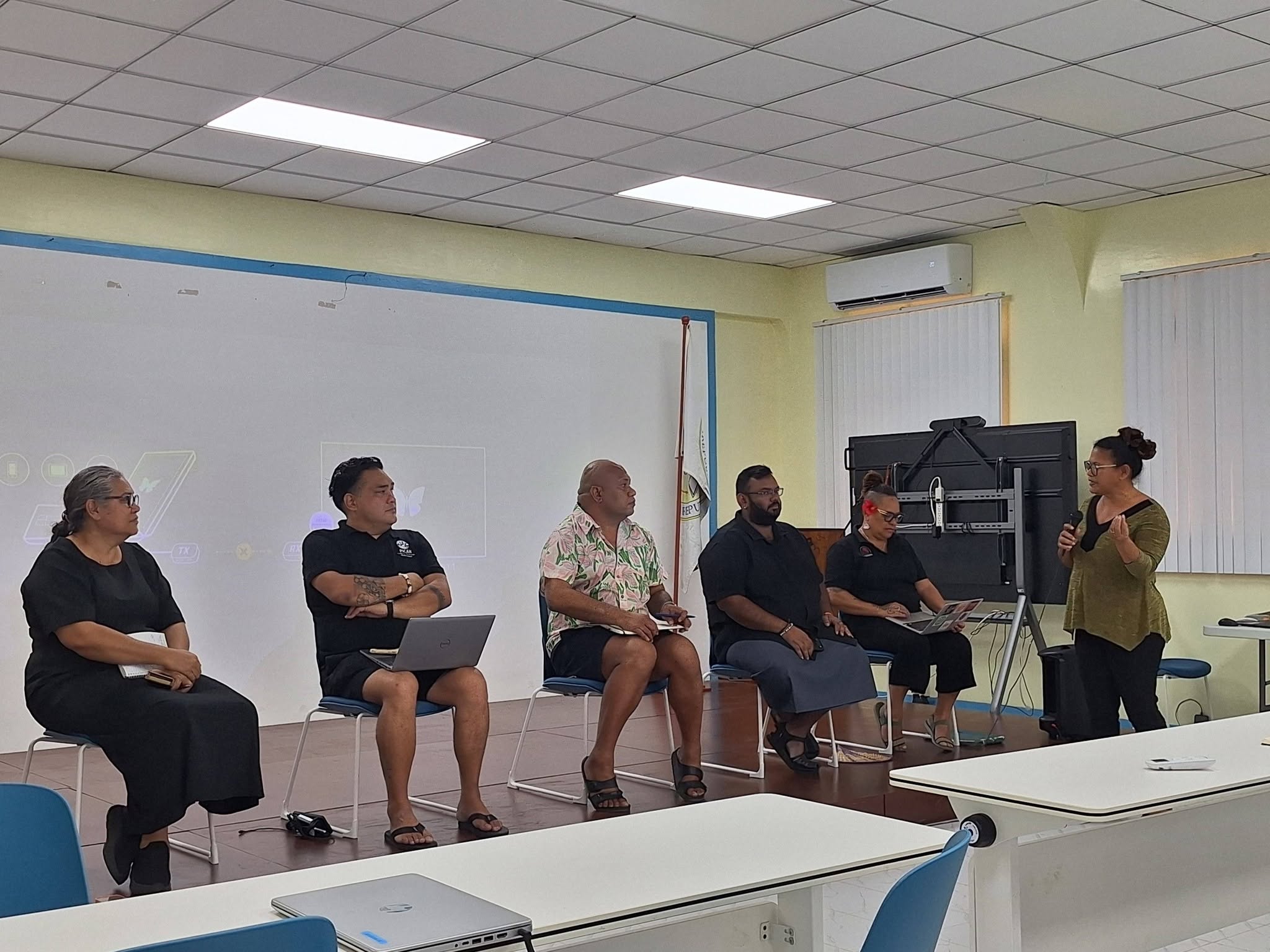
By Pita Ligaiula in Koror, Palau
Pacific civil society organisations are demanding their participation in regional decision-making be formally institutionalised, saying they should no longer have to fight for a place at the table each time Pacific leaders meet.
The call was made during a civil society presentation at the Pacific Media Workshop in Palau ahead of the 55th Pacific Islands Forum Leaders’ Meeting.
Joey Tau, Coordinator of the Pacific Network on Globalisation(PANG), said civil society engagement with the Pacific Islands Forum has remained inconsistent for years.
“We are really clear on what we want,” Tau said. “For the longest time, we’ve been asking for engagement.”
“There are times when we’re at the table, there are times when we’re left to the last day of a Leaders’ Forum. So there is inconsistency in engagement,” he said.
Tau said civil society organisations are now calling for their engagement with the Forum process to be institutionalised, particularly as the region reviews its regional architecture.
He said civil society should not be treated simply as external partners, but as key stakeholders and implementers of regional policies.
“Development partners will leave, but civil society will remain.
“We see ourselves as crucial implementers to government,” Tau said.
Civil society organisations are also seeking stronger commitments from Pacific leaders to protect civic space, warning that opportunities for organisations to operate, speak freely and hold governments accountable are shrinking across the region.
The concerns include reduced or withdrawn funding and what civil society representatives say is a lack of adequate legal protection for organisations to speak freely and scrutinise governments and other institutions.
Tau said institutionalising civil society participation would also create an accountability mechanism.
“Every year an outcome comes out from the leaders’ meeting and then we have already seen the contradictions of the decisions made.
“We have a role in making sure that we hold our leaders accountable at the regional level ,” he said.
He said national civil society organisations could use regional decisions and commitments to advocate for reforms and accountability at home.
Tau told journalists that civil society wanted to be part of the regional system rather than classified as an outside partner.
“We don’t see ourselves as partners. We are part of the process
“We’ve been asking for a seat at the table. How do we inform the moving forward?,” he said.
PICAN Principal Advisor for Strategy and Regional Affairs, James Viernes, said civil society had not been invited to participate in the regional architecture review, which he described as being in its fourth and final stage.
Viernes said the Forum Leaders’ Meeting in Palau was therefore critical for addressing what he described as a process and secretariat issue.
He said civil society processes were often not recognised and that engagement procedures could be unclear or constantly changing.
“If a decision is not taken as to how civil society will be brought into this regional architecture meaningfully at this last stage, then the collective ambition of the Pacific, as articulated in the 2050 Strategy for the Blue Pacific Continent, will not be realised
“It will not be realised without civil society,” Viernes said.
PIANGO Executive Director Emeline Siale Ilolahia said civil society had rejected attempts to place it in different tiers or categories within the regional architecture.
“We are not belonging to anyone. We are part of this family.
“In every ministerial meeting, we should be there.”
“Give us that space, give us that opportunity for us to design what we should look like in the regional architecture. But definitely we are not an outside partner,” Ilolahia said.
Ilolahia said civil society needed a clearly defined and institutionalised role so organisations could focus on representing and mobilising communities rather than repeatedly seeking permission to participate.
“We need to be institutionalised so that we don’t have to come and beg for those things every day and every time there’s a meeting.
“We need to be there,” she said.
Pacific Island Students Fighting Climate Change Engagement and Outreach Lead Abdul Mufeez Shaheed said verbal recognition of civil society’s role was not enough.
He said civil society continued to be absent from important ministerial meetings where decisions affecting the region were made.
“Unless and until the institutionalisation happens in writing, we continue to run around asking for spaces.
“We are saying we are part of the process,” Shaheed said.
Shaheed said civil society wanted its role formally written into policy, creating a clear process and accountability mechanism.
“You say it, you recognise it. Now, write it down.
“We want it policy. We want it written down,” he said.
He said leaders needed to formally agree on where and how civil society would participate in the Forum process.
“It’s one thing to say it’s a secretarial or procedural problem, but when you have it in writing, it’s easier to pass an accountability mechanism,” Shaheed said.
Civil society representatives said their central message to Pacific leaders in Palau was clear that participation must no longer depend on changing processes, personalities or informal invitations.
They want a permanent, formal and accountable place in Pacific regional decision-making.