
By Dr Transform Aqorau
One of the least understood, but most successful, innovations in international fisheries law emerged not from one of the world’s great powers, but from the small island countries of the Pacific.
Many people today hear about “Ship Rider Agreements” and wonder whether they compromise the sovereignty of Pacific Island countries or somehow allow foreign countries to police our waters. The answer is simple: they do not. In fact, Ship Rider Agreements are among the strongest expressions of Pacific Island sovereignty because they are built on the principle that all enforcement authority remains with the coastal State.
To understand why Ship Rider Agreements, exist, we need to go back to the birth of the modern law of the sea.
When the 1982 United Nations Convention on the Law of the Sea (UNCLOS) created the Exclusive Economic Zone (EEZ), it gave coastal States sovereign rights over the natural resources within 200 nautical miles of their coastlines. For Pacific Island countries, this was both an extraordinary opportunity and an enormous responsibility.
Overnight, many Pacific Island countries became custodians of some of the largest ocean territories on Earth.
But there was one problem.
Although they now possessed jurisdiction over millions of square kilometres of ocean, very few had the ships, aircraft, personnel or financial resources necessary to patrol and enforce those rights effectively.
The Pacific therefore faced a choice.
Either accept that these enormous ocean spaces would become impossible to police or develop entirely new ways of exercising sovereignty.
The Pacific chose innovation.
This spirit of innovation became one of the defining characteristics of the Forum Fisheries Agency (FFA).
Throughout the 1980s and 1990s, Pacific Island countries pioneered fisheries compliance measures that were years, and in some cases decades, ahead of the rest of the world.
One of the earliest initiatives was the FFA Regional Register. If a fishing vessel seriously violated the fisheries laws of one FFA member and fled beyond that country’s jurisdiction, the information could be shared regionally. The vessel could then be removed from the Regional Register, effectively preventing it from obtaining licences to fish anywhere in the FFA region. Instead of relying solely on arrest at sea, Pacific countries used collective market access as an enforcement tool.
Another world-leading innovation was the introduction of satellite-based Vessel Monitoring Systems (VMS). The FFA became the first fisheries management region in the world to require licensed fishing vessels to carry satellite transponders that transmitted their positions at regular intervals. This gave fisheries authorities near real-time knowledge of vessel movements across one of the largest ocean regions on Earth.
Pacific Island countries also adopted another highly innovative legal approach inspired by the principles behind the United States Lacey Act. FFA members progressively developed measures to ensure that fish caught illegally in one Pacific country’s waters could not simply be landed legally in another Pacific Island port. In other words, illegal fish would find no safe harbour within the region.
These measures transformed fisheries enforcement.
Yet they were still not enough.
The Pacific Ocean covers almost one-third of the Earth’s surface. Even with patrol boats supplied by Australia and other partners, the reality was stark. A patrol boat could spend days travelling simply to reach one area of its own EEZ. Fuel was expensive. Crews were small. Maintenance costs were high. No Pacific country could realistically maintain a constant physical presence across such vast ocean spaces.
Recognising these limitations, a small group of us began working in 1991 on what became the Niue Treaty on Cooperation in Fisheries Surveillance and Law Enforcement in the South Pacific Region.
Our objective was simple but ambitious.
If Pacific Island countries could cooperate in managing fisheries, why could they not also cooperate in enforcing their fisheries laws?
After months of legal drafting and negotiations, the Niue Treaty emerged as the world’s first regional treaty devoted specifically to cooperative fisheries surveillance and enforcement.
The Treaty created an umbrella framework that allowed Pacific Island countries to help one another protect their fisheries resources without compromising national sovereignty.
In 1995, I was given the responsibility by the Forum Fisheries Agency to prepare the first Subsidiary Agreement to implement many of the Treaty provisions. This agreement enabled patrol boats from one Pacific country to operate in another country’s EEZ under agreed conditions and to carry authorised fisheries officers from neighbouring countries. It established practical arrangements for reciprocal enforcement and operational cooperation.
Those arrangements later evolved into the much more comprehensive Niue Treaty Subsidiary Agreement (NTSA), which today remains one of the most sophisticated regional fisheries enforcement frameworks anywhere in the world.
The philosophy, however, has never changed.
Pacific countries remain fully sovereign.
They simply cooperate more effectively.
As technology advanced, satellite imagery, radar systems, automatic identification systems (AIS), drones and other surveillance technologies dramatically improved maritime monitoring.
But technology can never replace people.
A satellite may identify suspicious activity.
Only an authorised fisheries officer can investigate it, board a vessel where legally authorised, inspect documentation, collect evidence and initiate legal proceedings.
Physical presence at sea remains indispensable.
This is where the Ship Rider concept becomes so important.
The United States, France, Australia and New Zealand possess ships and aircraft capable of remaining at sea for extended periods. These vessels provide valuable surveillance platforms.
However, they do not possess legal authority to enforce the fisheries laws of Pacific Island countries inside another State’s EEZ simply because they are present there.
That authority belongs exclusively to the coastal State.
The solution developed by Pacific Island countries was both elegant and legally sound.
Rather than giving foreign naval vessels enforcement powers, the coastal State places one of its own authorised fisheries officers on board the foreign vessel.
That officer retains the legal authority of his or her own government.
The foreign vessel merely provides transport, communications, accommodation and operational support.
The authority never changes hands.
The sovereignty never leaves the coastal State.
The officer is enforcing the law of his or her own country.
The ship is simply providing the ride.
Hence the name “Ship Rider.”
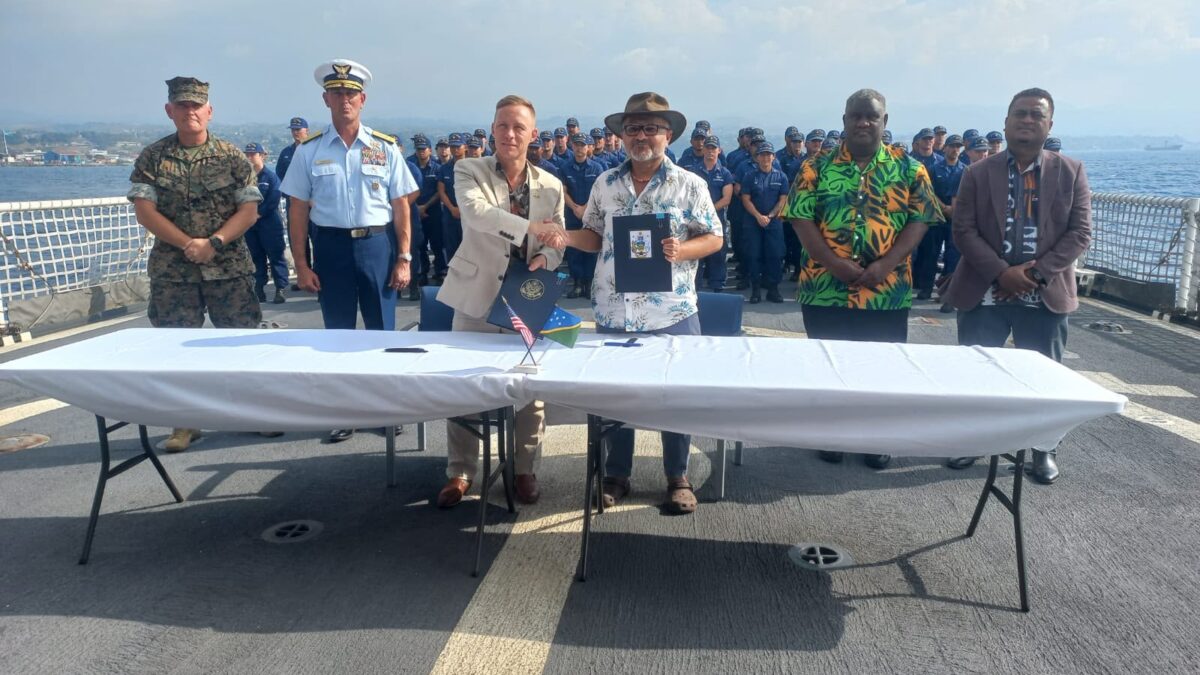
This arrangement only exists because there is a formal agreement between the two governments setting out exactly what each party may and may not do.
Without that agreement, there is no authority.
With the agreement, the legal basis is clear.
Some critics occasionally argue that Ship Rider Agreements somehow undermine sovereignty because foreign military or coast guard vessels are operating in Pacific waters.
That misunderstands how the arrangements actually work.
The presence of a foreign vessel does not mean foreign jurisdiction.
Jurisdiction remains with the coastal State.
The authorised fisheries officer acts under the laws of his or her own country. Decisions about boarding, inspections, evidence gathering and enforcement are undertaken within the legal framework agreed between the parties.
Indeed, Ship Rider Agreements demonstrate sovereignty rather than diminish it. A sovereign State has the right to decide how it will exercise its jurisdiction and with whom it will cooperate. Choosing to use another country’s vessel as a platform for one’s own enforcement officers is no different in principle from hiring an aircraft or sharing intelligence. The sovereign decision remains that of the coastal State.
Having spent several weeks at sea aboard two purse seine fishing vessels operating on the high seas, I can personally attest to the sheer scale of the Pacific Ocean. Until one has stood on the deck of a fishing vessel and seen nothing but water in every direction for days on end, it is difficult to appreciate the enormity of the challenge facing fisheries enforcement agencies.
The ocean is vast beyond imagination.
No single Pacific Island country can monitor it alone.
That is precisely why cooperation has become one of the Pacific’s greatest strengths.
The Pacific has shown the world that even small developing States can shape international law through creativity, trust and practical cooperation. Many of the fisheries compliance tools now regarded as international best practice were first developed in our region out of necessity.
The Ship Rider concept is another example of Pacific innovation. It allows us to maximise scarce resources while preserving what matters most—our sovereignty over our ocean resources.
As technology continues to evolve, satellites, artificial intelligence, drones and advanced analytics will make surveillance even more effective. Yet they will never eliminate the need for people, partnerships and legal cooperation.
The Pacific Ocean will always be too vast for any one nation to patrol alone.
But together, Pacific Island countries—and trusted partners acting under Pacific authority—can significantly increase the physical presence at sea, improve compliance, deter illegal fishing and better protect the resources upon which our economies, food security and future generations depend.
The Legal Foundation: Why Ship Rider Agreements Are Defensible Under International Law
The legal basis for Ship Rider Agreements is both robust and well established.
First, the 1982 United Nations Convention on the Law of the Sea (UNCLOS) gives coastal States sovereign rights over the exploration, exploitation, conservation and management of living resources within their Exclusive Economic Zones (Article 56). It also gives coastal States the authority to enforce their fisheries laws within those zones, including boarding, inspection, arrest and judicial proceedings (Article 73). Nothing in UNCLOS prevents a coastal State from deciding, by agreement, how it will exercise those enforcement powers.
Secondly, UNCLOS encourages international cooperation, particularly in the conservation and management of living marine resources (Articles 61, 62, 63, 64 and 118). Ship Rider Agreements are an example of precisely that kind of lawful cooperation.
Thirdly, the Niue Treaty and the Niue Treaty Subsidiary Agreement (NTSA) provide the regional legal framework through which Pacific Island countries cooperate in fisheries surveillance, information sharing, reciprocal enforcement and operational assistance. The Ship Rider concept reflects the same legal philosophy: cooperation without surrendering sovereignty.
Fourthly, Ship Rider Agreements are entirely consistent with the general international law principle that States may conclude treaties or executive agreements concerning matters within their sovereign competence. This principle is reflected in the Vienna Convention on the Law of Treaties (1969), which recognises the freedom of States to enter into agreements governing their mutual rights and obligations.
Finally, State practice provides powerful support. Similar Ship Rider arrangements have operated successfully for decades between the United States and numerous Pacific Island countries, as well as with Caribbean States and other maritime nations. Their longevity, widespread acceptance and successful implementation reinforce their legitimacy under international law.
For these reasons, Ship Rider Agreements are not legal anomalies. They are carefully negotiated bilateral arrangements that respect the sovereignty of coastal States, operate within the framework of UNCLOS, complement the Niue Treaty system, and exemplify the cooperative spirit that international law encourages.
Far from weakening Pacific sovereignty, Ship Rider Agreements strengthen the ability of Pacific Island countries to exercise the sovereign rights that international law has already recognised. They are not only legally tenable; they are legally sound, practically necessary, and internationally defensible.