



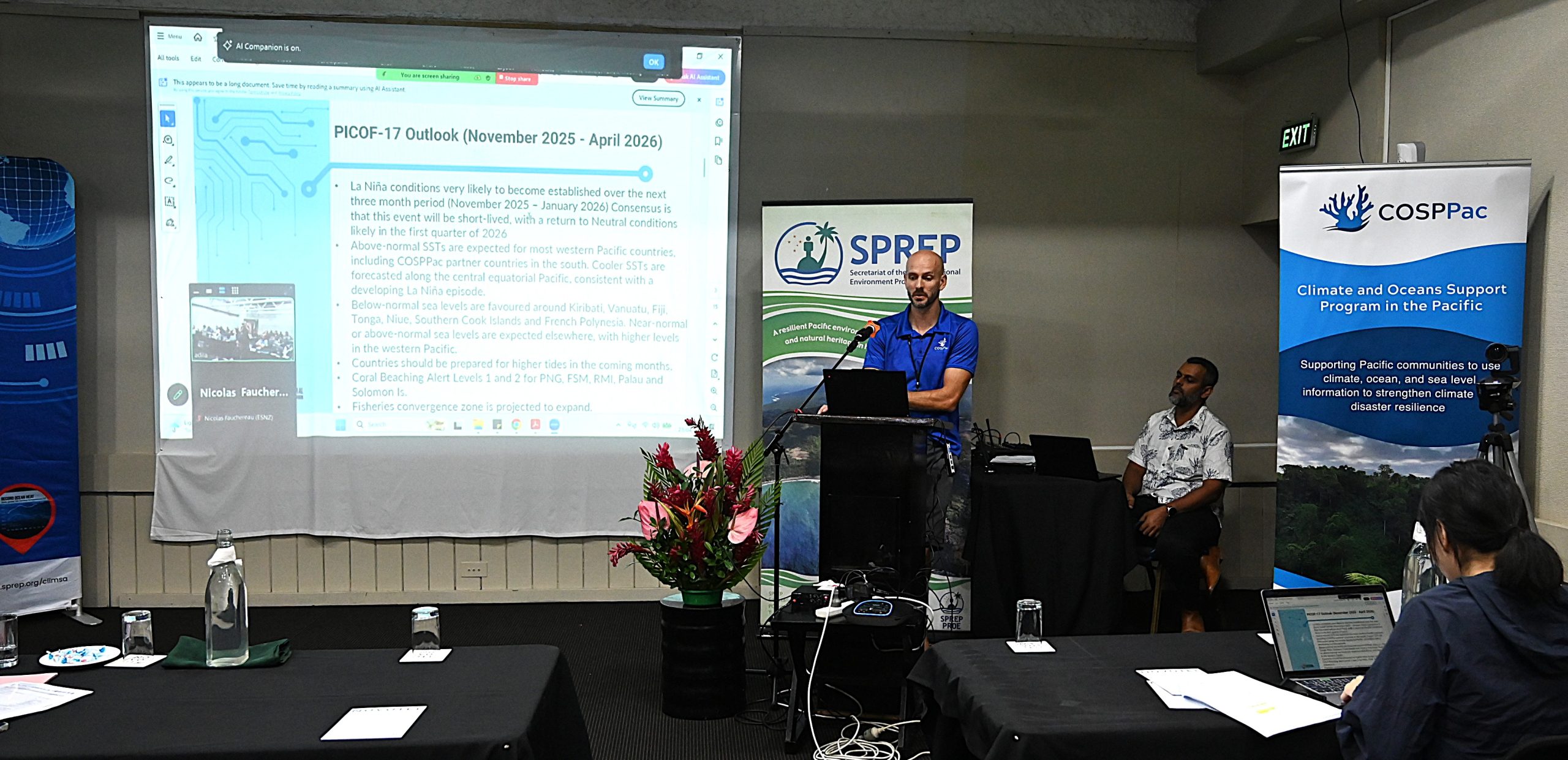
Loss of life, damage to agricultural crops, coral reefs and domestic and commercial property damages were among the impacts reported at the 18th Pacific Islands Climate Outlook Forum (PICOF-18), in Nadi, Fiji, bringing together climate scientists, oceanographers and sector representatives from across the region.
The two-day forum, organised by the World Meteorological Organisation (WMO) Pacific Regional Climate Centre Network (RCC-N) including the Secretariat of the Pacific Regional Environmental Program (SPREP), reviewed climate and ocean conditions from October 2025 to April 2026 and produced consensus-based outlooks for May to October 2026.
Opening the forum, SPREP’s Director of Climate Science and Information, Salesa Nihmei, called on delegates to remember those who had perished in recent months.
“In the weeks and months just passed, our Pacific family has endured harrowing hazards. Tropical cyclones, storms, swells, and the raw fury of nature have tested our shores, our homes, and our spirit. But more than that, we have lost loved ones,” Nihmei shared with delegates.
Country reports presented at PICOF-18 showcased extreme events over October 2025 to April 2026. La Niña conditions, combined with the peak of the wet/warm season, drove an increased frequency of extreme rainfall events, marine heatwaves, and coastal hazards across Melanesia, Micronesia and Polynesia in the South Pacific La Niña impacts were also reported across the north tropical Pacific.
In Melanesia alone, Papua New Guinea bore the heaviest toll, with 21 lives lost in the Kukas landslide and a further six fatalities from flooding in Madang Province.
Fiji, Vanuatu and Solomon Islands also recorded flooding deaths, while a waterspout destroyed homes in Sigatoka’s Korolevu Village.
New Caledonia endured extreme heat that placed vulnerable populations, including elderly residents, under strain.
Across Polynesia, Niue recorded 702.7 millimetres of rainfall in November 2025 alone, the highest monthly total in more than 120 years. Samoa experienced repeated flooding causing road damage, landslides, water contamination and crop losses across multiple districts.
Tonga faced a prolonged marine heatwave from January to March, coral bleaching on Tongatapu’s reefs, waterspouts (ahiohio) in Ha’apai and the passage of Tropical Cyclone Urmil.
In Tuvalu, wind gusts from a convergence zone event severely damaged 49 homes on Nanumea Island, with a further 52 houses still under assessment, and king tides inundated low-lying areas, including the premises of the national meteorological service.
In Micronesia, flooding cut off airport access roads, damaged infrastructure and causeways, and contaminated groundwater supplies in Kiribati.
Ko Barrett, Deputy Secretary-General of the WMO addressed the delegates of PICOF-18 via video conference, said “The WMO State of the Global Climate Report for 2025 confirms 2015 to 2025 were the hottest 11 years on record, while extreme weather continues to affect millions of people and cost billions of dollars globally. In this context, the Pacific continues to demonstrate strong leadership, with the PICOF serving as a model of coordination.”
In addition to the rainfall and cyclone impacts, the ocean review, Dr Grant Smith from the Australian Bureau of Meteorology reported that sea surface temperatures were above normal across much of the western, northern and southern Pacific. Marine heatwaves strengthened over the review period, reaching the “strong” category across the Federated States of Micronesia and the Republic of the Marshall Islands by March 2026.
Barrett reaffirmed WMO’s commitment to supporting the Pacific RCC Network and highlighted ongoing initiatives aimed at closing the gap between global climate products and local decision-making in Pacific Island communities.
Nihmei emphasised that the human cost underscored the critical importance of the forum’s work.
“Platforms like PICOF are about supporting climate scientists at National Meteorological and Hydrological Services (NMHSs) and giving our communities the warning they need to reach safety. They are about empowering NMHSs to forecast earlier, communicate clearer, and prepare better,” he said.
“When we strengthen these platforms, we strengthen the chain of survival from the global forecasting centre all the way to the last family in the last village on the last atoll.”
PICOF-18 will produce a Regional Climate and Ocean Outlook Statement covering May to October 2026, including atmospheric, ocean and tropical cyclone forecasts for the western Pacific. This consensus statement will guide Pacific Island NMHSs as they develop their own national climate bulletins and advisories.
The forum brought together technical experts from the Australian Bureau of Meteorology, Earth Sciences New Zealand, APEC Climate Centre, Meteo-France, Australian Commonwealth Scientific and Industrial Research Organisation, US National Oceanic and Atmospheric Administration, the Pacific Community (SPC), Seoul National University and the University of Hawaii, alongside meteorologists and climate officers from Pacific Island countries across Melanesia, Micronesia and Polynesia. Sector representatives present at the meeting are the Vanuatu Department of Agriculture and Rural Development, Pacific Catastrophe Risk Insurance Company (PCRIC) and UN ESCAP.
The two-day forum was supported by the European Union Intra-ACP ClimSA programme (ClimSA) project, Australia and New Zealand Aid funded Climate and Oceans Support Program in the Pacific (COSPPac), Republic of Korea-Pacific Islands Climate Prediction Services (ROK-PI CliPS 3) project, and UNEP Enhancing Climate Information and Knowledge Services for Resilience in 5 Island Countries in the Pacific (UNEP CIS-Pac 5).