



By Makereta Komai, PACNEWS Editor in Samarkand, Uzbekistan
The impact of the conflict in the Middle East is expected to dominate discussions this week at the Asian Development Bank’s Annual Meeting in the ancient southern Uzbekistan city of Samarkand.
ADB President, Masato Kanda told journalists Sunday that he’s received ‘so many requests’ for assistance and intervention from developing member countries, particularly from the Pacific.
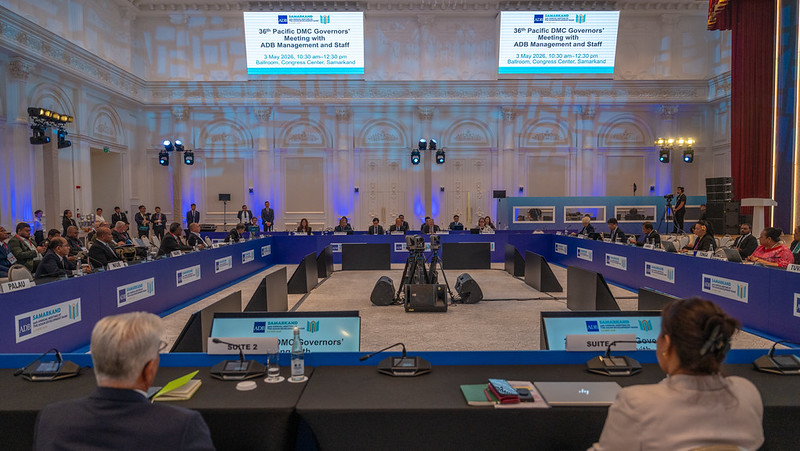
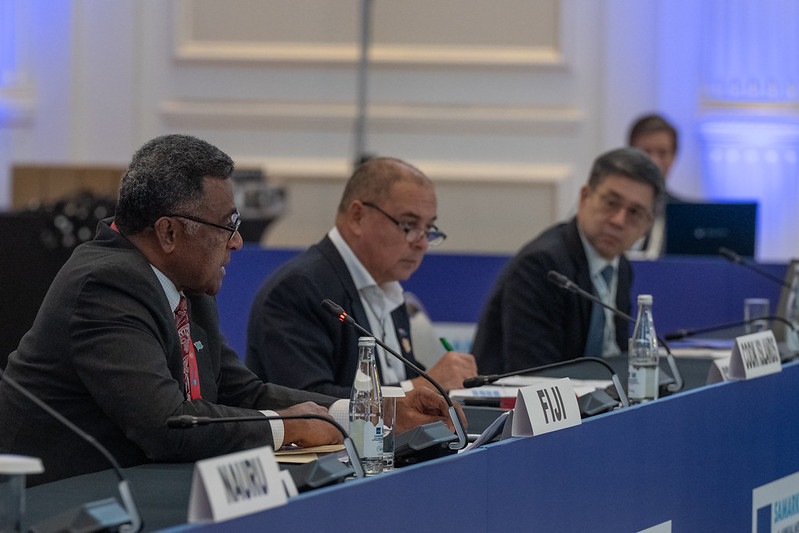
“This morning (Sunday) I met with Pacific Developing Member Countries Governors who have raised their concerns with me, said President Kanda in response to PACNEWS.
“The impact on small island countries in the Pacific is particularly significant. For example, Tonga spends over 10 percent of GDP on fossil fuel imports.
“Our ADB’s most recent economic outlook was just recalculated last week, and it showed that it’s more serious than before – it estimates that the growth of the Pacific will decline from 4.2 percent last year to 2.8 percent in 2026 – slowing down by as much as 1.4 percent.
Recent bank estimates say growth of Pacific economics will decline to 2.8 percent in 2026 from 4.3 percent last year – slowing down by as much as 1.4 percent.
President Kanda said in a severe case scenario, growth will further reduce to 2 percent which almost half compared to last year.
The ADB is ready to deliver urgent help to Pacific Developing Member Countries (PMDCs), impacted by the war, resulting in fuel shortages.
“We have received requests for support from several Pacific countries already, and we are working quickly to deliver them. We are ready to support Pacific countries to build their resilience against external shocks through diversifying energy sources.
“For instance, in the Solomon Islands, the ADB is supporting a 50megawatt Tina River hydro power project. This project is expected to provide 70 percent of electricity for their capital, Honiara once completed in 2028.
“We are also strengthening power grid storage system in several countries. So, we have to turn this crisis into opportunities to make our countries more resilient than before, said President Kanda.
He told journalists the fall out of from the Middle East crisis has severely impacted the energy sector.
“It did not stop there, with higher prices quickly spilling into fuel, freight and fertiliser, said Kanda.
If the conflict between the U.S and Iran escalates, ‘the world will not only see a security crisis but a stress test of the global order.”
“It is a reminder that countries remain highly vulnerable to shocks originating in a few strategic corridors. It is exposing the cost of overreliance and accelerating the shift from pure efficiency toward resilience.
He’s assured the bank’s 69 member countries that “ADB remains a steadfast partner during these challenging times.”
Last month, the ADB announced a financial support package to developing member countries to manage their economic fall-out from the Middle East conflict.
Economies in Asia and the Pacific have been hit hard with higher energy prices, supply chain and trade disruptions, and tighter financial conditions. Tourism and remittances could also be impacted, according to the latest ADB brief.
It outlined three risk scenarios – indicating that effects on the region’s developing economies will depend largely on the duration of disruptions. Under a short-lived conflict, energy price pressures would ease relatively quickly. More prolonged disruptions would lead to larger and more persistent impacts on growth and inflation.
Earlier on Sunday, the bank unveiled a US$70 billion programme to expand energy and digital infrastructure across the Asia-Pacific region by 2035. This includes US$50 billion for the Pan-Asia Power Grid and US$20 billion for the Asia-Pacific Digital Highway.
Across developing Asia, demand for reliable and affordable electricity is growing faster. The Pan-Asia Power Grid will help countries connect their power systems, scale up cross-border electricity trade, and accelerate the integration of renewable energy.
The US$50 billion mobilised by 2035 will expand and modernise transmission networks and strengthen grid stability. ADB’s initiative aims to help integrate about 20 gigawatts of renewable energy across borders.
“We plan to connect about 22,000 circuit-kilometres of transmission lines. This will improve energy access for about 200 million people and reduce regional power sector emissions by about 15 percent. It will also help create 840,000 jobs, said Kanda.
The theme of this year’s Annual Governors meeting is “Crossroads of Progress: Advancing the Region’s Connected Future”.
https://www.adb.org/annual-meeting/2026/events/opening-session-board-governors