The debate about our new constitution is missing the most important question.
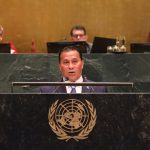
By Filipo Tarakinikini Permanent Representative of Fiji to the United Nations
The debate about Fiji’s new constitution has begun in earnest, and I am glad for it. People are talking about identity, about how power should be exercised, about what kind of nation we want to be. Some are calling for Fiji to be declared a Christian State. Others insist on a secular state that keeps religion out of public life entirely. Both positions, I want to suggest respectfully, are asking the wrong question.
The real question is not what label we put on the State. The real question is this: why do the rights in our Bill of Rights actually exist? Why do you have dignity? Not because the Constitution says so — a constitution can be overthrown, as Fiji knows better than most. Not because parliament voted for it — parliament can vote it away. But why, at the deepest level, does every Fijian — iTaukei, Indo-Fijian, Rotuman, Banaban, every one of us — have a worth that no government can take away?
Four constitutions in fifty years. Each overthrown. The lesson is not that rights are impossible to protect. It is that rights built on political agreement alone are only as durable as the agreement that produced them.
This is not a rhetorical question. It is the most practical question a constitution-drafter can face. We have had four constitutions in fifty years. Each was overthrown. Not because the rights they listed were wrong — they were largely right. But because they rested on political agreement alone, and when political agreement broke down, the rights broke with it.
So what is the answer? I believe it is this: every Fijian has dignity because they are made in the image of God. Not because of their race, their religion, their capacity, or their productivity. Not because the State confers it. Because of what they fundamentally are — an image-bearer of the God who made them and who loves them. That dignity cannot be overthrown. It cannot be suspended. No coup, no parliament, no emergency decree can touch it.
Now I know what some readers are thinking. What about our Hindu brothers and sisters? Our Muslim community? Does acknowledging God in the Constitution mean their rights are less secure? The answer is exactly the opposite. The concept that every person bears the image of God applies to everyone equally — without exception, without qualification. A Hindu Fijian’s dignity is not protected by writing Hinduism into the Constitution. It is protected by the universal claim that every human being, regardless of faith, has a God-given worth that no State can override. That claim is stronger and more reliable than any multicultural formula that tries to balance all traditions against each other and ends up with none of them providing a real foundation.
We are not asking Fiji to become a theocracy. We are asking Fiji to be honest about where its values come from.
To those calling for a Christian State: I understand the passion behind that call. Christianity has shaped Fiji more profoundly than any other force since Ratu Seru Cakobau’s conversion in 1854. The faith of the majority of our people is real and it matters. But a Christian State — in the sense of a State governed by a church or that enforces Christian practice on those of other faiths — is not what the gospel requires of us, and not what our people need. What we need is a Constitution that is honest about the Judeo-Christian foundation of the values it proclaims, while guaranteeing with full force the equal rights of every citizen regardless of their personal faith.
To those calling for a secular State: I understand that concern too. Religion has sometimes been used to justify injustice, and a constitution must protect everyone equally. But a truly secular constitution — one that removes any acknowledgment of God and tries to ground human dignity in political agreement alone — has not protected rights more reliably. It has protected them less. The most secular constitutions in the world are today among the most vulnerable to authoritarianism, precisely because they have no transcendent reference point — no authority beyond the will of the current majority — to which citizens can appeal when that majority turns against them.
There is a third way, and it is the way of our own history. When Christianity came to Fiji, our iTaukei ancestors did not experience it as a replacement of everything they knew. They experienced it as the meeting of the God they had always sensed — in the land, in the ocean, in the ancestors — with the God who had been revealed in Jesus Christ. The concept of vanua — the living unity of land, people, and spirit — did not disappear. It was deepened. That integration, that synthesis, is one of the great spiritual achievements of the Fijian people. Our Constitution should honour it.
What I am proposing for Fiji’s revised Constitution is therefore not a theocracy and not a hostile secularism. It is a Constitution that is honest: honest that our values come from somewhere, honest that human dignity is grounded in something deeper than political will, honest that the land is sacred and not just an asset, honest that our obligations run to generations not yet born and not just to voters at the next election.
The rights of every Fijian — Christian, Hindu, Muslim, and those of no faith — are safer when they rest on a foundation that no government can move.
I have spent my career watching what happens when constitutions are built on foundations that cannot bear the weight placed on them. I have seen it in Darfur, where constitutional institutions too weak to constrain ethnic and political violence produced a genocide. I have seen it in Yemen and Libya, where the collapse of the State left nothing beneath the claims of rights and justice — no ground on which to stand. And I have seen it here at home, four times in fifty years.
Fiji deserves better. Our children deserve better. The Constitution Review Commission has before it a rare and precious opportunity: to give this nation a constitutional foundation that is not merely technically competent but philosophically serious — one that future generations can look to not just as a legal document but as a statement of what Fiji believes about the human person, about the land, about the obligation we hold to one another and to God.
That is the conversation I am asking Fiji to have. Not Christian State or secular state. But a state that knows why its people have dignity — and builds its constitution on that knowledge.
Filipo Tarakinikini is a former Fiji military officer and UN security expert from Mataqali Navitilevu, Yavusa Naitavuni, Delailasakau village, Naitasiri Province.