



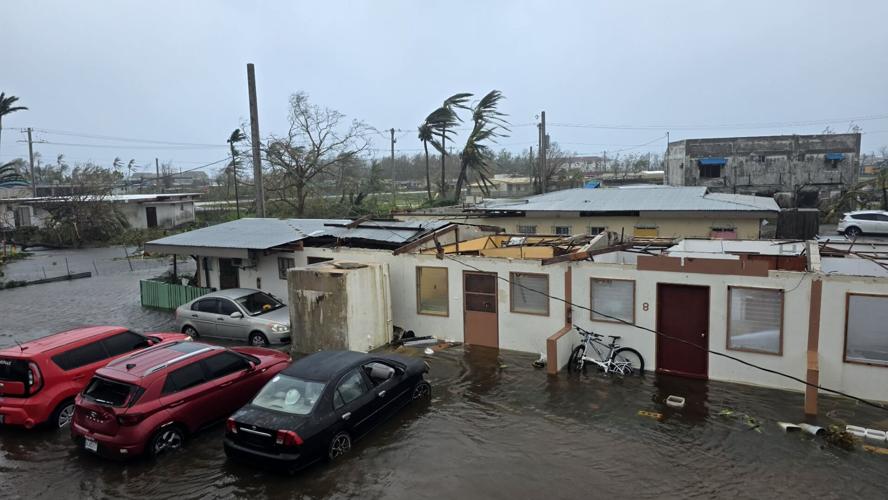
Super Typhoon Sinlaku claimed 12 lives between Guam, Chuuk, and the Commonwealth of the Northern Mariana Islands, making it one of the deadliest for Micronesia in decades, based on post-storm reports.
Looking forward, forecasters will have a better idea by early next week of whether tropical disturbance Invest 91W will turn into another problem for the Marianas or fizzle out.
This, as a developing El Niño weather pattern could raise the chances for more storms through 2026.
A National Weather Service post-storm report lists 12 fatalities from Sinlaku, 10 of which are considered “direct” and two of which are “indirect.”
One has to go back to Super Typhoon Chataan in 2002, which killed 48, to see a higher death toll in Micronesia.
Beyond that, one has to go back to Super Typhoon Pamela in 1976, which killed 11, to find a comparable storm.
A search continued Tuesday for five of the people on the fatality list for Sinlaku, crew members of capsized cargo vessel The Mariana, which overturned near Pagan in the CNMI during the storm.
With none of the five mariners found weeks after the storm, deaths were assumed, according to Ken Kleeschulte, lead meteorologist with NWS Guam in Tiyan.
Rescuers recovered a body from the capsized cargo vessel last week, based on a statement from the U.S Coast Guard.
An elderly man and woman found dead in a Tamuning home with carbon monoxide in the air are listed as indirect fatalities for Guam by NWS.
The pair was found days after Sinlaku, after police responded to reports of a generator running indoors.
For Chuuk, one person died after a tree fell on them during Sinlaku, and a second died due to a capsized boat, according to NWS.
A third death was recorded after a downed tree blocked a road and prevented a pregnant woman from getting to the hospital, resulting in the death of the baby, according to Kleeschulte. He said information was relayed by the government of Chuuk state.
The cause of a fourth death in Chuuk, related to the storm, remains unknown, NWS reports show.
Kleeschulte said the post-Sinlaku report will be updated.
Though Guam and the rest of Micronesia are no stranger to storms, even super typhoons that blow through the region rarely result in more than a handful of deaths, a review of storm records shows.
Sinlaku was far deadlier than Typhoon Mawar in 2023. NWS recorded two indirect deaths from Mawar, both swimmers, who got into Guam waters before and after the storm.
Super Typhoon Pongsona in 2002 recorded one indirect death on Guam, after a woman was cut by flying glass and then suffered a fatal heart attack, according to NWS reports.
In 2018, Super Typhoon Yutu reportedly took dozens of lives in the Philippines.
But Yutu resulted in one indirect death in Micronesia, during an earlier devastation of Saipan, from a woman found dead of carbon monoxide poisoning from a portable generator used indoors.
Flash flooding and landslides from Chataan killed 48 people in Chuuk, in 2002, making it the deadliest natural disaster in the history of the Chuuk islands, according to the National Oceanic and Atmospheric Administration.
Chataan was an outlier in terms of deadly storms in Micronesia.
Pamela in 1976 killed 10 people in Chuuk and officially killed another on Guam, according to NWS, though the American Red Cross estimated Guam may have seen as many as three deaths.
As for tropical disturbance Invest 91W, NWS Guam lead meteorologist Kleeschulte said it’s too soon to say how the system will shape up.
“Yes, be ready, but don’t panic,” Kleeschulte said.
“To say anything for certain is going to come over the Marianas over a week from now is not really very accurate,” he said. “We could get a tropical system through us. We can get nothing.”
News of the brewing disturbance came Monday, just two weeks after Sinlaku’s passage kept high winds and heavy rains over Guam for the better part of four days and slammed Saipan and Tinian.
Kleeschulte on Tuesday said 91W remained “very weak” and was “just sitting there” in eastern Micronesia, near Kosrae and several hundred miles to the southwest of the Marianas.
“Until it gets much closer, we’re not going to really know what we’re looking at,” he said.
By the time 91W drifts west towards the Marianas, it could develop into a storm, or bring a little more rain, Kleeschulte said.
It could head towards Guam, shoot north, or shoot south of the island.
“The key thing is everyone should always be prepared, be ready for one. But right now, we’re not forecasting anything in here as of yet,” he said.
Residents can start closely eyeing the weather early next week, according to Kleeschulte, when forecasters will have a better idea of what 91W will do.
Things can change as the system moves closer, he stressed, pointing to Sinlaku’s last-minute turn earlier this month.
“Even a few days before it came here, we were looking at the possibility of a direct hit on Guam. And instead, as the time went on, it went farther and farther north,” Kleeschulte said of Sinlaku.
As of Tuesday, the Joint Typhoon Warning Centre had Invest 91W rated “sub-low,” meaning little development is expected over the next few days.
An El Niño weather pattern, associated with more and stronger storms for the Marianas, could develop within the next couple of months, Kleeschulte said Tuesday.
Warm ocean waters that feed strong typhoons, usually out west near the Philippines, shift to the east of the Marianas during El Niño periods.
Developing storms blow west through the region, and Kleeschulte said storms that threaten Guam and the rest of the Marianas usually start down to the southeast, near the Federated States of Micronesia, or, less frequently, directly to the east.
“With El Nino, we do tend to get more tropical cyclones through the region,” he said, “and they do tend to be a little bit stronger because they develop farther to the east, and it gives them longer time to strengthen heading our direction.”
Kleeschulte said it is possible that more strong Category 4 or Category 5 typhoons like Sinlaku could develop, but it doesn’t mean that it’s certain.
Typhoon Mawar in May of 2023 was the strongest typhoon to pass over Guam in the last two decades, but came just before an El Niño period in June.
Forecasters with the NWS predicted two or three major storms would form in the region after Mawar.
Besides Typhoon Bolaven, passing south of Saipan in October 2023 as a low-grade typhoon, Guam and the CNMI were spared of any more big hits that year.