Home Blog Page 1062

Strengthening a nuclear-free Pacific — Rarotonga Treaty 2021 talks

0

States Parties to the South Pacific Nuclear Free Zone Treaty, the Treaty of Rarotonga, are advancing efforts to secure the entire Blue Pacific as a nuclear free zone.

In their inaugural meeting, held virtually Wednesday and observed by Forum Non-Party Members, the Treaty’s Consultative Committee considered how we are faring as a nuclear-free zone in the global context, and discussed practical means of operationalising the Treaty.

Meeting Chair and Deputy Secretary for Foreign Affairs of Fiji, Esala Nayasi, recalled Forum Leaders’ decision in 2019 to operationalise the Treaty and congratulated the Forum family for the 35th Anniversary of its entry into force. During opening remarks on behalf of PIF Secretary General, Henry Puna, the Deputy Secretary General Dr Filimon Manoni noted the historic significance of this first Consultative Committee meeting and referred to the Treaty as representing the fullest possible contribution, within our means, to protecting humanity from the dangers of nuclear war.

He noted that with peaceful uses of nuclear energy becoming more widespread today, nuclear challenges have become more complex in both non-peaceful and peaceful uses.

The growing urgency of climate change causing more frequent, stronger natural disasters across the globe have drawn attention to nuclear safety issues and large-scale risk such as the 2011 Fukushima accident.

Under the Treaty, the Consultative Committee is mandated to consult and cooperate on any matter arising in relation to the Treaty or for reviewing its operation. Operationalising the Treaty means revisiting its framework and provisions, including legal obligations to renounce and prevent nuclear weapons, nuclear testing, and nuclear dumping, as well as to utilise its Control System to verify compliance with the Treaty.

Welcoming the committee session and its timing within days of the 35th anniversary of the Rarotonga Treaty, Secretary General Henry Puna said the meeting “is especially significant, given the timing and context of new challenges for our region. It represents renewed commitment to advance the mechanisms of the Treaty to ensure its full operation, effect, and compliance. In turn, securing the nuclear-free status of our Blue Pacific.”

States Parties to the Treaty of Rarotonga are Australia, the Cook Islands, Fiji, Kiribati, Nauru, New Zealand, Niue, Papua New Guinea, Samoa, Solomon Islands, Tonga, Tuvalu, and Vanuatu.

Lisa Williams-Lahari| Public Affairs Adviser
Pacific Islands Forum Secretariat
Ratu Sukuna Road | Private Mail Bag | Suva | FIJI
E: lisaw@forumsec.org | W: www.forumsec.org

SOURCE: PIFS/PACNEWS

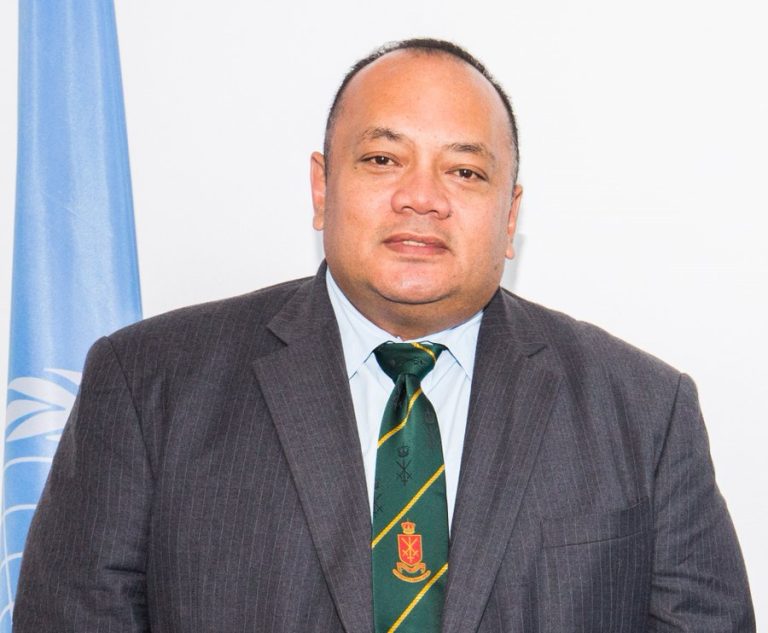
Tongan MPs choose Siaosi Sovaleni as new Prime Minister

Tonga’s Parliament has elected a new prime minister to replace Pōhiva Tu’i’onetoa.

Siaosi Sovaleni, 51, the Minister of Education, has won convincingly with 16 votes, to former Minister of Finance and MP Dr ‘Aisake Eke, who got 10 votes.

The Interim Speaker Lord Tangi announced the results this afternoon after he first informed King Tupou VI about the winner.

The results showed what appeared to be the nobility MPs’ votes were split with apparently four of them supported Sovaleni while the remaining five voted for Dr Eke.

Sovaleni, who was a minister in good standing in the Tu’i’onetoa government, recently crossed the floor to form his new bloc and gain the support from a united group of independent MPs and PTOA Party MPs.

Three other MPs who were part of Tu’i’onetoa’s PAK party, also crossed the floor and joined Sovaleni.

The only people’s MP and interim Cabinet Minister who supported Tu’i’onetoa was the Niua MP Vātau Hui.

The defection of the four members meant Tu’i’onetoa had to withdraw his candidacy for the premiership election because he did not have the number of MPs required by law to support and nominate him as a candidate.

This week, Tu’i’onetoa complained about being dumped by his own interim Cabinet Ministers, saying he just found out after the general elections on 18 November that his unity with his interim ministers in the past four months was fake.

In his speech before the election this morning, Sovaleni said people, the chiefs and the king lived under what he described as one house. He said people have to learn to know how to live together.

He said education, health, economic developments, e-government, Climate Changes, war on illicit drugs, natural disasters, youths and women initiatives and good governance were some of his priorities.
In his vote of thanks after he was declared the winner this afternoon, Sovaleni was emotional and congratulated his supporters and all MPs. He also thanked his unsuccessful rival candidate Dr Eke and said they previously worked together in the Ministry of Finance.

SOURCE: KANIVA TONGA NEWS/PACNEWS

Fiji calls for climate resilience to be at the core of UN peace and security

Fiji joined 113 member states of the United Nations who called on the United Nations Security Council (UNSC), to integrate climate resilience into the UN’s work in advancing international peace and security.

This was highlighted at the UNSC open debate on “Maintenance of International Peace and Security: Security in the context of Terrorism and Climate Change.”

UN Secretary-General, António Guterres, in his remarks to the UN Security Council, reiterated that the Security Council and all Member States must work simultaneously on peacebuilding and mitigating the impacts of climate change.

UNSG Guterres affirmed that climate emergency is the vital issue of our time and although some progress was made at the twenty-sixth Conference of the Parties to the United Nations Framework Convention on Climate Change (COP26), the objectives are far from being reached.

He stated that, “We have to continue our efforts to keep the goal of limiting global warming to 1.5°C alive, and we are in a race against the clock, and no one is safe from the destructive effects of climate disruption.”

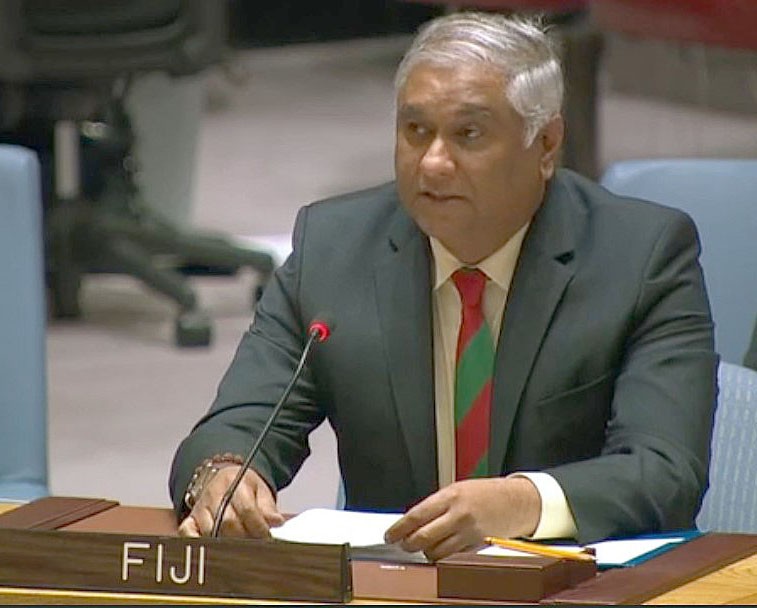
In addressing the UNSC, Fiji’s Permanent Representative at the UN, Ambassador Satyendra Prasad, called for collective action by the UNSC and the UN system “to holistically respond to climate crisis, which impacts peace, security and stability”.

Ambassador Prasad said that “how the Security Council takes forward the advice of so many member states in the General Assembly, will shape how well and how substantively the world can respond to growing and more diverse threats to peace and security within regions and between states.”

He echoed the sentiments of Blue Pacific leaders, that “climate change is the single gravest threat to the livelihoods, security, and wellbeing of the peoples of the Pacific.”

Ambassador Prasad called on UNSC to speedily adopt the resolution on climate and security.

“When you do so, you will be telling our communities and people who face constant relocation that this Security Council is also theirs.”

“All dimensions of human security including the right to live peacefully in their own homelands are part of our peace and security perspective. We have been saying that climate change is the most persistent and gravest threat to peace and security in our regions not from today or yesterday, but for the better part of three decades,” said Ambassador Prasad.

He said it’s important for those responsible for the climate crisis to live up to their commitments and provide consistent support through climate financing for adaptation, mitigation and loss and damage for those living in regions where the climate crisis is fuelling growing conflict and insecurity.

With the historic climate and security resolution having the broad support of the 113 countries, Fiji will continue to build partnerships for the realisation of global climate ambition.

SOURCE: FIJI GOVT/PACNEWS

Australia accused of Pacific climate change con

Australia is wrongly claiming Pacific funding projects with no environmental benefit as climate adaption aid, according to a report authorised by Greenpeace Australia Pacific.

The Pacific Research and Investigations Report said Australia did so to meet its funding obligations to smaller island nations and that the nation had “greenwashed” its most expensive climate adaption aid promise.

It accused Australia of using “accounting tricks” to spend US$80 million over 2018 and 2019 for a governance facility in Papua New Guinea.

“Neither the project’s long description or Australia’s own evaluation report mention climate adaptation or the environment,” the report said.

Greenpeace also found that projects in Kiribati had been misleadingly described as “significantly focused” on climate adaption.

Former Kiribati president Anote Tong disputed the labelling after, in 2013, an Australian-funded road rehabilitation project was established in South Tarawa, the nation’s capital and the home to more than half the country’s population.

While the rehabilitation of the road was much needed, it did not have any relevance to climate change or increasing the resiliency of Kiribati’s population, the report said.

“Climate change projects in my view should be about building resiliency so that when the next storm comes, or the next king high tide, we will remain above water and be safe – but that is not the case,” Tong said.

He called the road “a wonderful project” for the country’s small transportation network on the atoll.

“But it hasn’t done anything to help with climate change because already the road is threatened by erosion on one side,” Tong said.

“The water has been coming over the road in extra high tides and actually damaging it and that road project was one of the climate change projects.”

Dr Vijay Naidu, a professor of development studies at the University of the South Pacific (USP), is scathing over a lack of further action from the Australian government after pushing a two-degree warming on greenhouse gas emission limitations rather than the universally accepted 1.5 degrees.

He stated that: “because Australia is the most powerful actor and can be labelled the regional bully, it managed to push small islands states in the region for a long time to accept its agenda”.

The Australians had also failed to share or deliver its emissions reduction targets or level of climate ambition at the most recent 2019 Pacific Islands Forum.

A $500 million(US$355 million) pledge on climate aid was offered to cover the period of 2020 until the end of 2025.

“The pledge was met with mixed reactions by the region, with Pacific island leaders stating that this was yet another example of Australia offering financial assistance in exchange for the Pacific islands’ silence on climate change,” the report said.

Australia, unlike other developed countries that acknowledged their culpability for greenhouse gas emissions, was seen in the Pacific as shirking its international responsibility to climate justice.

Investigations found that Australia underspends on climate aid comparably, allocating around 1 per cent of its total foreign aid on climate adaption – based on average spending from 2016 until 2018 – whereas other Western nations fork out up to 10 times more.

By the end of that period, Australia had stopped its contributions to a UN green climate fund despite appeals from the Pacific island nations for greater “multilateral climate finance”.

Australia has all but snubbed the Paris agreement, a legally binding international treaty on climate change adopted by 196 countries at the 2015 climate change conference, which has affected its nearest Pacific neighbours.

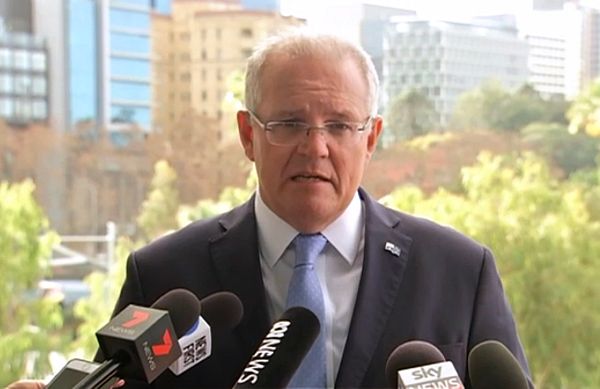
Greenpeace also pointed to public comments from Australian prime minister Scott Morrison, who said the country is not held accountable by the signatories of the agreement and “nor are we bound to go tip money into that big climate fund – we’re not going to do that either”.

Dr Naidu said Australia’s preference to offer so-called adaptation aid over strengthening its domestic mitigation policies has affected the Pacific’s view of Australia.

“Australia is seen as a hypocrite by many Pacific island countries for failing to cut down its emissions, but trying to make up for its sins by offering aid for adaptation to island countries – and the island countries know this,” he said.

The entire block of Pacific island nations had once called for the establishment of a technical support arm for developing countries to access a “loss and damage” financial assistance for climate impacts.

But the report revealed that an anonymous source had aid that at the 2019 climate change conference climate, Australia pushed hard against the proposal in negotiations.

It came after the report found that while former Pacific leaders and countries’ opposition politicians had responded to Greenpeace’s questions, government officials in power did not.

“Speaking out about Australia’s climate policies carries a degree of political risk, as aid may not be recommitted in following years,” the report said.

SOURCE: PACIFIC ADVOCATE/PACNEWS

Australia’s chief of Defence Force visit Fiji

Australia’s Chief of the Defence Force, General Angus Campbell will visit Fiji on 15-18 December 2021, his second official visit to Fiji as Chief of the Australian Defence Force (ADF).

General Campbell’s visit is at the invitation of the Commander of the Republic of Fiji Military Forces (RFMF), Major General Jone Kalouniwai, and is an opportunity to deepen the relationship between the ADF and its vuvale in the RFMF.

“Despite the challenges of COVID-19, the military partnership between Australia and Fiji has continued to grow. Fiji and Australia have worked together to respond to Tropical Cyclone Yasa, and have continued to deploy Fijian Peacekeepers to the Middle East, enhance stability in Solomon Islands and deliver on important training and infrastructure projects for Fiji”, General Campbell said.

“Australia is committed to taking our engagement with Fiji to a new level, working with Fiji to build a region that is prosperous, secure and sovereign” he continued.

The ADF and RFMF are collaborating closely on major RFMF infrastructure projects at Blackrock Camp, Stanley Brown Naval Base and the new Maritime Essential Services Centre. General Campbell will meet the RFMF’s senior leaders to discuss these important infrastructure projects, our shared priorities, further joint training and two-way personnel exchange opportunities and other initiatives delivered through the Australia-Fiji Vuvale Partnership.

SOURCE: ADF/PACNEWS

COVID-19: Don’t underestimate Omicron, WHO chief warns

The Omicron variant is “probably” now present in most of the world’s countries and it would be a mistake to dismiss the COVID-19 strain as “mild”, said the head of the UN health agency (WHO) on Tuesday.

Tedros Adhanom Ghebreyesus, Director-General of the World Health Organisation, told reporters from WHO headquarters in Geneva that the variant was now present in 77 countries.

Omicron is spreading at a rate we have not seen with any previous variant. We’re concerned that people are dismissing Omicron as mild”, he said. “Surely, we have learned by now that we underestimate this virus at our peril.”

“Even if Omicron does cause less severe disease, the sheer number of cases could once again overwhelm unprepared health systems. I need to be very clear: vaccines alone will not get any country out of this crisis. Countries can – and must – prevent the spread of Omicron with measures that work today.”

The United Kingdom’s top health adviser warned on Tuesday that Omicron infections could reach one million per day there, by the end of this month, adding that the National Health Service (NHS) would face significant pressure if only a fraction of those newly infected need to be hospitalised – a troubling scenario in a country where some 70 per cent of the population are fully vaccinated.

Tedros warned that making choices about strategies to halt the pandemic, was the wrong approach: “It’s not vaccines instead of distancing. It’s not vaccines instead of ventilation or hand hygiene. Do it all. Do it consistently. Do it well.”

He said in the past 10 weeks, the international vaccine rollout initiative, COVAX, has shipped more vaccines than in the first 9 months of the year combined, with most countries using vaccines as fast as they get them.

“A small group of countries are facing challenges rolling out vaccines and scaling up rapidly, and WHO and our partners are working closely with those countries to overcome bottlenecks”, he added.

“Although we expect further improvements in supply, there are no guarantees, and the hard-won gains we have made are fragile.”

Tedros said “evolving evidence suggests a small decline in the effectiveness of vaccines against severe disease and death”, noting that booster rollouts for all over-18s to fight Omicron in some countries, had begun despite a lack of evidence that they will be effective.

“WHO is concerned that such programmes will repeat the vaccine hoarding we saw this year, and exacerbate inequity…Let me be very clear: WHO is not against boosters. We’re against inequity. Our main concern is to save lives, everywhere.”

The WHO chief said that giving boosters to groups at low risk, simply endangers the lives of those facing higher risk, who have not yet got their primary doses, due to supply constraints.

On the other hand, giving additional doses to people at high risk can save more lives than giving primary doses to those at low risk, he reasoned.

“Together, we will save the most lives by making sure health workers, older people and other at-risk groups receive their primary doses of vaccines.

“In most countries, those being hospitalized and dying are those who have not been vaccinated. So, the priority must be to vaccinate the unvaccinated, even in countries with most access to vaccines.”

He said the priority in every country, for the sake of the global effort to halt the pandemic, “must be to protect the least protected, not the most protected.”

Some 41 countries have still not been able to vaccinate even 10% of their populations, and 98 countries have not yet reached 40 percent.

“If we end inequity, we end the pandemic”, he emphasised. “If we allow inequity to continue, we allow the pandemic to continue.”.

SOURCE: UN NEWS CENTRE/PACNEWS

No return to normal without universal COVID jabs: UN General Assembly President

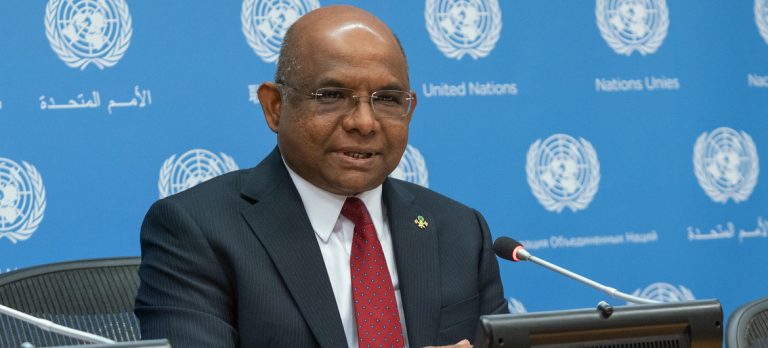
The President of the United Nations General Assembly on Tuesday announced a New Year resolution on vaccine equity, calling on governments to come together on this issue ahead of a major event in mid-January.

“Unless we can vaccinate the world, there is no way out of this. You see different types of variants coming out, and this is going to continue,” Abdulla Shahid told journalists in New York.

He said he would convene a high-level event in the General Assembly on 13 January with the goal of ensuring equitable access and delivery of vaccines “to everyone, everywhere, at the earliest.”

Leading up to the event, Member States will be able to register their support for universal COVID vaccinations in what Shahid is calling a New Year’s resolution.

“I want to see renewed political commitment and meaningful engagement to ensure universal vaccination,” he told correspondents.

Shahid noted that the international community had missed the target set by the World Health Organisation (WHO) to inoculate 40 percent of the world’s population by the end of this year, and that there are concerns about meeting the next target of 70 per cent by the middle of 2022.

“We do not have vaccine equity,” he said. “When you look at countries in Africa where you have an average vaccination rate of maximum, 5 or 6 percent. We are unable to say with confidence that we are anywhere near to equity.”

He noted that this is exactly why the General Assembly must unite on vaccinations.
“The new normal will be pushed again further and further” into unknown territory he said. “This we cannot afford, and that is why we need to get together for the effort, a united effort.”

In his press conference, he also spoke about responding to the needs of a warming planet, human rights, and revitalising the work of the United Nations.

He also stressed the importance of involving young people in the UN’s work, in particular through his Fellowship of HOPE, which will bring eight young diplomats from underrepresented countries to the President’s Office starting in January.

“As a small islander who has seen and experienced the struggles of so many countries in keeping up with the rest of the world on the diplomatic stage, I know they will walk away with knowledge and skills to support their nations,” Shahid said. “As true multilateralists,” he said.

SOURCE: UN NEWS CENTRE/PACNEWS

New Caledonia remains in limbo after referendum

Questions remain over the future of New Caledonia as pro-independence groups refuse to discuss the future of the French Pacific territory with the government in Paris, until after the 2022 French presidential election.

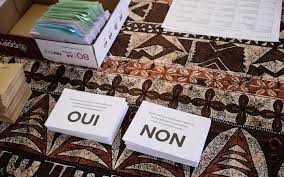
On paper, the result from Sunday’s referendum appears clear cut, with 96.49 per cent of voters choosing to stay with France.

However, the final result was distorted by the small turnout.

Only 43.9 percent of eligible voters headed to the polls, after pro-independence groups, made up mainly of indigenous Kanak people, had called for a boycott of the referendum after France declined a request to delay the ballot to allow for a traditional mourning period following a surge in COVID cases in September.

The previous votes in 2018 and 2020 saw participation levels at more than 80 percent.

Pro-independence groups have refused to enter into discussions until France’s presidential election in April next year, which means the future of the Pacific territory is now undecided.

For many Kanak people, the desire for independence is linked to their hopes that the territory’s violent colonial legacy will be acknowledged and can be reconciled.

Emmanuel Tjibaou, who’s father Jean-Marie was the leader of the Kanak independence movement before being assassinated in 1989, believes New Caledonia will eventually become independent.

His grandfather was just 10 years old when the French military killed members of his tribe for refusing to participate in World War I.

“It’s quite a long way for us to go but we still believe that our country will stand free,” he told Pacific Beat.

“We believe our future will never go under the French flag.”

Paul Fizin, a linguist with the Kanak Language Institute, says the territory is divided.

“For lots of Kanak people, this election is an electoral hold up,” he said.

SOURCE: ABC/PACNEWS

New NZ fund to help Pacific nations recover from covid-19

0

The New Zealand government is setting up a new investment fund to help Pacific nations recover from covid-19.

InvestPacific is the first partly private investment fund established that exclusively targets the Pacific.

New Zealand is putting NZ$17 million(US$11.4 million) into the Invest Pacific fund and is expecting the fund to attract another NZ$40 million(US$26.9 million) via private investment.

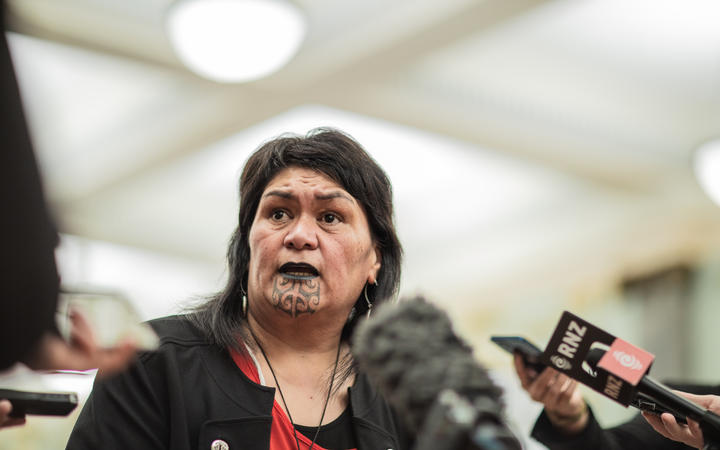
The Foreign Affairs Minister Nanaia Mahuta said InvestPacific enables communities to realise their own goals and priorities, and improve their social and economic wellbeing.

“They’re prioritising coordinating with the Pacific region – particularly Māori and Pasifika – as a key to maintaining an indigenous focus,” she said.

Government officials plan to go to market early next year to speak with those interested in managing the fund.

New Zealand’s Minister of State for Trade and Export Growth Phil Twyford said if things remain on track, investments for projects will made by the end of next year.

“Projects we will tackle will have to do with climate change, adaptation, trade diversification, and building social infrasture. How do we build more prosperous and resiliance societies across the Pacific,” he said.

“This is a significant step in our approach to working with Pacific partners, and it positions the Pacific strongly to take advantage of the stable trade and investment environment created by the PACER Plus agreement.

We are continuing to look for opportunities to work with partners across the Pacific to help raise incomes and generate new jobs, and I’m confident we will see a raft of investment prospects through this programme,” Phil Twyford said.

SOURCE: RNZ PACIFIC/PACNEWS

New Zealand Government eyes ‘Pacific preference’ in immigration to boost region

0

By Sam Sachdeva

The Government has marked the first anniversary of a polarising Pacific trade deal with talk of expanding a seasonal worker scheme into a more sweeping ‘preference’ in our immigration settings

For those in need of a reminder about the precarious state of the Pacific’s Covid-hit economies, on Monday came the news of a $100 million(US$67 million)-plus financial injection for the Cook Islands.

The Asian Development Bank, which is providing $80m (US$53.9 million) in direct loans and a $21m(US$14 million) grant to New Zealand to support the Cooks’ transition “from recovery to sustainable, private sector-led growth”, did not mince words when speaking about the fiscal risks.

“The Cook Islands’ nascent economic recovery could unwind if further impacts from the pandemic delay the revival of its tourism industry.”

Equally stark numbers came from a Ministry of Foreign Affairs and Trade economic update noting New Zealand’s imports from the Pacific dropped by 73 percent in the year to June 2021, while its exports to the region fell by 30 percent in the same period.

Amidst the gloom and global uncertainty, there is some hope that a Pacific trade deal still in its embryonic stages can act as “the engine that pulls us collectively out of the pandemic and into a new and more prosperous future”, as Phil Twyford put it.

The Minister of State for Trade and Export Growth was speaking at an event to mark the first anniversary of PACER Plus, which entered into force in December last year.

Views on the agreement’s merits are mixed: critics have argued it benefits Australia and New Zealand more than Pacific nations required to cut valuable tariffs, and Fiji and Papua New Guinea – the two largest economies in the region – have so far refused to join the deal.

But while PACER Plus was rarely mentioned during a panel of Pasifika business owners convened for the event, there was excitement about the potential for economic growth and development in the region.

WE Accounting co-founder Wyndi Tagi, whose company operates in New Zealand and Samoa, said growing connectivity and experience in remote working showed the opportunity to expand the region’s exports of services while stopping a brain drain.

“When the borders are closed and tourism takes a hit, there’s still opportunities to bring outside money into the Pacific Islands…the outsourcing industry is a multi-billion-dollar industry, so why shouldn’t the Pacific Islands be taking a piece of that?”

Christopher Saili, the managing director of Pacific Islands engineering start-up Kahuto Pacific, said e-commerce had gone from a “distant dream” to a closer reality, thanks to investment in infrastructure like undersea internet cables and high mobile penetration across the Pacific.

Twyford himself cited one technological development – the creation of the ASYCUDA customs border management system – as an example of one of the “early wins” made possible by PACER Plus, noting the story of a freight forwarder in Tonga who was now saving time and money by lodging manifests online.

“It’s very practical – it’s possibly not very glamorous, but it actually does make a big difference.”

But one major gap in the deal was pointed out by Saia Finau Latu, chief executive of construction company TROW Group, who spoke of his struggles to recruit workers from the Pacific.

“If we need fruit pickers, easy, we can get fruit pickers simple. But if we need skilled labourers, to bring them over, whether [from] Samoa or Tonga or Fiji we can’t get them – we need to get some [from the] Philippines…

“We need more than just coming in [and] fruit picking, let’s do that policy change so we can get our people opportunities to grow.”

The lack of any binding labour mobility provisions were a bone of contention at the time PACER Plus was signed, with Pacific countries keen to win expanded commitments from New Zealand and Australia.

The number of Pacific workers coming to New Zealand for horticultural work through the Recognised Seasonal Worker (RSE) scheme has also plummeted due to border restrictions, leading to fears of labour shortages.

But Twyford said the Government had bigger ambitions than returning RSE numbers to normal.

“Almost always and all too often, the rules that govern labour mobility are the kind of orthodox immigration systems that almost all countries have, which have been written in the interests of capital, not labour, and have been written in the interests of wealthy countries, not developing countries.

“I see an opportunity in the labour mobility work that we are now beginning to craft together in the region to turn a new page and to think about labour mobility as an engine for collective economic development.”

As part of its work on the country’s immigration settings, the Government was looking at establishing “a Pacific preference” to provide skilled and semi-skilled workers with employment opportunities beyond horticulture, and in turn encourage them to return home with new skills.

“It’s really important that we don’t design policies that will make the brain drain worse in other countries – we want a kind of circular labour mobility that will actually help Pacific countries to grow the workforces they need for the new economy of the 21st century.”

Speaking to Newsroom after his speech, Twyford said he was hopeful of tangible gains on the policy during 2022, having spent months working with foreign affairs and immigration officials on how to make the concept a reality.

He noted Pacific nations would need to be at the forefront of negotiations to protect their own interests.

“It’s not a situation where you know, New Zealand just says ‘Here are our needs, you can fill them, take it or leave it’ – it’s actually, ‘What are the industries where we might be able to help each other out, where we have some skills shortages, and you can allow workers to to travel to do that’.”

Dr Anna Powles, a senior lecturer at Massey University’s Centre for Defence and Security Studies, told Newsroom the benefits of PACER Plus to date remained unclear, along with how it fit into Foreign Affairs Minister Nanaia Mahuta’s new “Pacific resilience” vision.

But Twyford seemed confident that the immigration work could act as a game changer for the region, and possibly even entice Fiji to join PACER Plus despite its earlier reticence.

“The big ticket item is labour mobility, that’s the thing that people in the region – that’s what makes their eyes light up. They see the economic value there.”.

SOURCE: NEWSROOM/PACNEWS

Stay connected

529FansLike
172FollowersFollow
156SubscribersSubscribe
- Advertisement -