

By Pita Ligaiula in Koror, Palau
The Asian Development Bank says it is working to expand access to affordable climate and development finance for Pacific Island countries without adding to their already heavy debt burdens, as governments confront rising climate risks and the high cost of building infrastructure across small and remote economies.
ADB President Masato Kanda said the Pacific faced unique and growing challenges, including frequent cyclones, sea-level rise, coastal erosion and the high cost of delivering infrastructure and services across widely dispersed islands.
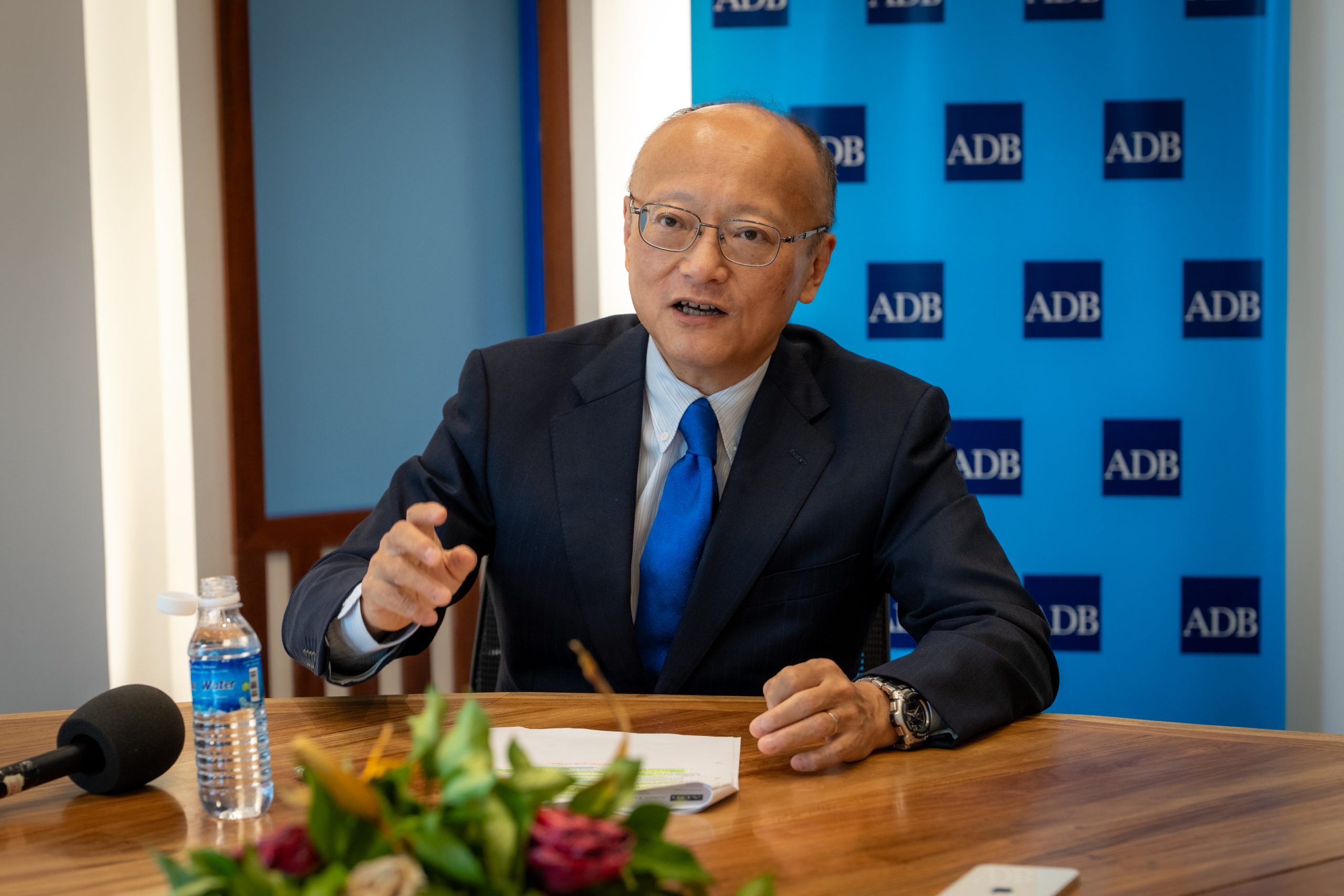
Responding to a PACNEWS question at a media roundtable on the margins of the 55th Pacific Islands Forum Leaders’ Meeting in Koror, Kanda said Pacific countries were central to the Bank’s mission.
“This is quite a relevant question.
“I met many leaders, and most of them are addressing these challenges.”
“The Pacific Islands are central to ADB’s mission and to our commitment to building a prosperous, inclusive, resilient and sustainable region,” Kanda said.
Kanda said ADB was the Pacific’s most significant multilateral development partner, with US$3.7 billion in projects currently underway across the region.
“Much of that support is provided as grants without adding to heavy debt burden,” he said.
The ADB President said the Bank recognised that Pacific countries could not be treated in the same way as larger economies because of their geography, small populations and high infrastructure costs.
“We recognise that Pacific Island countries face very unique challenges,” he said.
These included exposure to cyclones, sea-level rise and coastal erosion, as well as “the high cost of building small and remote economies.”
“This is really difficult,” Kanda said.
Kanda said ADB was committed to developing solutions led by Pacific countries and based on their national priorities.
“We are committed to developing development solutions that are Pacific-led,” he said.
He stressed that the Bank did not intend to impose a single model across the region.
“Not imposed by us,” Kanda said.
The approach would instead focus on solutions tailored to the specific circumstances and priorities of each Pacific country while mobilising resources at a larger scale.
“Tailor-made to each country and capable of mobilising resources at scale.
“The need is tremendously big,” Kanda said.
Kanda highlighted a new regional programmatic approach on climate action as an example of how ADB was seeking to respond to Pacific financing needs.
He said the long-term initiative would bring together climate finance, resilient infrastructure, stronger institutions and regional cooperation under a single approach.
“This is a long-term regional initiative to bring together financing, resilient infrastructure, strengthening institutions and regional cooperation in a single coherent approach,” Kanda said.
A key objective, he said, was to make it easier for Pacific countries to access international climate finance.
The programme is seeking to streamline access to the Green Climate Fund by reducing the number of applications and lowering transaction costs for Pacific governments.
“At this programme, we are seeking to streamline access to the Green Climate Fund (GCF) by fewer applications and less transaction costs,” Kanda said.
Kanda said the approach was aimed at bringing together Pacific leadership, development finance and regional cooperation to address the scale of the climate challenge.
“We are bringing together Pacific leadership, development finance and regional cooperation,” he said.
The ADB President’s comments come as Pacific leaders continue to call for faster and more affordable access to climate finance, warning that small administrations face increasing pressure to prepare projects, meet donor requirements and respond to climate disasters while managing already limited government capacity.