
By Pita Ligaiula in Koror, Palau
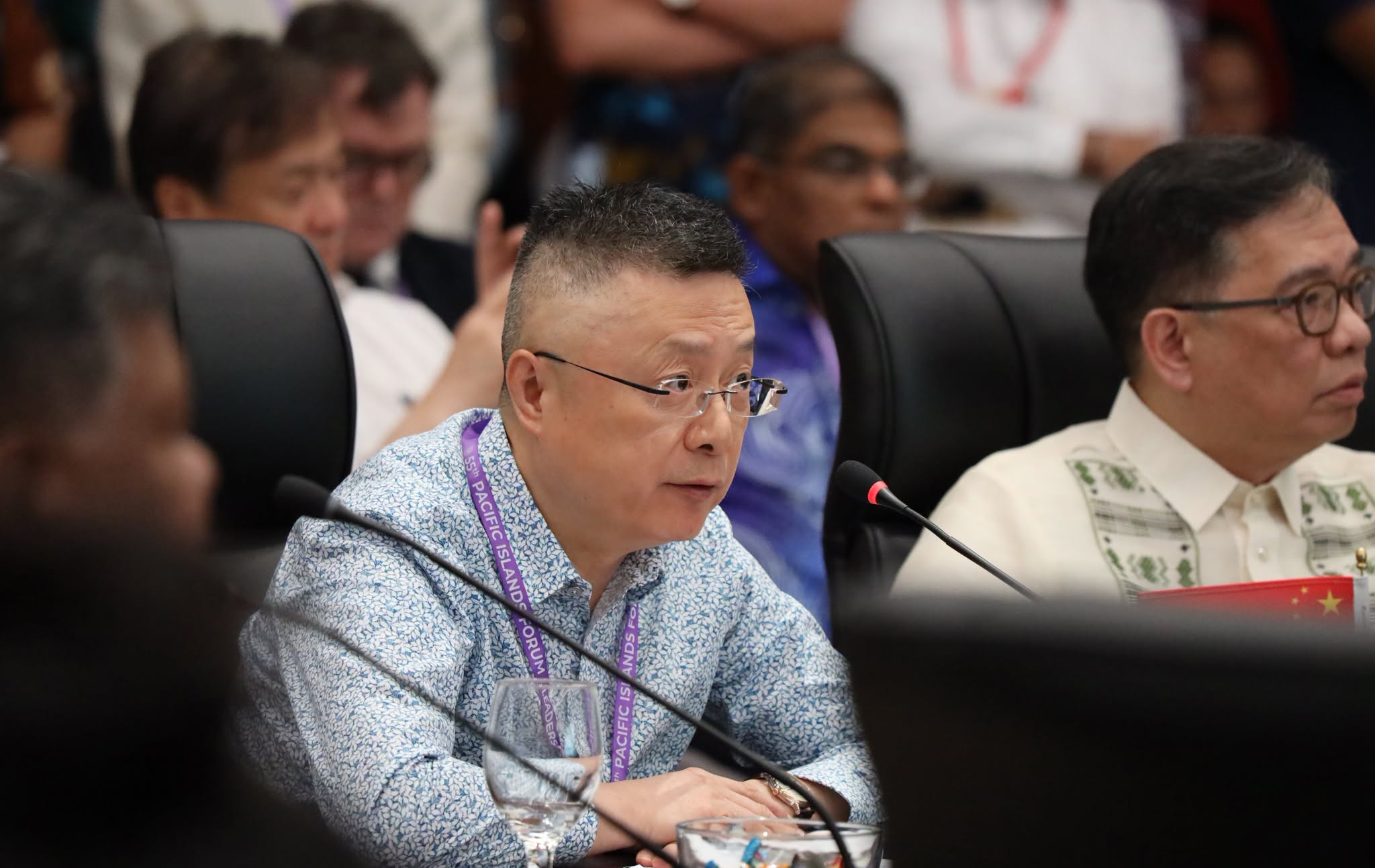
China has pledged to increase investment and engagement in the Pacific, with its Special Envoy for Pacific Island Countries Affairs Qian Bo telling Forum leaders that Beijing remains a “sincere friend and reliable partner” of the region.
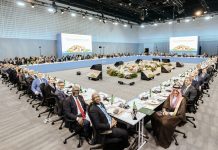
Addressing the Leaders Dialogue with Dialogue Partners at the 55th Pacific Islands Forum Leaders and Related Meetings in Palau, Qian said China wanted to deepen cooperation in renewable energy, the blue economy, trade, infrastructure and climate action.
“China has always been a sincere friend and reliable partner for PICs on their path of development,” Qian said.
He said China and Pacific Island countries shared values of “peace, respect and inclusiveness” and a common vision of national development and rejuvenation.
“Though oceans apart, China and Pacific Island countries are closely bonded in hearts and souls,” Qian said.
Qian said China had continued to advance infrastructure projects across the region since the previous Forum dialogue.
He said 10 major projects had been completed, including the National Referral Hospital Comprehensive Medical Centre in Solomon Islands, the National Convention Centre in the Federated States of Micronesia (FSM) and the Power Grid Project in Papua New Guinea.
Other projects underway include the Nauru Sports Centre, the Vanua Levu Road upgrade in Fiji, the South Tarawa Transport Network upgrade in Kiribati and the Port Vila Road upgrade in Vanuatu.
China has also signed Framework Agreements on Enhanced Economic Partnership with Papua New Guinea, Fiji, Kiribati, Nauru, Tonga, Vanuatu, the Federated States of Micronesia and Solomon Islands.
Qian said the agreements would facilitate trade with China while supporting industrialisation and agricultural modernisation in Pacific countries.
China will also increase support for Pacific countries seeking to reduce their dependence on single sources of energy.
“China will scale up support for PICs’ transition towards renewable energy.
“With its complete industrial chains, mature technologies and experience in delivering projects, China will help interested countries reduce dependence on single-source energy supply, advance energy infrastructure development and improve energy reserve capabilities, Qian said.
Qian said China had pledged US$2 million last year to support 100 community-centred projects across the Pacific.
Projects already being rolled out include a wind power project in Tonga, a solar power project in Nauru, a renewable energy-powered desalination project in Vanuatu and a low-carbon demonstration zone in Papua New Guinea.
He said China had also increased support for healthcare and education, deploying seven medical teams to Pacific countries since last year.
The Chinese hospital ship Ark Silk Road, he said, had provided medical services to more than 16,000 patients in Fiji, Tonga, Papua New Guinea and Nauru.
A major proposal outlined by Qian was the creation of a China-Pacific Island Countries Blue Partnership.
The partnership would focus on the blue economy, marine conservation, aquaculture and emerging marine industries.
“We will strengthen cooperation in blue economy, marine ecological conservation and nearshore and offshore aquaculture, as well as emerging marine industries, including marine renewable energy and marine biomedicine,” Qian said.
He said China wanted to support Pacific countries in moving from “surviving on the sea” to “prospering from the sea”.
China will also provide US$200,000 this year to support the Secretariat of the Pacific Regional Environment Programme.
Qian said Beijing would open its domestic market further to Pacific exports and encourage private-sector investment in the region.
“China will open wider its super-sized domestic market, welcomes more export of PICs’ high-quality products to China.
Pacific products could be promoted through platforms including the China International Import Expo, he added.
China also plans to align its Belt and Road Initiative with the Pacific’s 2050 Strategy for the Blue Pacific Continent and the Pacific Roadmap for Economic Development.
Qian said China would continue to support the international nuclear non-proliferation regime and the South Pacific Nuclear-Free Zone.
“China will firmly uphold the UN-centered international system and the international order underpinned by international law,” he said.
He also raised the issue of Taiwan, saying Beijing appreciated the commitment of the majority of Pacific Islands Forum members to the one-China principle.
Qian said UN General Assembly Resolution 2758 affirmed China’s position that participation by Taiwan in international organisations must be handled according to the one-China principle.
“We appreciate the firm commitment by the vast majority of the PIF members to the one-China principle, which constitutes the political bedrock and fundamental prerequisite for closer cooperation between China and PIF,” he said.
Qian said China was ready to continue working with Pacific Island countries to deliver economic and development benefits.
“The beautiful blue Pacific is the shared home of China and PICs.
“China stands ready to work hand-in-hand with PICs to deliver greater benefits to peoples on both sides,” he said.