

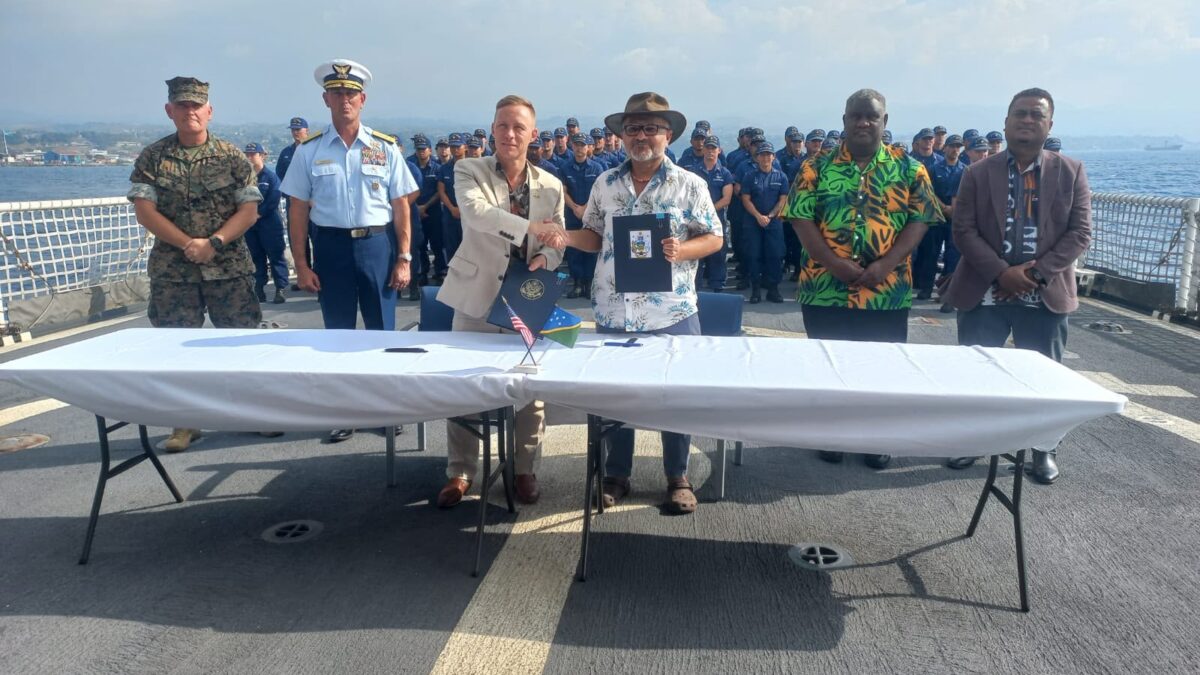
Pacific fisheries expert and Solomon Islands University (SINU) Vice Chancellor Dr Transform Aqorau says the public debate over Ship Rider Agreements is confusing international law with geopolitics, arguing that the legal question of such agreements is largely settled while the real issue is whether they serve Solomon Islands’ national interests.
Dr Aqorau said the recent discussion had highlighted the importance Solomon Islanders place on sovereignty, their oceans and the country’s role in an increasingly complex international environment.
“The first issue is a question of international law: Are Ship Rider Agreements lawful, and are they consistent with the sovereignty of Solomon Islands?
“The second is a question of geopolitics and national policy: Should Solomon Islands choose to enter into such an agreement with a particular country, taking into account today’s international political environment?
“These are fundamentally different questions. Unfortunately, much of the current debate treats them as though they are interchangeable. They are not,” he said in a social media post.
Dr Aqorau said international law has long recognised the sovereign rights of coastal States over their Exclusive Economic Zones and allows countries to determine how those rights are exercised, including through bilateral and regional agreements.
“None of these options diminish sovereignty. Indeed, the very ability to make those choices is one of the defining attributes of sovereignty itself.”
He said Ship Rider Agreements have existed across the Pacific and the Caribbean for decades because they allow coastal States to exercise their own legal authority while using the operational support of partner countries.
“The legal authority never belongs to the foreign vessel. The enforcement authority remains with the coastal State.
“The foreign vessel simply provides a platform from which the coastal State’s authorised officers can exercise their own legal powers,” he said.
Dr Aqorau said the Pacific developed Ship Rider arrangements to address the practical challenge of policing vast Exclusive Economic Zones with limited patrol vessels, aircraft, personnel and financial resources.
“Ship Rider arrangements evolved as another practical solution to a practical problem.
“They enabled Pacific countries to exercise their own sovereign authority more effectively by making use of the ships, aircraft and logistics of trusted partners while retaining complete legal control over enforcement decisions,” he said.
Dr Aqorau said the more difficult question is geopolitical rather than legal.
“Reasonable people can disagree on this. Some argue that entering into security cooperation with one major power may be interpreted as alignment with that country’s broader strategic interests.
“Others argue that practical cooperation to combat illegal fishing, drug trafficking, people smuggling and transnational crime is simply good governance and should not be interpreted as choosing sides in global politics.
“Both perspectives deserve respectful consideration. Neither perspective changes the underlying legality of the agreement,” he said.
Dr Aqorau said international law remains politically neutral and allows sovereign States to decide with whom they enter agreements, provided those agreements are lawful.
“Every sovereign State has the right to determine with whom it will enter into agreements, provided those agreements are themselves lawful.”
He said Solomon Islands has entered a range of bilateral agreements over many years, including development, policing, fisheries, trade, defence cooperation, labour mobility and investment arrangements, as well as more recent agreements with China.
“Whether one supports or opposes those arrangements is ultimately a political judgement. The legal capacity of Solomon Islands to enter into such agreements, however, flows from exactly the same principle of sovereignty that underpins Ship Rider Agreements.”
Dr Aqorau cautioned against using legal arguments as substitutes for political preferences.
“Law asks whether an agreement is valid. Politics asks whether entering into it is wise. These are different disciplines requiring different analytical frameworks.”
Drawing on his experience advising successive governments, Dr Aqorau said his role has always been to explain the legal framework rather than make political decisions.
“My responsibility has always been to explain what the law permits, what it prohibits, what options exist, and what the legal consequences may be.
“The political choices that governments make within those lawful options are matters for elected leaders and, ultimately, for the people,” he said.
Dr Aqorau said the current debate should focus on the country’s strategic choices rather than the legality of Ship Rider Agreements.
“The real debate today is not whether Solomon Islands has the legal capacity to enter into Ship Rider Agreements or similar international arrangements. That question is largely settled.
“The real debate is about which partnerships best serve our national interests in a rapidly changing world.
“That is a debate worth having.
But it is a different debate altogether,” he said.