


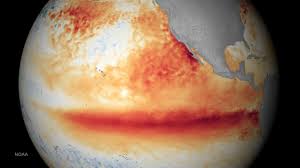
The United States National Oceanic and Atmospheric Administration (NOAA) has declared that El Niño conditions are present in the Pacific, with forecasts indicating a high probability the climate pattern could develop into a “super” El Niño by the end of the year.
NOAA confirmed o that sea surface temperatures in the Pacific have already exceeded the 0.5 degrees Celsius threshold required to declare El Niño conditions.
According to model forecasts, there is a 63 percent probability that temperature anomalies will exceed 2 degrees Celsius by winter, placing the event in the “very strong” or “super” El Niño category.
Such events are rare, having occurred only five times since 1950. The most recent super El Niño took place in 2015-16.
Scientists say a super El Niño can significantly alter global weather patterns by shifting jet streams and changing rainfall distribution across different regions.
Forecasts indicate wetter-than-average conditions for Texas and the United States Gulf Coast, while Papua New Guinea and Australia are expected to face below-average rainfall and increased drought risk.
Globally, potential impacts include weakened Asian monsoons, flooding in parts of South America and disruptions to marine ecosystems.
Experts have warned that the current El Niño is developing during a period of record-high global temperatures, raising concerns that weather extremes could be more severe than those experienced during previous events.
Satellite observations by the NASA-European Space Agency Sentinel-6 Michael Freilich mission have detected Kelvin waves, large pulses of warm water moving eastward across the Pacific Ocean.
The satellite recorded sea level increases of up to six inches near Peru, indicating the build-up of subsurface heat that fuels El Niño development.
Researchers noted that similar ocean conditions were observed before the powerful 1997-98 El Niño, although fewer Kelvin waves have been detected so far, leaving uncertainty about the event’s eventual strength.
Scientists also warned that marine heatwaves associated with El Niño could threaten seabirds, sea lions, whales and fisheries along the United States West Coast.
Historical examples, including the 2014-16 marine heatwave known as “The Blob”, demonstrated that such conditions can result in large-scale wildlife losses and long-term ecosystem damage.