

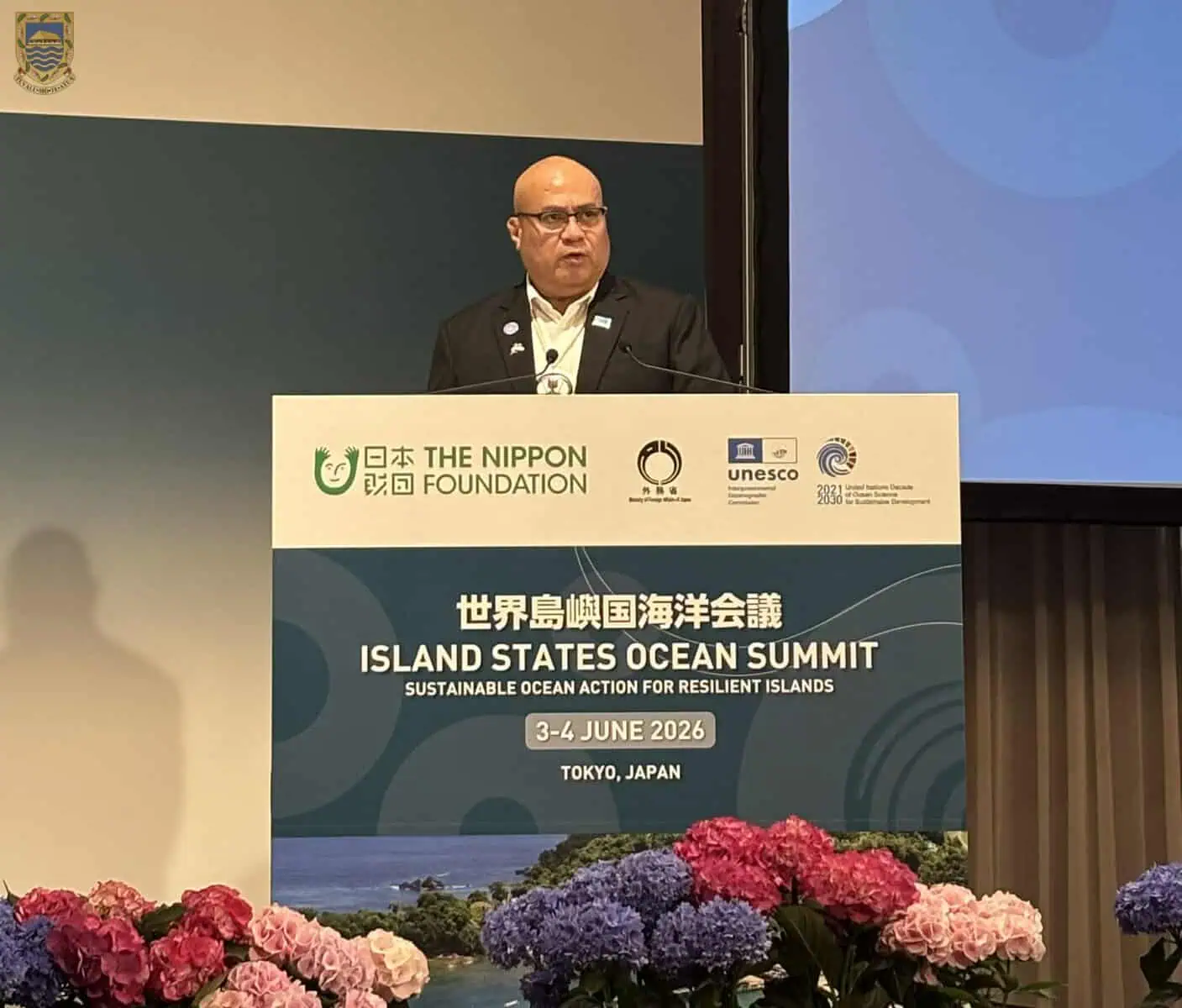
Tuvalu Prime Minister Feleti Teo, a Pacific Island nation facing the threat of submersion due to climate change-induced sea level rise, said that the International Court of Justice (ICJ)’s July 2025 advisory opinion affirming every nation’s obligation to address climate change was “a milestone achievement.”
He stressed that island states with minimal greenhouse gas emissions but extreme vulnerability to the effects of climate change “need to be compensated for damages that we suffered.”
Teo visited Japan to attend the Island States Ocean Summit held in Tokyo on June 3-4.
The ICJ opinion characterises climate change as an “existential problem of planetary proportions that imperils all forms of life,”and states that nations failing to take action could bear legal responsibility.
The United Nations General Assembly, comprising 193 member countries, also adopted a resolution in May 2026 in support of the opinion by a large majority.
“So the conversation has kind of shifted from moral obligations to a legal commitment,” Teo said in an exclusive interview with the Mainichi Shimbun.
He argued that countries responsible for causing climate change must provide aid or “be held accountable for their actions in causing climate change.”
Although neither the ICJ opinion nor the UN resolution is legally binding, Teo said that they will “hopefully be the basis of a future treaty” establishing binding international measures.
Regarding the U.S administration of President Donald Trump’s decision to withdraw from the UN Framework Convention on Climate Change, Teo said, “It’s a very major setback.”
He added that “countries like Tuvalu have always looked to the U.S to set the example,” and continued, “I hope that bigger players like Japan and other European countries will be able to convince the U.S to … have a relook at their current policies on climate change.”
Calling the introduction of renewable energy “one of the top priorities” for resource-import-dependent Tuvalu, Teo said, “We’re hoping that Japan can help us be a more energy secured economy.”
Tuvalu’s government has been raising coastal land and taking other adaptive steps to cope with global warming, while also advancing a plan to move the nation’s governmental functions, culture and identity into the online virtual space known as the metaverse.
Teo described this as “planning for the worst-case scenario,” explaining that one of the objectives is to preserve Tuvalu’s sovereignty as a digital nation even if its physical territory is submerged.