
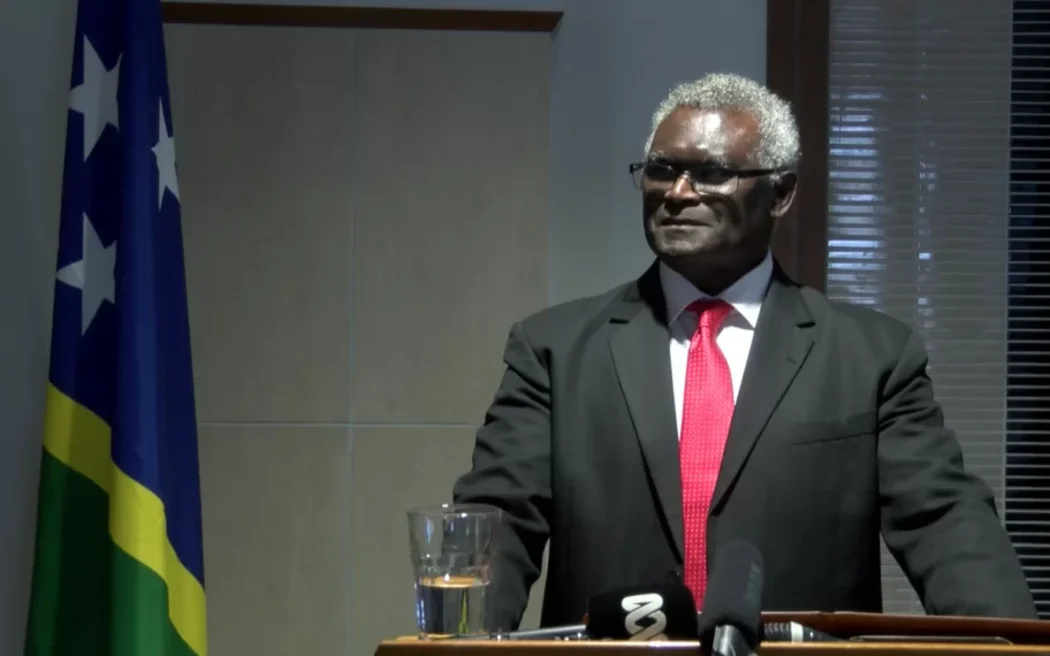
Solomon Islands leader of the Opposition, Manasseh Sogavare, has warned that the ruling government’s plan to sign a shiprider agreement with the United States amounts to surrendering Solomon Islands’ sovereign control over its own waters and has called on the Government to release the full text and table it in Parliament before taking any further step toward signature.
“This Government wants Solomon Islanders to believe this is simply a security partnership,” Sogavare said.
“It is not. Read closely. Agreements of this kind hand a foreign navy standing legal authority to act in our waters in exchange for a theoretical right Solomon Islands could never realistically exercise. That is not a partnership between sovereign equals. That is our sovereignty being sold, one clause at a time.”
Solomon Islands is the last of the region’s long-standing holdouts on this agreement.
Twelve Pacific Island countries—Cook Islands, Fiji, the Federated States of Micronesia, Kiribati, the Marshall Islands, Nauru, Palau, Papua New Guinea, Samoa, Tonga, Tuvalu and Vanuatu—have already signed a shiprider agreement with the United States.
Of those twelve, three—the Federated States of Micronesia, Palau and Samoa—have since been upgraded to an “enhanced” or “remote-authorisation” model, allowing U.S Coast Guard vessels to board and enforce on the host nation’s behalf even when no local officer is on board.
History across the Pacific shows these agreements rarely remain in their original, more limited form. That is why the terms Solomon Islands agrees to today will shape our sovereignty for years to come.
Every version of this agreement signed elsewhere in the Pacific follows the same American template. In the near-identical text Vanuatu signed in 2016, United States vessels may act unilaterally, boarding, searching and pursuing suspect vessels in Vanuatu’s waters whenever a local shiprider is simply “not available”, a threshold the host country does not control. In exchange, Vanuatu received only a mirror-image right to do the same in United States waters, a right no Pacific island maritime service the size of Solomon Islands could realistically exercise.
If Solomon Islands signs the same template, it should expect no different. Regional commentators have already identified this same imbalance in other Pacific agreements. That is not reciprocity. It is a one-way transfer of authority dressed up as an equal partnership.
The Wale Government will argue that the agreement is needed to combat drug traffickers, narco-submarines and illegal fishing. Those are genuine threats, and Solomon Islands have every right to seek assistance in addressing them. But genuine security concerns cannot justify granting standing enforcement powers in our territorial waters without full public scrutiny. The question is not whether we need help, but what legal authority we are being asked to surrender in return.
Other small states facing the same proposal negotiated stronger safeguards. Jamaica and Barbados both pushed back on the same American template and secured consent-based provisions requiring telephonic or written permission before any boarding operation rather than accepting automatic entry.
Stephen Vasciannie, a Jamaican legal commentator, has publicly advanced the same sovereignty concerns. If Caribbean nations a fraction of our size could hold the line on their own waters, Solomon Islands can too. The Wale Government has not explained why it did not even try.
This is consistent with the position maintained by both the DCGA and GNUT Governments throughout their time in office: agreements affecting the sovereignty and security of our nation must be shaped on Solomon Islands’ terms, tested against regional frameworks and subjected to parliamentary scrutiny and not rushed through to satisfy a foreign timetable.
The Opposition has received information that, despite the Prime Minister’s announcement that the shiprider agreement will be signed in Honiara, no decision to enter into the agreement has in fact been made by the Government Caucus or Cabinet.
If those reports are correct, the process raises equally serious questions about the Government’s own decision-making.
Sogavare questioned why Prime Minister Matthew Wale would make such a significant commitment without first obtaining the endorsement of either Cabinet or Government Caucus.
“The Prime Minister has, since taking office, demonstrated a pattern of unilateral decision-making even though he knows he leads a coalition of six political parties. This is nothing short of dictatorial leadership,” Sogavare said.
“The Prime Minister must clarify why he bypassed the Cabinet. Ministers must be given the opportunity to scrutinise and deliberate on an agreement that has serious implications for Solomon Islands’ sovereignty before any commitment is made,” he said.