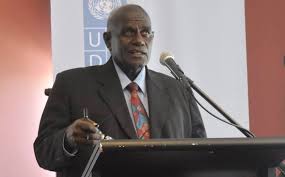
Bougainville House of representatives Speaker Simon Pentanu has challenged claims made in Papua New Guinea’s National Parliament regarding the sessional order on the Bougainville referendum, saying key issues were never agreed upon and discussions between the two Speakers were not formally completed.
In a statement to the House of Representatives, Pentanu said his remarks were prompted by a ministerial statement delivered in the PNG National Parliament earlier this week concerning the sessional order.
Pentanu said that under the Melanesian Agreement, he and the Speaker of the PNG National Parliament were required to engage, draft and agree on the sessional order.
“The Joint Supervisory Body of December 2025 asked us to work in coordination with the National Minister of Bougainville Affairs and the ABG Minister for Independence and to report back to the JSB.”
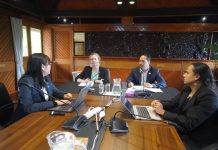
He said the two Speakers, parliamentary clerks and officers travelled to Fiji on 21 April 2026, to work on the draft sessional order.
According to Pentanu, the National Parliament team tabled the draft sessional order in Fiji for discussion.
“We had a lengthy discussion on the draft sessional order.
“We were unanimous in agreeing to on the procedures relating to tabling of the referendum result, tabling of the post-referendum consultation report; and to the procedure for debate once the statement is made by the Minister for Bougainville Affairs,” he stressed.
He said agreement was not reached on two critical issues.
“However, we did not reach agreement on the voting majority on the motion to be put to the Parliament.
Our views differed and it is around this that most of our discussions revolved. First; the motion or the question to be put to the National Parliament, second; the voting threshold,” he emphasised.
Pentanu said his delegation argued that the motion before the National Parliament should reflect the objectives being pursued by both governments through the Melanesian Agreement and the Melanesian Framework.
He said the motion ultimately adopted by the National Parliament was different from the draft discussed in Fiji.
“I will also point out that the question or the motion now adopted by the National Parliament in the Sessional Order, was not the question that was in the draft Sessional Order, tabled in Fiji for discussion. It is totally a different question.”
“It is a direct question on the referendum result. The motion adopted states, ‘That the National Parliament accepts the Referendum Results.’ This is not what was discussed or agreed,” he explained.
On the issue of voting requirements, Pentanu said previous engagements between the two parliaments had seen both sides agree on a simple majority.
“In regards to the voting threshold, in our previous parliamentary engagements between the two Parliaments, starting in Lae and in Port Moresby, both sides were in agreement on a simple majority,” he stated.
He said the proposal for a three-quarter absolute majority remained contentious.
“The 3/4 absolute majority is always going to be a point of contention. If it is advanced as a legal argument this ignores what has really been a political negotiation throughout the consultation by both governments on the results of the Bougainville Referendum,” the Bougainville Speaker said.
Pentanu said the three-quarter majority threshold was raised during discussions in Fiji but his delegation opposed it.
“When the draft sessional order was tabled in Fiji, 3/4 absolute majority was put on the table. My officers and I did not agree on the voting threshold of 3/4 absolute majority,” he said.
Pentanu said the Bougainville side argued that neither Section 342(2) nor any other provision of Part XIV of the PNG Constitution or the Bougainville Peace Agreement prescribed such a majority.
“Our team advanced the discussions that the voting majority should be a simple majority because there is no prescribed majority in section 342 (2) or anywhere in Part XIV of National Constitution or even the Bougainville Peace Agreement”
“This is also a conventional parliamentary practice, when there is no prescribed majority, the parliament should always apply a simple majority in any matter before the House,” he said.
Pentanu said his delegation maintained that any constitutional amendments arising from the motion would later be subject to the prescribed constitutional voting requirements.
“In this case, our position was that this motion will trigger the constitutional amendments which have prescribed majority in law. In amending the constitution, there are prescribed majorities required to amend the constitution; for these reasons we did not agree on the 3/4 absolute majority in Fiji,” he said.
He said that because no agreement was reached in Fiji, both Speakers agreed to hold another meeting in Port Moresby with the Minister for Bougainville Affairs and the Vice President, who is also Minister for Bougainville Independence Mission Implementation.
“We agreed for the continued meeting to take place in Port Moresby on the 6th of May 2026.”
Pentanu said that meeting never took place.
“This meeting did not eventuate and we are surprised that the sessional order has found its way into the National Parliament,” he said
He said he was disappointed by how the process had unfolded.
“It is disappointing to be misrepresented in the manner in which the crafting of the sessional order has been handled.”
“It is also disappointing because we have not formally completed the work required of the Speakers pursuant to the Melanesian Agreement and the JSB,” Pentanu emphasised.
Pentanu said his statement was not intended as criticism of proceedings in another parliament but was necessary to correct what he described as a misrepresentation.
“It is not in order for me as Speaker, presiding in this House to criticise proceedings in another House over which I have no say or control.”
“And this statement is not a criticism; however, when I am mentioned as Speaker and I am misrepresented in a statement in another Parliament, it is in order for me to correct this,” he explained.
He said consultations had been conducted in good faith.
“I believe the consultations at the formal and informal level were carried out in good faith, with honesty and integrity at our leadership level. This should also have been how the matter of the sessional order was managed” Pentanu said.
Pentanu expressed hope that discussions would continue.
“As Speaker my hope is that the ongoing consultations will still continue in good faith,” he said.